
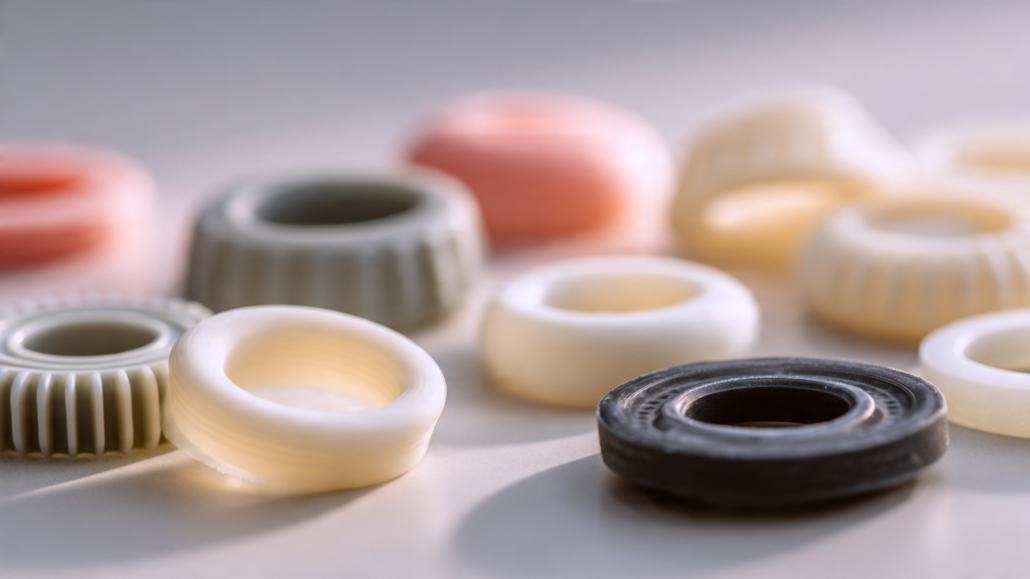
Food-Safe Rubber Seals Material Types Explained
Food‑safe rubber seals are chosen by material for temperature range, chemical resistance, and validated migration/cleanability data. Silicone offers wide thermal performance and hygiene but limited abrasion resistance. EPDM resists hot water, alkalies and is cost‑effective for gaskets. FKM provides superior chemical resistance for aggressive fluids. NBR/HNBR suit oil contact and dynamic seals; TPEs work for lower‑temperature flexible parts. Suppliers must supply traceable test data, certifications, and validated cleaning regimes to confirm suitability — further guidance follows.
Key Takeaways
- Choose material by temperature, chemical exposure, and regulatory needs (FDA, EU 10/2011, NSF) for safe food-contact performance.
- Silicone offers the widest temperature range and thermal cycling resistance but limited abrasion resistance and potential migration if ungraded.
- FKM provides superior chemical resistance and low-migration options when peroxide-cured, suitable for harsh chemistries.
- EPDM excels in hot water and alkaline cleaning compatibility, cost-effectiveness, and hygienic cleaning with low extractables.
- Specify hardness, surface finish, color coding, lot traceability, and supplier migration/traceability data for regulatory compliance.
Quick Decision Guide: Food‑Safe Rubber Seals
When selecting food-safe rubber seals, engineers and procurement specialists should first narrow choices by application parameters—contact type (direct or incidental), temperature range, chemical exposure, and regulatory requirements (FDA, EU 10/2011, etc.)—so material selection (EPDM, FKM, silicone, NBR, PTFE blends) and hardness can be matched to performance needs; this rapid filter reduces candidate materials to those that meet compatibility, cleanability, and certification constraints before detailed testing or supplier qualification. The guide prioritizes functional fit: assess surface finish requirements for hygienic crevice minimization, specify acceptable color coding for allergen or zone control, and define mechanical tolerances. Rapid bench checks for compression set, extractables screening, and visual surface integrity accelerate decisions. Suppliers should provide traceable data sheets, lot traceability, and manufacturing process controls to enable confident selection.
Key Food‑Contact Requirements: Temperature, Migration, Cleaning, Contact Time
Selection of food-contact elastomers requires specification of maximum and minimum service temperatures to guarantee seal integrity and prevent accelerated aging. Material migration potential must be evaluated against regulatory migration limits and assessed for extractables that affect cleanability and product safety. Cleaning protocols and contact time parameters are then defined to match the compound’s resistance profile and minimize residue retention.
Temperature Resistance Limits
In evaluating temperature resistance limits for food‑safe rubber seals, manufacturers and food processors must consider not only the maximum and minimum service temperatures but also the effects of thermal cycling, contact duration, and cleaning procedures on seal integrity and potential chemical migration. Materials should be specified with verified continuous-use ranges and short-term excursions, and lab validation must include thermal cycling to detect hysteresis, compression set, and changes to burst pressure. Design margins account for contact time with hot or frozen products and accelerated aging under expected cleaning regimes. Practical implementation favors grades with narrow, predictable thermal expansion and documented failure modes.
- Define continuous and intermittent temperature limits.
- Test seals under representative thermal cycling profiles.
- Correlate contact time to mechanical degradation.
- Specify burst pressure at temperature extremes.
Migration And Cleanability
Balancing migration control and cleanability requires specifying materials and processes that minimize extractables while allowing complete residue removal under routine sanitation. Selection emphasizes low-migration elastomers with tightly bound additives and minimal surface porosity to reduce chemical residues and microbial adsorption. Design confines — smooth profiles, accessible joints, and compatible fasteners — facilitate mechanical and chemical action during cleaning cycles. Cleaning validation protocols quantify residual chemistry and bioburden after representative procedures, defining contact time, detergent concentration, and temperature bounds. Innovative coatings and vulcanization adjustments can lower diffusivity without compromising flexibility, but require validation for durability under repeated sanitation. Maintenance schedules integrate inspection for microcracks that increase adsorption. Manufacturers document validated cleaning regimes and provide traceable material data sheets for regulatory compliance.
Silicone vs EPDM vs FKM: Food‑Safe Applications and Tradeoffs
How do silicone, EPDM, and FKM compare when used for food-contact seals? The assessment focuses on performance envelopes, regulatory fit, and manufacturing tradeoffs. Silicone offers broad temperature range and predictable silicone shelf‑life but limited abrasion resistance. EPDM excels in hot water/alkaline resistance and cost-effective sealing but is sensitive to oils. FKM (with FKM peroxide‑curing options) provides outstanding chemical and oil resistance and high-temperature endurance; curing method affects compression set and traceability.
Silicone, EPDM, and FKM: tradeoffs in temperature, chemical resistance, regulatory fit, and manufacturing for food-contact seals.
- Temperature & thermal cycling: silicone > FKM > EPDM for extremes.
- Chemical resistance: FKM (peroxide‑cured) > EPDM > silicone.
- Cleanability & migration risk: silicone and EPDM are favorable with proper grades.
- Manufacturing & innovation: FKM enables advanced formulations; cost and tooling tradeoffs must be managed.
NBR, HNBR & TPE: Food‑Safe Budget and Oil‑Resistant Options
NBR is presented as a cost-effective elastomer offering good resistance to oils and common food-grade lubricants for moderate-temperature sealing tasks. HNBR is noted for retained mechanical properties and chemical stability at elevated temperatures, making it suitable for sterilization cycles and hot‑fill processes. TPE is introduced as a flexible, moldable food‑safe alternative where softer shore hardness and ease of processing are required.
NBR: Cost‑Effective Oil Resistance
Many applications require a cost‑effective elastomer that resists oils while meeting food‑contact regulations, and nitrile butadiene rubber (NBR), its hydrogenated variant (HNBR), and select thermoplastic elastomers (TPEs) occupy this niche. NBR is emphasized for its balance of performance, manufacturability, and compliance when optimized as cost effective formulations and oil resistant blends for food processing equipment. Typical use-cases include dynamic seals, gaskets, and diaphragms exposed to edible oils and lubricants. Design considerations focus on hardness, extraction limits, and accelerated aging profiles under sanitizing agents.
- Material properties: moduli, elongation, and permeability.
- Compatibility: food-grade additives and migration testing.
- Processing: molding cycles, post-cure, and tooling wear.
- Application fit: dynamic vs static sealing requirements.
HNBR: High‑Temperature Durability
Emphasizing elevated thermal and oxidative stability, hydrogenated nitrile butadiene rubber (HNBR) is specified where food‑contact seals must withstand higher service temperatures, prolonged exposure to hot oils, and aggressive sterilization cycles. HNBR offers improved resistance to high temperature creep compared with standard NBR, maintaining dimensional integrity under sustained load. The material exhibits low compression set across broader temperature ranges, extending sealing life in valves, gaskets, and dynamic shaft seals. Formulations tailored for food contact prioritize peroxide curing and selected additives to meet regulatory requirements while preserving mechanical performance. Design guidance focuses on compound selection, gland geometry, and surface finish to minimize wear and facilitate cleaning. Applications that demand thermal resilience and predictable ageing benefit from HNBR’s balance of durability and processability.
TPE: Flexible Food‑Safe Alternative
Often chosen for its combination of flexibility and cost‑effectiveness, thermoplastic elastomer (TPE) provides a practical food‑safe alternative to elastomeric compounds like NBR and HNBR when lower temperature service, frequent flexing, and ease of processing are priorities. TPE enables rapid molding, solvent resistance suited to many food-grade lubricants, and compatibility with recyclable blends for circular manufacturing. Applications favor dynamic seals, gaskets, and soft-touch interfaces where controlled compression set and sensory feel matter. Design and specifying teams leverage color coding to indicate hardness, compound family, or regulatory status on the production line.
- Processing: injection molding reduces cycle time and scrap.
- Performance: good flex-life; limited high‑temp resistance.
- Compliance: achievable FDA/EC formulations; verify lot testing.
- Sustainability: recyclable blends support end‑of‑life strategy.
Compatibility Charts: Chemicals, Temperatures, and Cleaning Methods
When evaluating food-safe rubber seals, compatibility charts serve as concise decision tools that map specific elastomer formulations against chemical exposure, temperature ranges, and approved cleaning procedures. They present cleaning compatibility, chemical resistance, sanitizer interaction, and surface porosity data in matrix form so engineers compare EPDM, FKM, NBR, and TPE quickly. Charts note concentration limits, contact duration, and degradation modes at defined temperatures, and flag swelling, hardening, or embrittlement. Cleaning protocols list recommended detergents, acceptable sanitizers, thermal sanitation temperatures, and mechanical-cleaning effects on seal geometry and porosity. For innovation teams, these localized, practical charts accelerate material selection and lifecycle planning, enabling rapid iteration of seal design and maintenance schedules without speculative testing.
Regulatory Tests & Certifications to Require: FDA, EU, NSF, Migration Testing
Which regulatory tests and certifications are essential depends on the target market and application of the seal: manufacturers and specifying engineers must require documentation that demonstrates compliance with FDA 21 CFR 177 (for food-contact elastomers), EU Regulation 10/2011 (and its successor frameworks for plastic materials where applicable), NSF/ANSI 51 or 61 for equipment-contact approvals, and migration or extractables testing tailored to the specific elastomer and food simulants. Technical procurement should insist on regulatory traceability and clear labeling standards linked to batch certificates. Practical implementation centers on documented test methods, acceptance criteria, and shelf-life considerations. Key items to require from suppliers:
- Certificate of Compliance plus raw-material traceability
- Migration/extractables reports with food-simulant matrices
- NSF or EU conformity declarations and test protocols
- Labeling standards, lot codes, and retention policies
Why Seals Fail : And How to Fix Food‑Safe Gasket Problems
Regulatory conformity and documented testing establish what a food-contact seal should guarantee, but real-world failures arise from mechanical, chemical, and procedural mismatches between specification and service. Failure modes include compression set from incorrect installation torque, chemical attack from unexpected sanitizers, abrasion from particulate flows, and creep from sustained load. Diagnostics combine visual inspection, hardness mapping, and targeted shelf life testing to isolate degradation mechanisms. Remedies prioritize material substitution (fluorosilicone, EPDM variants), controlled installation procedures with calibrated torque tools, and design changes such as backup rings or drain grooves to prevent entrapment. Validation requires accelerated aging, migration re-checks, and field trials with measured installation torque and maintenance intervals. Iterative feedback loops between procurement, engineering, and quality ensure durable, innovative gasket solutions.
Frequently Asked Questions
Can Rubber Seals Harbor Biofilms Despite Being Food‑Grade?
Yes. Rubber seals can harbor biofilms despite food‑grade status; microbial adhesion occurs after surface conditioning by proteins and residues. Regular monitoring, optimized surface finishes, and targeted sanitation protocols reduce colonization and sustain hygienic performance.
How Do Colorants in Seals Affect Food Safety?
Colorants can compromise safety by reducing color stability and requiring rigorous migration testing; they may mask allergen contamination and trigger labeling obligations. The manufacturer evaluates formulations, conducts analytics, and updates regulatory labeling to mitigate risk.
Are Lubricants Used on Seals Food‑Safe?
Yes. The responder states food grade lubricants can be used on seals if formulations meet migration limits and NSF certified greases (H1) are specified; selection depends on temperature, compatibility with elastomers, and regulatory documentation for production environments.
Can Seals Be Autoclaved Repeatedly Without Degrading?
Seals can sometimes withstand repeated autoclaving, but performance depends on material selection; engineers evaluate temperature cycling and chemical resistance, balancing elastomer formulation, design tolerances, and validation testing to guarantee long‑term dimensional stability and sealing integrity.
How Does Seal Texture Impact Cleanability?
Seal texture directly governs residue retention and cleaning efficacy; higher surface roughness reduces wipeability. Microtexture mapping informs cleaning protocols and targeted wipeability testing, enabling practical, localized design adjustments for innovative, easily sanitized seals.
Conclusion
Selection favors materials that balance regulatory compliance, service conditions and maintenance realities. Engineers and maintenance staff prioritize silicone, EPDM or FKM where heat, chemical exposure and longevity demand it; NBR, HNBR and select TPEs serve cost‑conscious or oil‑resistant needs. Compatibility charts, migration testing and certifications (FDA, EU, NSF) verify suitability. Routine inspection, correct cleaning protocols and proper installation mitigate failure modes, extending seal life and preserving food safety and process reliability.
This article was produced by RK Rubber Enterprise Co. — a leading rubber supplier and manufacturer in the Philippines committed to delivering cost‑efficient, high‑quality rubber products and expert support. RK Rubber helps clients select appropriate seal materials, provides installation and testing assistance, and offers practical guidance throughout the project lifecycle to ensure compliance, longevity and reliable operation.