
Preventive Maintenance for Elastomer Gaskets: Best Practices
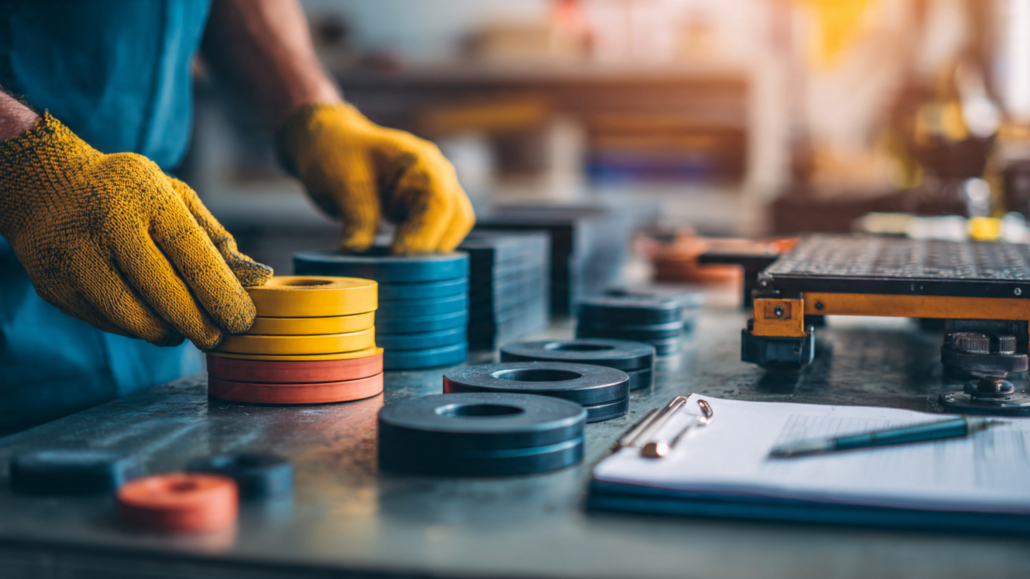
Preventive maintenance for elastomer gaskets requires systematic selection, storage, installation, inspection, and replacement tailored to fluids, temperatures, and flange conditions. Materials must match chemical exposure and be traceable by batch and cure date. Store flat in low‑UV, climate‑controlled areas and handle with gloves to avoid contamination. Verify flange flatness, surface finish, bolt condition, and use calibrated torque sequences. Inspect for extrusion, swell, hardness change, and leaks on a scheduled basis. Further sections provide specific checklists and measurable thresholds.
Key Takeaways
- Inspect gaskets visually and with hardness checks at frequencies based on service severity, documenting defects and seating irregularities.
- Match elastomer compound to fluids, temperatures, and exposure durations, using compatibility tests and re-evaluating after process changes.
- Store gaskets flat in original inert packaging, controlled temperature/humidity, FIFO rotation, and clearly labeled with batch/cure dates.
- Prepare flanges by removing old gasket material, verifying flatness/roughness, deburring edges, and confirming alignment before installation.
- Follow incremental torque sequences with calibrated wrenches or tensioners, proper bolt lubrication, and record preload values for traceability.
Quick Preventive Checklist for Elastomer Gaskets
For routine field inspections, maintenance personnel should follow a concise preventive checklist that emphasizes visual condition, dimensional integrity, material compatibility, and installation seating. The checklist enumerates steps: confirm material traceability against installation records, note visual inspection frequency per unit and operating hours, document surface defects, measure cross-section and ID/OD tolerances, and verify compression set and seating pressure. Inspectors log environmental exposure and chemical-contact history, isolating anomalies for lab validation. Tightening sequences and torque values are checked against localized flange maps. Replace criteria are binary: immediate for cuts or extrusion, scheduled for creep beyond tolerance. Electronic records and QR-linked tags enable rapid feedback loops to design and procurement teams seeking iterative gasket improvements.
Choose the Right Elastomer for Your System
Selection begins with a chemical compatibility assessment to guarantee the elastomer resists process fluids and any cleaning agents encountered at the gasket location. Specified hardness and durometer must match flange geometry and required compression set to maintain seal integrity under local clamping conditions. The chosen material also needs an operating temperature range that covers both steady-state process temperatures and expected transient excursions.
Chemical Compatibility Assessment
When evaluating chemical compatibility, engineers must match elastomer composition to the specific fluids, temperatures, and exposure durations encountered in the system. A systematic chemical compatibility assessment quantifies risk by combining compatibility testing data with field-specific parameters: concentration, temperature cycles, and cumulative contact time. Practical protocols include accelerated aging, swell measurements, and tensile retention after controlled solvent exposure to simulate worst-case service. Results guide selection among fluorocarbon, EPDM, nitrile, and specialty compounds, prioritizing long-term seal integrity and maintenance intervals. Documentation should map each fluid to tested elastomers and define inspection triggers. Innovative teams leverage localized service data and periodic re-evaluation when process chemistries or operating profiles change, ensuring adaptive gasket selection and reduced downtime.
Hardness And Durometer
Specify elastomer hardness by matching durometer to the sealing application’s load, compression set tolerance, and dynamic movement to guarantee consistent contact stress without over-compression or extrusion. Selection is guided by measured Shore A values that balance resilience and stiffness for static flanges, reciprocating seals, or high-cycle rotary interfaces. Field engineers evaluate installation squeeze, expected deformation, and permissible leakage to set target durometer bands; prototypes validate contact stress via pressure mapping. Consider Material aging effects: higher crosslink density increases hardness over time, altering sealing force and necessitating margin in initial durometer choice. Maintenance protocols record original Shore A, periodic hardness checks, and replacement thresholds tied to performance loss. This localized, data-driven approach enables innovative lifecycle extension and predictable retrofit planning.
Operating Temperature Range
Evaluate elastomer operating temperature ranges against both continuous service limits and transient extremes to guarantee material integrity and sealing performance across the system’s thermal profile. The specification must match expected ambient and process temperatures, emphasizing low temp flexibility where freeze events or cold-starts occur. Designers consider glass transformation temperature, heat aging rates, and compression set at operating extremes. For systems exposed to thermal cycling, select compounds with proven resistance to embrittlement and fatigue; validate with accelerated cycling tests that mimic local duty cycles. Installation tolerances, gland design, and preload should account for dimensional change across the range. Documentation of acceptable limits and periodic inspection intervals enables targeted preventive maintenance. Novel formulations or coatings may extend service life when validated under representative thermal cycling protocols.
Store, Handle, and Clean Gaskets to Avoid Degradation
In storage and handling areas, gaskets require controlled environmental conditions and careful manual practices to preserve elastomer properties and sealing performance. Personnel should select inert packaging materials and label batches with cure date, compound, and recommended shelf life. The designated storage environment must maintain stable temperature, low humidity, and UV-free lighting; racks should prevent compression and deformation. Handling protocols minimize contact with oils, solvents, and sharp edges by using gloves and soft tools. Cleaning uses compatible, low-residue agents and gentle wiping; avoid aggressive solvents that swell or embrittle elastomers. Routine inspection records quantify dimensional tolerance, surface defects, and contamination levels. Innovations like RFID tracking and climate sensors enhance traceability and proactive replacement decisions, reducing failure risk while optimizing inventory and lifecycle management.
Install Gaskets Correctly: Flange Prep and Torque Best Practices
Proper flange surface preparation and precise bolt torque are critical to achieving a reliable elastomer gasket seal. Technicians must remove corrosion, old gasket material, and contaminants, then verify flatness and surface finish to specified tolerances before gasket placement. Bolts should be tightened in the correct sequence using calibrated tools to the manufacturer’s target torque (or specified stretch), with verification passes to guarantee uniform load.
Flange Surface Preparation
When preparing flange faces for gasket installation, technicians must inspect and restore sealing surfaces to specified tolerances, removing corrosion, raised burrs, and foreign material without altering face flatness or finish. Surface profiling is documented using portable meters to verify micro-roughness; acceptable ranges are matched to elastomer shore hardness and gasket style. Localized coating removal is performed where coatings interfere with compression, using controlled mechanical or chemical methods that leave base metal intact. Sharp edges and crevices are deburred and cleaned with non-shedding tools; solvents are selected for compatibility. Alignment features and bolt holes are checked for concentricity and burr-free condition. Records of measurements, photos, and corrective actions enable iterative improvements and feed back into maintenance innovation programs.
Correct Bolt Torque
Apply consistent, specified bolt torque to achieve the gasket compression required for a reliable seal without overstressing the flange or fasteners. The technician evaluates flange class, gasket hardness and operating pressure, then sets target torque and documents torque sequencing to guarantee even load. Calibration of tools and use of proper bolt lubrication are mandated to convert torque to accurate preload; dry or inappropriate lubricants mislead readings. Innovation in torque-monitoring tools can be localized to the facility for predictive maintenance integration.
- Verify bolt size, grade and thread condition before assembly.
- Follow specified torque sequencing pattern and incremental steps.
- Use calibrated torque wrenches or tensioners with traceable records.
- Apply consistent, approved bolt lubrication sparingly and uniformly.
- Re-torque after controlled thermal cycles when procedure requires.
Inspect Gaskets Regularly: What to Look For and How Often
Regular inspections should be performed on elastomer gaskets to detect wear, deformation, surface cracking, extrusion, compression set, chemical degradation, and flange misalignment before they compromise sealing performance. Technicians conduct a visual inspection for surface anomalies, dimension changes, and seating irregularities, documenting findings with photos and localized notes. Inspect frequency is driven by service conditions: weekly checks in aggressive or high-cycle applications, monthly in standard process lines, and quarterly for low-stress environments. Complement visual inspection with periodic leak testing—pressure decay, bubble, or tracer gas methods—after maintenance or if anomalies are observed. Innovative facilities integrate portable sensors and inspection checklists into maintenance rounds to prioritize replacements. Records guide targeted interventions, minimize downtime, and enable data-driven improvements without preemptive replacement.
Set Replacement Schedules and Track Gasket Failures
In setting replacement schedules, maintenance planners establish metrics based on observed failure modes, service severity, and historical life data to guarantee gaskets are retired before compromised sealing occurs. Schedules integrate condition-based triggers and fixed intervals informed by failure trends and component criticality. A centralized log couples timestamped failures with operating parameters to refine mean time between failures (MTBF). Spare inventory is aligned to risk tiers to support rapid replacement and iterative design improvements. Continuous feedback loops enable predictive adjustments and localized optimization.
- Record failure mode, location, and operating context promptly
- Update schedule thresholds when failure trends shift
- Maintain spare inventory by criticality and lead time
- Use digital tags for lifecycle tracking and analytics
- Review replacements after abnormal events to inform design
Frequently Asked Questions
Can Elastomer Gaskets Be Recycled or Disposed of Safely?
Yes. He notes elastomer gaskets can be reclaimed or safely disposed: reclaimed rubber suits reuse; thermochemical recycling converts waste to oil/monomers; local regulations dictate processing, collection logistics, and emissions controls for innovative, practical implementation.
Can Additives or Sealants Improve Gasket Lifespan?
Yes. He notes chemical coatings and lubricant treatments can extend gasket lifespan by reducing wear, swelling, and friction; selection must match elastomer chemistry, operating temperatures, and fluids, and require localized testing and monitored application protocols.
How Do Extreme Temperatures Affect Gasket Chemical Compatibility?
Extreme temperatures alter gasket chemical compatibility by inducing thermal mismatch stresses and triggering phase changes in elastomers; this changes permeability, swelling and reaction rates, requiring localized material selection, predictive testing, and innovative compound formulations for resilience.
Are There Industry Standards for Gasket Compression Set Testing?
Yes. The industry specifies compression testing via standardized protocols (ASTM, ISO, DIN) detailing sample geometry, load, temperature, and dwell times. Practitioners adopt these technical, practical methods locally to drive innovative, reproducible gasket performance data.
Can Ultraviolet Light Accelerate Gasket Aging in Outdoor Installations?
Yes, ultraviolet light accelerates gasket aging. The assessor notes uv exposure causes material embrittlement, surface cracking and hardness increase; field data recommend UV-stabilized compounds, protective coatings, and frequent localized inspections to innovate longevity.
Conclusion
Preventive maintenance of elastomer gaskets preserves seal integrity, reduces unplanned downtime, and lowers lifecycle costs when procedures are technical, practical, and localized to the installation environment. By selecting compatible elastomers, maintaining controlled storage and handling, preparing flanges and applying correct torque, and performing routine inspections with documented criteria and intervals, operations teams can predict failure modes and schedule timely replacements. Consistent tracking of gasket performance enables targeted improvements and safer, more reliable sealing systems.
RK Rubber Enterprise Co. supports these best practices through its product and service offerings. As a leading rubber supplier and manufacturer in the Philippines, RK Rubber provides cost-efficient, high-quality elastomer gaskets and expert installation support to help teams implement proper storage, handling, inspection, and replacement routines. The company’s commitment to continuous improvement in manufacturing, policies, and training—along with flexible project support—helps clients minimize seal failures, optimize lifecycle costs, and increase operational reliability while contributing to local skills development and industrial growth.