
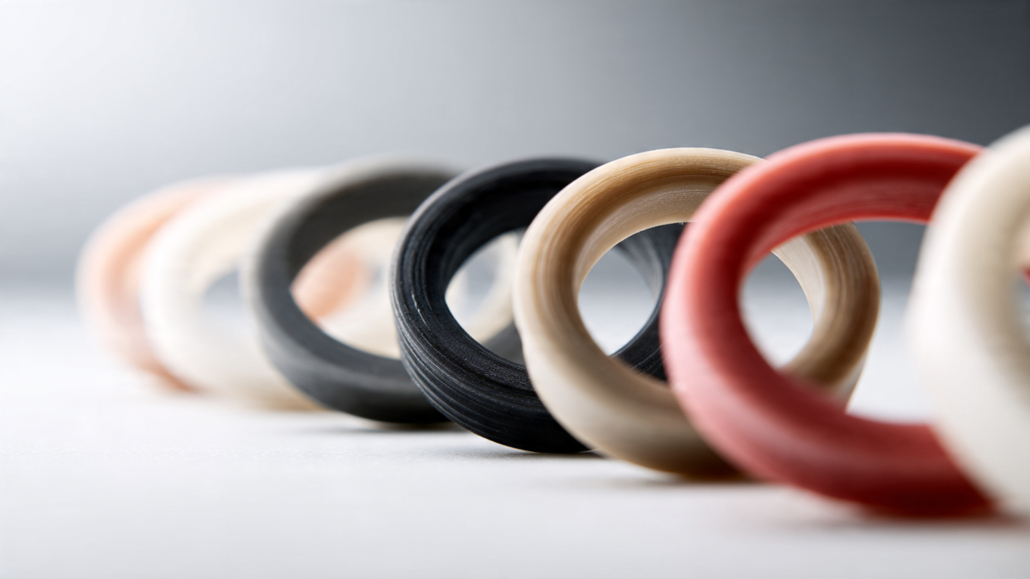
Top 7 Rubber Seal Compounds for Pharmaceuticals
Silicone (VMQ), fluoroelastomer (FKM/FPM), EPDM, butyl, bromobutyl, HNBR and specially formulated low‑particulate elastomers are the seven compounds most used for pharmaceutical seals. Each balances chemical compatibility, sterilization robustness, extractables control and lifecycle cost. Selection is driven by formulation chemistry, sterilization method, permeability needs and validation burden. Procurement should demand material certifications, traceability and targeted E&L data. Further discussion outlines application‑specific tradeoffs and verification steps.
Key Takeaways
- Prioritize fluoroelastomers (FKM/FPM) for broad chemical resistance and low sorption with validated cure/post-cure controls.
- Use silicone (VMQ) when wide temperature range and aqueous compatibility are primary, but validate against solvents and E&L.
- Choose EPDM for steam, hot-water, and water-based cleaning compatibility with proven low-extractables grades.
- Select butyl or bromobutyl for low permeability and moisture-sensitive packaging, balancing durometer and sterilization needs.
- Base compound choice on application risk, extractables/leachables data, accelerated aging, and total lifecycle cost.
Choosing Pharmaceutical-Grade Rubber Seals: Evaluation Checklist
Evaluating pharmaceutical-grade rubber seals begins with a focused checklist that prioritizes regulatory compliance, functional performance, and lifecycle cost; procurement teams should verify material certifications (e.g., USP Class VI, ISO 10993, FDA food contact) and confirm traceability to raw-material lots. The checklist includes documented regulatory testing protocols, accelerated aging data for shelf stability, and compatibility matrices for intended formulations. Supplier auditing should assess quality management, change-control practices, and contamination controls, with on-site audits prioritized for critical suppliers. Functional tests—compression set, tensile strength, and particulate shedding—must align with application risk profiles. A rigorous cost analysis balances unit price, expected service life, and validation costs, enabling selection of compounds that minimize total cost of ownership while supporting innovation and compliance.
Silicone (VMQ) Seals: Chemical Resistance & EL Profile
Silicone (VMQ) seals offer broad temperature tolerance and acceptable resistance to aqueous and polar pharmaceutical formulations, but limited compatibility with hydrocarbons and certain aggressive solvents must be documented in material selection. A concise chemical compatibility summary against intended formulations and cleaning agents supports risk-based seal choice and cost-effective inventory control. Extractables and leachables (E&L) profiles should be reviewed from certified suppliers and verified by targeted testing where product-contact risk or regulatory expectations require confirmation.
Chemical Compatibility Summary
Typically used across a wide range of pharmaceutical applications, silicone (VMQ) seals offer favorable thermal stability and elastomeric properties but present specific chemical resistance limitations that must be assessed against formulation components and cleaning agents. The summary focuses on practical compatibility, highlighting polymer interactions and degradation pathways that affect seal service life, regulatory risk, and maintenance costs. Compatibility testing, selection of appropriate hardness and fillers, and documented cleaning protocols reduce unexpected failures and compliance exposure.
- Aqueous cleaners and mild solvents: generally compatible; monitor swelling and polymer interactions.
- Strong ketones, aromatic hydrocarbons, and chlorinated solvents: can cause rapid degradation pathways and loss of sealing integrity.
- Oxidizing agents and high-concentration acids/bases: require validation and frequent inspection.
Extractables & Leachables
How should extractables and leachables (E&L) from silicone (VMQ) seals be approached to balance patient safety, regulatory expectations, and lifecycle costs? A risk-based framework prioritizes targeted studies, combining accelerated aging with representative contact conditions to simulate worst-case exposure while controlling test duration and expense. Selection of analytical methods—GC-MS, LC-MS, and ICP-MS—must align with likely VMQ oligomers, additives, and potential metal residues. Data-driven acceptance criteria and supplier change control reduce downstream remediation costs. Early design-of-experiments and prototype testing enable innovation in low-extractable formulations without compromising compliance. Documentation should map materials, test matrices, and results to regulatory guidance to support filings. This practical, compliance-focused approach manages cost and protects patients while enabling material innovation.
Fluoroelastomer (FKM/FPM) Seals: Performance & Extractables
Fluoroelastomer (FKM/FPM) seals are evaluated for their broad chemical resistance, particularly to aggressive solvents and oils commonly encountered in pharmaceutical processing. Attention is required on extractables and leachables profiles, since high-performance polymers can still contribute low-level impurities under stress conditions. Cost-conscious selection balances upfront material cost against reduced failure risk and simplified compliance testing for extractables.
Chemical Resistance Properties
In evaluating chemical resistance for FKM/FPM seals, manufacturers and quality teams prioritize documented compatibility with process fluids, cleaning agents, and sterilants to guarantee seal integrity and regulatory compliance. Assessment focuses on minimizing polymer degradation and solvent permeation while optimizing crosslink density to balance elasticity and barrier performance. Sorption kinetics data guide dwell times and material selection to limit uptake and dimensional change. Practical decisions weigh lifecycle cost, maintenance intervals, and validated cleaning regimes.
- Select grades with proven resistance to target solvents and reduced sorption kinetics to lower downtime.
- Specify crosslink density and compound formulation that mitigate polymer degradation without excessive stiffness.
- Implement accelerated compatibility testing and routine inspection criteria to sustain compliance and enable material innovation.
Extractables And Leachables
Addressing extractables and leachables (E&L) for FKM/FPM seals is essential to make certain product safety, regulatory compliance, and predictable process economics. Evaluation focuses on minimizing organics and metal ions under operational conditions, balancing compound selection against lifecycle cost. Manufacturers employ targeted regulatory testing protocols and accelerated migration studies to quantify potential leachables, then apply a risk assessment framework to prioritise mitigation. Material formulation, cure systems, and post-curing reduce extractable load; secondary coatings or barrier layers can be cost-effective where needed. Data-driven decisions—using validated analytical methods and supplier transparency—enable innovative seal designs that meet pharmacopeial expectations without overspecifying performance. The approach emphasises documented controls, traceability, and periodic retesting tied to process changes.
EPDM Seals: When to Choose EPDM for Aqueous Products
When selecting seal materials for aqueous pharmaceutical systems, EPDM (ethylene propylene diene monomer) is preferred where resistance to steam, hot water, and common water-based cleaning agents is required without incurring the higher cost of fluoroelastomers. EPDM formulation choices emphasize low extractables, demonstrated Sterilization compatibility, and predictable ageing under repeated autoclave cycles. The material supports regulatory compliance while enabling cost-effective innovation in system design.
- Select EPDM grades validated for aqueous chemical resistance and minimal extractables.
- Specify sterilization compatibility data (autoclave, hot water) and batch-level traceability.
- Evaluate compression set, temperature limits, and cleaning-agent compatibility versus lifecycle cost.
Decision-making should prioritize documented performance, supply-chain transparency, and scalability for production.
Butyl & Bromobutyl Seals: Moisture Control & Gas Barrier
For moisture-sensitive and low-permeability pharmaceutical applications, butyl and bromobutyl elastomers offer cost-effective barriers to water vapor and small gases while maintaining chemical inertness under typical storage and processing conditions. The material selection emphasizes low moisture ingress and controlled gas permeability, supporting product stability in vials, ampoules, and blister systems. Manufacturers valuing compliance benefit from predictable performance, straightforward qualification, and established regulatory histories. Design choices balance durometer and formulation to minimize leachables and maintain seal integrity during sterilization cycles compatible with these elastomers. Supply-chain efficiency and cost-conscious compound options make butyl variants attractive for high-volume packaging. Innovation focuses on tailored co-blocks and surface treatments that reduce permeability further without compromising compatibility, enabling pragmatic upgrades to existing filling lines and stability protocols.
HNBR Seals: Heat and Solvent Resistance
Exhibiting superior thermal stability and solvent resistance, hydrogenated nitrile butadiene rubber (HNBR) is frequently selected for pharmaceutical sealing applications that require prolonged exposure to elevated temperatures, aggressive cleaning agents, or organic process solvents. HNBR’s resistance to thermal ageing preserves elasticity and sealing force, reducing maintenance and replacement costs while supporting regulatory longevity expectations. Attention to compounding controls hardness, extractables, and compatibility with sterilization cycles. Design validation should quantify leak rates after accelerated thermal ageing and solvent exposure to guard against solvent swelling that can alter dimensions.
- Monitor thermal ageing effects via accelerated aging tests to predict service life.
- Specify compound grades with documented solvent swelling limits for intended process chemistries.
- Balance cost and performance by selecting formulations proven in compliance testing.
Match Seals to Applications: Vials, Syringes, Stoppers, and Spec Tips
Across common pharmaceutical formats—vials, syringes, stoppers, and specimen tips—seal selection must align form, function, and regulatory constraints to control contamination risk, dose accuracy, and lifecycle cost. The discussion emphasizes matching material properties to application: low particulate elastomers for syringes to preserve dose accuracy, and chemically resistant compounds for vials subject to solvent exposure. Design considerations include vial orientation and plunger movement; seals must tolerate repeated manipulation without ingress. Stopper texture affects wetting and piercing force, influencing automation throughput and patient safety. Specimen tips require low-extractables, minimal adsorption surfaces to protect analytical integrity. Procurement balances upfront material cost with long-term savings from reduced rejects, easier validation, and extended shelf life, encouraging innovative blends that meet USP and ISO expectations.
Frequently Asked Questions
Can Rubber Seals Be Gamma-Sterilized Without Changing Properties?
Yes; careful selection permits gamma-sterilized rubber seals to retain properties. Gamma stability varies by compound; evaluate sterilization methods, perform validation testing, consider cost-benefit, and document compliance while pursuing material innovation and supply-chain resilience.
How Do Seal Compounds Affect Protein Adsorption/Aggregation?
Seal compounds influence protein adsorption and aggregation by altering surface passivation and hydration layer integrity; the manufacturer prioritizes low-extractable, hydrophilic formulations, balancing cost, regulatory compliance, and innovative coatings to minimize biophysical destabilization.
Are There Eco-Friendly Recyclable Pharmaceutical Elastomers?
Yes. The responder notes bio based elastomers exist for pharmaceutical seals; they prioritize regulatory compliance, performance testing, and cost modeling, and can support closed loop recycling programs to reduce waste while maintaining quality and supply-chain controls.
What Qualification Testing Do Suppliers Typically Provide?
Suppliers typically provide qualification testing including extraction efficiency assays and mechanical endurance cycling, plus biocompatibility, USP/ISO standards, accelerated aging, dimensional verification, and lot traceability, emphasizing practical, cost-conscious, compliance-focused innovation.
Can Seals Cause Leachables That Interfere With Assays?
Yes. The responder notes seals can leach compounds causing assay interference; extractables testing and targeted leachables studies mitigate risk. Cost-conscious strategies prioritize validated materials, supplier data, and compliance-driven sampling to support innovative assay robustness.
Conclusion
In selecting pharmaceutical-grade rubber seals, decision-makers should prioritize compliance, extractables control, and lifecycle cost. Practical choices—silicone for wide temperature needs, FKM for chemical resistance, EPDM for aqueous systems, butyl variants for moisture and gas barrier, and HNBR for heat/solvent exposure—must be matched to specific primary container types. A documented material justification, supplier qualification, and routine extractables testing minimize risk and support cost-effective, regulatory-compliant sealing solutions.
RK Rubber Enterprise Co., a leading rubber supplier and manufacturer in the Philippines, supports these best practices by providing high-quality, cost-efficient rubber compounds, expert material selection guidance, and installation services. Their commitment to ongoing manufacturing improvements, supplier qualification, and customer support helps ensure compliant seal choices and reliable performance across pharmaceutical applications.