
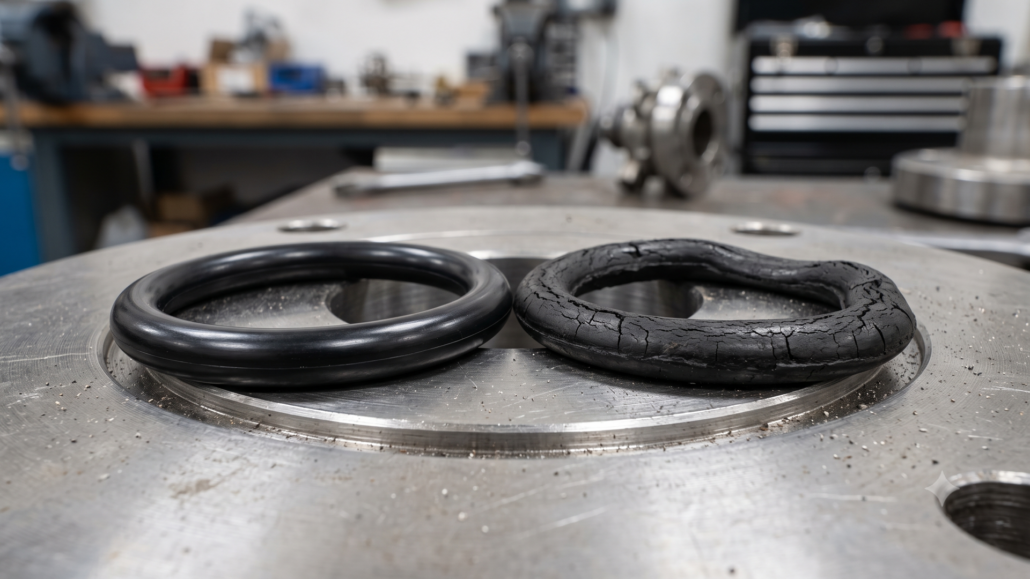
Rubber Compression Set Explained | Seal Longevity Philippines
Rubber compression set is the permanent loss of thickness after a seal is squeezed for a long time. It matters because the seal does not fully spring back, so contact stress drops and leaks become more likely. Heat, time, and fluid exposure make it worse by changing the rubber’s molecular structure. ASTM D395 measures it under controlled conditions. FFKM, FKM, and peroxide-cured EPDM usually hold up best. The details explain how to limit failures and choose the right compound.
Key Takeaways
- Rubber compression set is permanent thickness loss after compression, reducing a seal’s ability to rebound and maintain contact pressure.
- High compression set causes leaks because the seal no longer generates enough residual stress to block fluid or gas.
- Heat, time, and squeeze accelerate compression set through creep, stress relaxation, and chemical degradation of the rubber.
- ASTM D395 Method B is the standard way to measure compression set and compare materials under defined temperature and duration.
- FFKM, FKM, and peroxide-cured EPDM usually resist compression set better than NBR, CR, or sulfur-cured EPDM in hot service.
What Is Rubber Compression Set?
Rubber compression set is the permanent loss of thickness a rubber specimen retains after being compressed under a defined load and temperature for a set time. It is reported as a percentage of the original deflection, where 0% means full recovery and 100% means no recovery. In practice, the test shows how well a rubber part rebounds after being held under strain. ASTM D395 Method B is common: a button specimen is compressed to 75% thickness, aged, recovered, and measured. The result reflects molecular relaxation and viscoelastic creep over time. Higher values indicate less rebound. Temperature, duration, and cure system all matter, so the test conditions must be stated clearly for anyone comparing materials with confidence.
Why Compression Set Causes Seal Failure
When compression set becomes too high, a seal loses cross-section height and the residual contact stress can drop below the minimum pressure needed to block leakage. That is the core failure path. The seal may still look intact, but loss of elasticity and contact stress reduction leave too little force at the interface. For static seals, failure starts when remaining stress is below system pressure.
| Effect | Result |
|---|---|
| Thinner seal | Less sealing force |
| Stiffer seal | Poor compliance |
| Repeated heat | More permanent set |
Higher compression set also varies by elastomer and cure system, so one material can stay reliable while another fails early. In a sealing team, the right choice helps everyone keep confidence in the joint.
What Causes Compression Set in Rubber?
Compression set develops from several interacting mechanisms in rubber. Under steady squeeze, polymer chains undergo molecular rearrangement and creep, so the material loses part of its springback. Heat makes this happen faster. Three main drivers stand out:
Compression set arises as rubber chains relax under steady squeeze, reducing springback. Heat accelerates the process.
- Stress relaxation: chains shift and settle, cutting elastic recovery.
- Chemical attack: heat, oxygen, ozone, and fluids can cause oxidative chain-scission and crosslink breakage, especially in sulfur-cured compounds.
- Compound design: cure system, crosslink density, and fillers such as carbon black or silica shape how well a rubber keeps its form.
Higher temperature, greater compression, and longer dwell times all worsen the effect. Peroxide-cured EPDM and FKM/FFKM usually resist it better than standard sulfur-cured EPDM or NBR, helping teams build seals that stay dependable longer.
How ASTM D395 Measures It
ASTM D395 quantifies compression set by holding a rubber button in a fixed squeezed state and then checking how much thickness it failed to recover. In Method B, a 29 mm × 12.5 mm specimen is clamped between steel plates, often with test fixtures, and compressed to 75% of its original thickness for a set time at a set temperature. A common condition is 22 hours at 100°C, followed by 30 minutes of recovery before thickness is measured. The result is reported as CS% = [(t0 − tr) / (t0 − ts)] × 100. Method A uses constant force and is not comparable. Specifications must name the ASTM D395 method, temperature, and duration to limit measurement uncertainty.
Which Elastomers Resist Compression Set Best?
Among elastomers, FFKM and FKM resist compression set best at high temperature, with FKM often showing about 15–25% CS after 70 hours at 200°C in representative tests. For teams choosing seals, that usually puts fluoropolymer elastomers at the top when heat is harsh and life matters. High‑temperature silicones also perform well, often around 15–30% CS after 22 hours at 175°C, with platinum cures usually giving the better recovery.
- FFKM/FKM: best for severe heat.
- VMQ: strong for elevated temperature service.
- EPDM: peroxide‑cured grades beat sulfur‑cured grades.
NBR and CR trail behind at hotter conditions. The real answer still depends on cure chemistry, crosslink density, and ASTM D395 test details.
How Static and Dynamic Seals Differ
Static and dynamic seals are judged differently because they fail in different ways. Static seals are compressed once at installation and depend on elastic recovery to keep contact stress alive. As compression set rises, sealing force drops and leaks become more likely, especially after heat aging. Dynamic seals move through repeated compression and release, so a little compression set can reduce friction and stick-slip. But the tradeoff is real: wear, modulus, and fatigue still matter. For material selection, static service often favors peroxide-cured EPDM or FKM/FFKM in hot duty. Dynamic service may accept slightly higher CS if abrasion resistance and flexibility stay strong. Application examples include pipe gaskets, valve seats, shaft seals, and reciprocating actuators, where the seal must fit the motion and the environment.
How to Specify Compression Set Limits
Compression set limits should be written as a complete test requirement, not as a lone percentage. Teams avoid testing variability when they state the method, temperature, duration, and deflection together, such as ASTM D395 Method B, 22 h at 100°C, 25% deflection.
- Use Method B unless load control is the real need.
- Match the test temperature to, or above, the maximum service temperature so design margins stay real.
- Extend duration for long-life seals, from 70 h to 168–1000 h when needed.
For steam, hot-water, or high-temperature static seals, specify peroxide-cured EPDM or FKM/FFKM and set a tighter limit, often under 25% at the elevated condition. That keeps suppliers aligned and helps the team trust the seal.
Frequently Asked Questions
Why Is Rubber Good for Sealing?
Rubber seals well because it flexes to fill gaps, maintains contact pressure, and bonds by surface adhesion. Many formulations also provide chemical resistance, letting them hold against fluids, heat, and wear for a long time.
How Long Does a Rubber Seal Last?
A rubber seal can last months to decades, depending on material compatibility, environmental aging, temperature, squeeze, and chemicals. In hot, static service, life often shortens sharply; better compounds can extend reliable sealing for years.
Why Is Elastic Rubber Good for Sealing?
Elastic rubber is good for sealing because it keeps contact pressure against surfaces, adapts to gaps, and recovers after compression. Its thermal stability and chemical resistance help seals stay reliable, reducing leaks over time.
What Is the Compression Set of a Seal?
Compression set is the permanent thickness loss a seal keeps after compression and release, usually measured by material testing. It shows how aging mechanisms reduce recovery; lower percentages mean better elastic return and sealing.
Conclusion
Rubber compression set is a key indicator of how well a seal will hold its shape and maintain force over time. When a material takes a permanent set, sealing performance drops, leaks become more likely, and service life shortens. Measuring compression set with ASTM D395 helps compare materials and set practical requirements. Choosing the right elastomer and limiting heat, stress, and time exposure can improve long-term seal reliability in both static and dynamic applications.
At RK Rubber Enterprise Co., we are committed to providing high-quality rubber solutions that support durable, dependable sealing performance for a wide range of industries. As a trusted rubber supplier and manufacturer in the Philippines, RK Rubber Enterprise Co. continues to deliver expert support, practical guidance, and cost-efficient products that help customers achieve long-term reliability.