Rubber Lining for Mining Pipes | Abrasion-Resistant Solutions
Rubber lining is used on mining slurry pipes and tanks to resist abrasion, impact, erosion, and corrosion from hard, angular solids and aggressive liquids. It forms a protective elastomer barrier, absorbs shock, and helps reduce turbulence and wear at elbows, inlets, chutes, and tank walls. Soft natural rubber suits high-impact service, while other compounds fit hotter or chemical duties. Correct installation and inspection extend service life, and the details behind that choice are worth knowing.
Key Takeaways
- Rubber lining protects slurry pipes and tanks by isolating steel from abrasive particles, impact, cavitation, and corrosion.
- It absorbs shock and reduces shell fatigue, extending service life in high-wear mining applications.
- Common uses include elbows, hydrocyclone inlets, chutes, hoppers, mills, tanks, and thickeners.
- Select rubber type and thickness based on slurry severity, with soft natural rubber common for impact and abrasion.
- Proper surface prep, bonding, vulcanization, inspection, and repair are essential for long-lasting performance.
What Makes Mining Slurry So Hard on Equipment?
Mining slurry is hard on equipment because it combines severe abrasion, impact, erosion, and corrosion in one flow stream. Hard, angular mineral particles scrape metal, while particle impact from larger rocks deforms and tears exposed surfaces. In fast lines, especially at elbows, contractions, and pump inlets, hydraulic cavitation and high-velocity erosion thin walls and impellers. Mixed particle sizes make wear uneven, so damage rises faster than with dry abrasion alone. Once a surface opens, acids, alkalis, and salts can attack the base metal and shorten service life across a wide pH range. Poor flow geometry adds turbulence, noise, vibration, and frequent maintenance. Teams that work these systems know the pattern: slurry punishes weak spots first, then spreads failure fast across the circuit.
Why Rubber Lining Protects Slurry Pipes and Tanks
Rubber lining protects slurry pipes and tanks by creating a continuous elastomer barrier between the slurry and the steel substrate. This impermeable membrane blocks infiltration, slows corrosion, and helps extend service life in hard-wearing duty. Soft natural rubber compounds resist abrasion, cutting, and tearing, while neoprene or chlorobutyl add chemical, heat, and weather resistance when needed. The lining also provides impact damping, absorbing shock from ore and coarse aggregate so the shell sees less fatigue and surface damage. Vulcanized membranes restore smooth internal geometry, reduce turbulence, and lower pumping energy and erosion at elbows and transitions. Because the lining can be inspected and repaired locally, crews stay in control, downtime stays shorter, and lifecycle costs remain lower than replacing damaged steel.
Where Rubber Lining Fits Best in Mining Equipment
In slurry pipelines and pump boxes, rubber lining is most valuable where abrasive slurry moves at high velocity and a resilient internal barrier can extend service life by 15–20% over unlined steel. Chutes, hoppers, and mill feed boxes suit soft natural rubber because it absorbs drop energy in impact zones and resists cutting. Tanks and thickeners gain from vulcanized sheets that block corrosive liquor and protect steel after breaches.
| Equipment | Best fit |
|---|---|
| Elbows, passages | Precision-lined to limit cavitation and erosion |
| Hydrocyclone inlets | Durable at critical-velocity impact points |
At thermal limits, rubber should stay within its service range; where dry abrasion dominates, ceramics can lead. Yet for teams managing impact, abrasion, and chemical attack, rubber remains the shared, repairable choice.
How To Choose the Right Rubber Lining
To choose the right rubber lining, the slurry chemistry and wear pattern must lead the decision: soft natural rubber, typically 35–65 Shore A, suits high-impact abrasive service, while neoprene or chlorobutyl, at 45–65 Shore A, better handles oil, caustic, heat, and FGD or outdoor tank exposure. Compound selection also should reflect particle size and velocity, since heavier wear zones often need 12–25 mm thickness for longer life. Elbows and passages benefit from smooth profiles that avoid offsets and sharp changes. Certified surface prep, bonding agents, and tested vulcanization support bond integrity and impermeability. Maintenance matters too; choose compounds that allow repair, and align installation timing with planned shutdowns so crews can inspect, replace, and protect the substrate before corrosion spreads.
How Rubber Lining Gets Installed
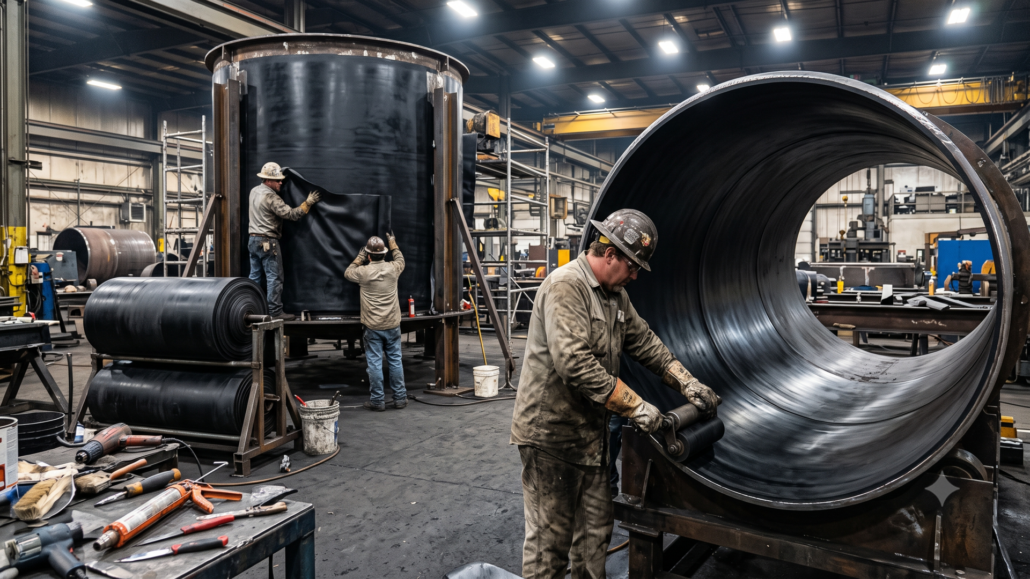
Once the lining material is selected, installation begins with strict substrate preparation: the steel is shot blasted to SSPC-SP 5 cleanliness with a controlled profile, then primed immediately to secure the bond. Surface cleanliness is checked before any sheet is placed, because the crew relies on it for a sound start. Rubber is then cut to size as calibrated sheets or preformed molds, set into position, and rolled to expel trapped air. Seam anchoring may be used at joints and penetrations to hold full contact. Cure method follows the job: autoclave, direct steam, or portable blankets with recorded heat, pressure, and time. Final checks include spark testing, thickness measurement, adhesion tests, and traceable records.
Rubber Lining vs. Other Mining Wear Linings
Compared with steel, ceramic, and other wear systems, rubber lining is often chosen when mining slurry service combines abrasion with impact, vibration, or thermal cycling. Its elasticity absorbs shock, limiting cracking where rigid ceramic alternatives perform best only in pure abrasion and high-velocity, low-impact streams. Soft natural rubber, typically 35–65 Shore A, suits coarse ore in pipes and pump boxes, while compound choice and thickness tune life to particle size, velocity, chemistry, and temperature. Rubber can extend service life by 15–20%, often reaching 10–20 years when specified well. It is fully impermeable to corrosive slurry and can be repaired in place. Against steel overlays and many polymer composites, it offers a practical balance of durability, downtime control, and cost.
Inspection, Repairs, and Emergency Support
Inspection begins with spark testing, thickness checks, and close visual review to catch breaches before slurry reaches the steel. Teams use the findings to forecast failure, set repair priority, and protect the liner community.
| Check | Purpose |
|---|---|
| Spark test | Finds pinholes |
| Thickness gauge | Tracks wear loss |
| Visual review | Spots cracks and edge lift |
| Records | Support warranty documentation |
When damage is small, cold-bond or chemical-cure patching can restore service fast. When wear is broad, full stripping, relining, and steel repair follow, often with hot vulcanization or autoclave curing. Emergency logistics matter, and 24-hour response helps reduce downtime.
Inspection plans should match service severity. Reports should retain lot numbers, adhesion results, and photos so decisions stay traceable and the crew stands on firm ground together.
Frequently Asked Questions
What Are the Disadvantages of Rubber Lining?
Disadvantages include heat limits, chemical incompatibility, installation sensitivity, added weight, reduced bore, and higher pumping energy. Severe gouging can overwhelm abrasion resistance, so careful chemical compatibility and handling are essential.
What Is the Rubber Lining in Tanks?
Rubber lining in tanks is a bonded elastomer barrier protecting metal interiors from slurry, chemicals, and gas. It offers chemical resistance, absorbs impact, and accommodates thermal expansion, helping crews extend service life and reduce downtime.
What Is the Alternative to Rubber Lining?
Alternatives to rubber lining include ceramic tiles, polyurethane, hardfacing, HDPE, and synthetic coatings. Each suits different wear, impact, and temperature conditions, allowing teams to choose a shared, durable solution for slurry service.
What Is the Difference Between FRP Lining and Rubber Lining?
FRP lining is rigid, thin, and better for chemical compatibility; rubber lining is thicker, flexible, and better for abrasion and impact. Their installation methods also differ: FRP is brittle, rubber is easier to repair.
Conclusion
Rubber lining remains a practical defense against the abrasive, corrosive demands of mining slurry. It helps extend pipe and tank service life, reduce leaks, and lower maintenance downtime when properly selected and installed. Its performance depends on matching the lining to slurry chemistry, temperature, and impact conditions. Compared with harder alternatives, rubber often offers a balanced mix of wear resistance and flexibility. Regular inspection and timely repair are essential to preserve protection and reliability. RK Rubber Enterprise Co. stands as a trusted rubber supplier and manufacturer in the Philippines, providing high-quality rubber products, expert support, and installation services to help ensure dependable performance in demanding mining applications.