Sr H7TJxuzBjv62aLDa9U 1

Reliable Rubber Manufacturer in the Philippines

Introduction

One small rubber pad or gasket can shut down an entire production line when it fails. That is why choosing a reliable rubber manufacturer in the Philippines never feels like a simple price comparison. Every decision touches safety, uptime, and long-term cost, even if the part itself looks small and ordinary.

For industrial plants, construction sites, commercial buildings, and automotive lines, rubber parts carry heavy responsibility. Bridge bearing pads hold massive structures, seals keep corrosive fluids where they belong, and dock fenders protect ships and piers from damage. When these parts fail, projects stall, schedules slip, and repair costs rise fast. In many cases, the part itself is inexpensive, but the downtime it causes is not.

We built RK Rubber Enterprise Co. around that reality. As a leading and reliable rubber manufacturer in the Philippines, we focus on more than just making parts. We combine material expertise, careful engineering, strict quality checks, and fast, responsive service. In this article, we share what truly defines a reliable rubber supplier, walk through our wide product range, and explain how our customer-first way of working helps projects finish safely, on time, and with less stress.

“Quality is never an accident; it is always the result of intelligent effort.” — John Ruskin
This principle guides how we choose materials, design parts, and manage every production batch we ship.

Key Takeaways

  • A reliable rubber manufacturer does more than ship parts on time. The right partner combines strong product quality, wide customization options, and hands-on customer support. This mix keeps your equipment safe, stable, and running longer.

  • RK Rubber Enterprise Co. serves civil engineering, marine, industrial, automotive, and commercial projects across the country. Our wide catalog and custom work let many teams source what they need from one reliable rubber supplier. That saves time and cuts coordination issues during planning and purchasing.

  • Our team understands rubber compounds in depth and follows strict standards such as ISO 9001, ASTM, DIN, and FDA for food-grade items. This mix of knowledge and standards helps each rubber part match its real-world job, from high temperature lines to heavy structural loads.

  • We have proven reliability on large projects like the Cebu Cordova Link Expressway, where we supplied elastomeric bearing pads. Along with project experience, we offer flexible service, expert consultation, and nationwide coverage, which makes us a trusted partner from NCR to Visayas and Mindanao.

What Makes RK Rubber Enterprise Co. A Reliable Rubber Manufacturer In The Philippines

Quality inspection of bridge bearing pads at construction site

When we talk about reliability, we do not stop at long-lasting parts. For us, a reliable rubber manufacturer in the Philippines must combine consistent quality, clear communication, technical guidance, and support that stays strong from design up to installation and after-sales.

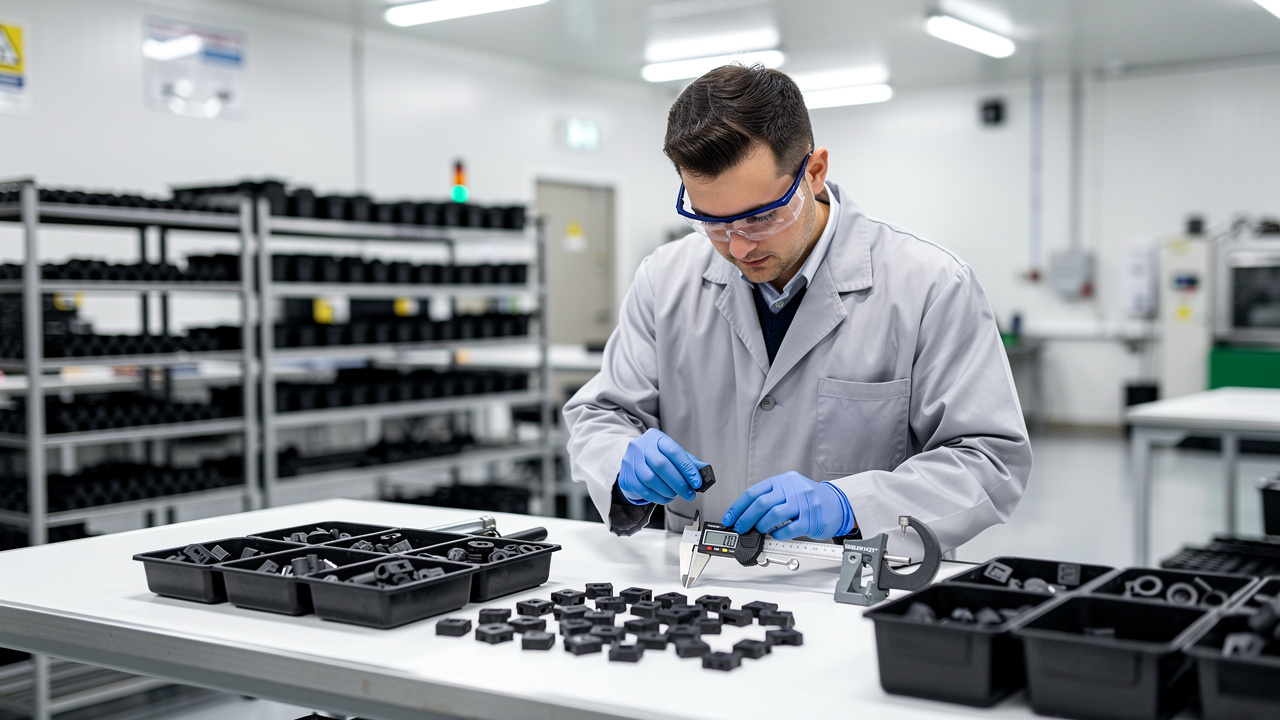
Quality starts with the compounds we use. We source high grade natural and synthetic rubbers and match each material to its job, from heat resistant silicone and Viton to weather resistant EPDM and oil resistant nitrile. In our plant, we follow strict process controls and apply international standards such as ISO 9001, ASTM, DIN, and FDA for food-related parts. At every stage, we run inspections so each batch meets the mechanical and chemical performance that the application needs.

Typical checks include:

  • Material checks for hardness, elasticity, and basic physical properties

  • Dimensional checks against drawings and tolerances

  • Visual inspection to spot surface defects, bubbles, or cracks

We also work with a zero defect mindset. Our teams check molds, curing conditions, and dimensions again and again, so items can handle extreme temperatures, constant vibration, impact, chemicals, and outdoor exposure. This care is the reason our elastomeric bridge bearing pads help carry major structures and why many clients treat our parts as safety components, not just consumables.

Customization is another pillar of our reliability. Many projects cannot use off-the-shelf items, so we adjust rubber strips, rubber pads, rubber bushings, profiles, rubber end caps, rubber footings, and gaskets to match exact drawings. We can change material type, size, shape, color, and hardness to fit your load, movement, and sealing needs. This is how we support both one-off special parts and repeat OEM orders.

Behind that flexibility stands a state-of-the-art facility that handles bulk orders without cutting corners on quality. We plan capacity carefully, keep common compounds ready, and structure our lines so we can serve urgent requirements. By combining efficient production with competitive pricing, we give clients cost-effective options while still delivering reliable rubber products that stand up under real stress.

Our track record includes major projects like the Cebu Cordova Link Expressway, where we supplied elastomeric bearing pads that carry massive loads and reduce vibration on the bridge. That kind of work shows how we perform as a reliable rubber supplier in NCR and across the Philippines, even when the technical bar is set very high.

Comprehensive Rubber Product Range For Many Industries

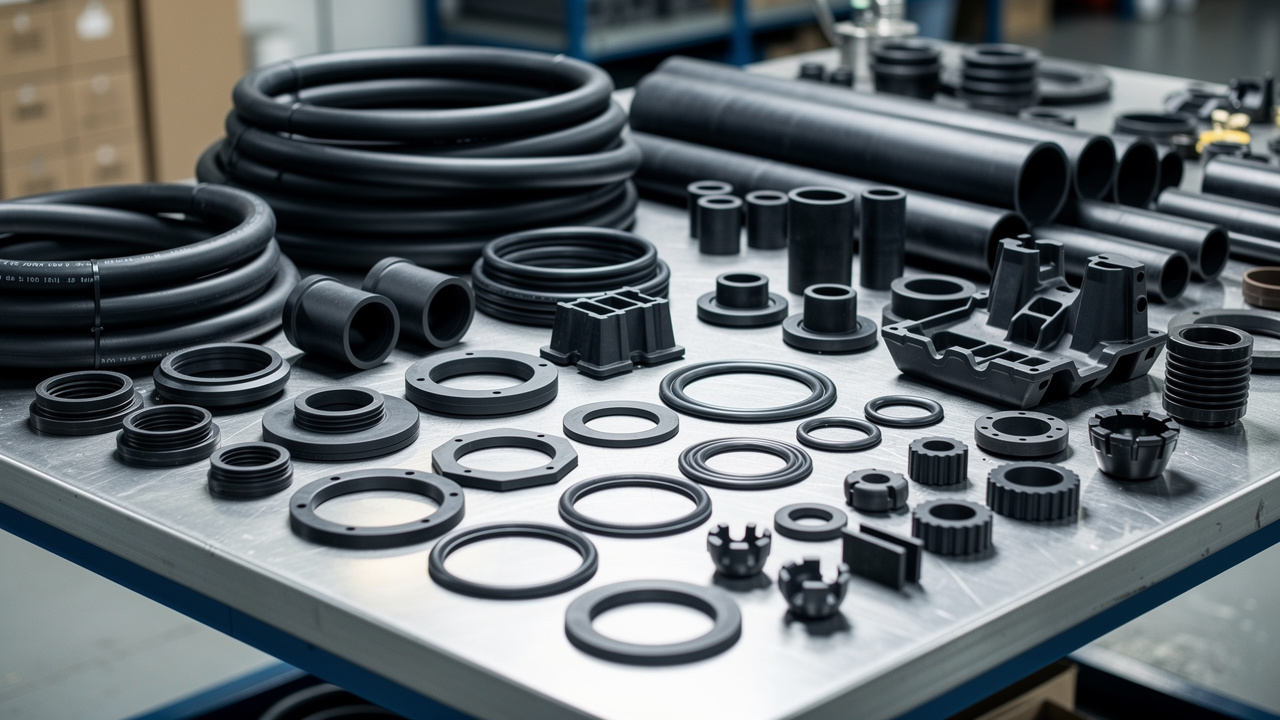
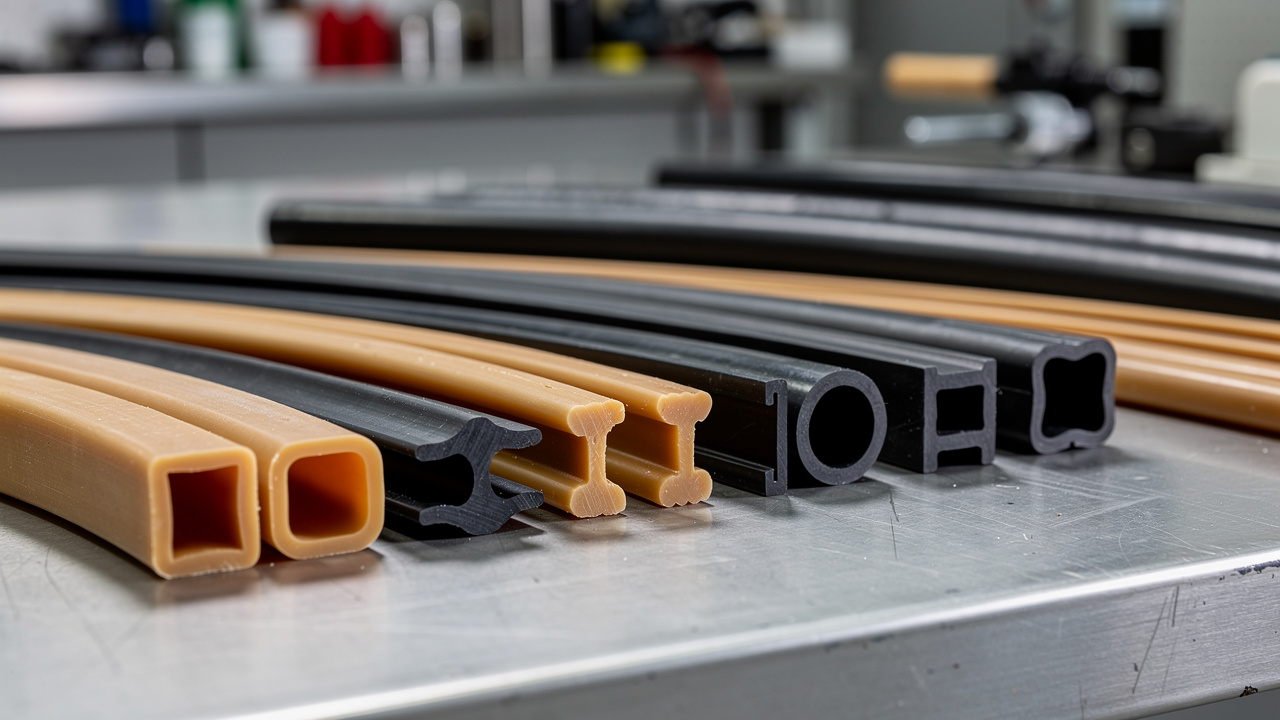
Diverse range of industrial rubber products and components

We position RK Rubber Enterprise Co. as a one-stop, reliable rubber supplier for many sectors in the Philippines. From infrastructure to food plants, our aim is simple. We want clients to find the right part with one partner, backed by strong technical support and consistent quality.

To give a quick overview, here is how our products support different sectors:

Sector

Key Rubber Products From RK Rubber

Main Uses And Benefits

Civil Engineering & Construction

Elastomeric bearing pads, expansion joint fillers, water stoppers, column and corner guards

Load transfer, movement control, sealing, and impact protection

Marine & Port

Dock fenders, TEE head mooring bollards, gate seals

Impact absorption, mooring safety, and leak control

Industrial & Manufacturing

Conveyor belts, rollers, gaskets, linings, sanitizing mats

Material handling, equipment protection, and hygiene

Mechanical & Automotive

Hoses, bushings, O-rings, wheel chocks, window seals

Fluid transfer, vibration isolation, and vehicle safety

For civil engineering and construction, we provide elastomeric bridge bearing pads, including steel laminated types that manage load transfer and movement in bridges and flyovers. We also produce expansion joint fillers, rubber water stoppers, gate seals, and compressible pads that keep structures sealed and able to move without cracking. In parking areas, warehouses, and loading bays, our rubber column guards, corner guards, rubber bumpers, stair nosing, and matting help protect both people and structures.

For marine and port work, we manufacture dock fenders in many designs such as arch, V type, cell type, D type, and T type, along with unit elements. These parts absorb heavy impact between vessel and pier. We also supply TEE head mooring bollards that hold massive mooring forces and gate seals that help keep dry docks and water control points tight against leaks.

In industrial and manufacturing plants, we support material handling and equipment safety. Our product line includes conveyor belts, polyurethane wheels, rubber rollers, footings, blocks, and boxes that reduce vibration and protect machines. We also supply silicone rubber gaskets, rubber grommets, W type and J type seals, rubber linings for tanks and chutes, rubber finger pluckers for poultry plants, and sanitizing rubber foot mats for clean areas. Each item is built from the right compound to stand up to abrasion, chemicals, or constant motion.

For mechanical, automotive, and related sectors, we produce industrial reinforced, automotive, and food-grade hoses, along with bushings, bellows, O-rings, piston rings, end caps, duct plugs, ramps, and window seals. Our rubber wheel chocks and wheel guards help keep vehicles safe on slopes and in tight spaces. Across these lines, we offer wide customization, so nearly every product can match specific size, pressure, or movement requirements for your plant or project.

Our Customer-Centered Approach, Expert Support, And Flexible Service

Engineering consultation for custom rubber product design

We believe reliability should be felt not only in the product but also in the way we work with clients. That is why we treat each project as a partnership, not just a purchase order. From the first call, we listen to your goals, site conditions, and limits on time or budget, then we build a clear plan together.

Our consultation work is hands-on. We often start with drawings, sketches, or even a worn-out sample part, then discuss real operating conditions such as load, temperature, movement, and chemicals. From there, our team suggests the best compounds, whether that means natural rubber for high resilience, nitrile for oil contact, silicone for extreme heat, EPDM for outdoor exposure, Neoprene for balanced performance, or Viton for aggressive chemicals. This helps you avoid material mistakes that can cause early failure.

A typical project with RK Rubber Enterprise Co. may involve:

  1. Initial discussion of drawings, samples, and site conditions

  2. Material and design review based on load, movement, and temperature

  3. Quotation and lead time confirmation, aligned with your schedule

  4. Production, inspection, and delivery with status updates along the way

  5. After-sales support for installation questions and performance feedback

Changes are normal in construction and industrial work, so we keep our process flexible. When clients adjust dimensions, hardness, or delivery dates, we do our best to adapt without hurting quality or schedules. Our production and sales teams work closely, which helps us keep control even when urgent orders come in or site conditions shift.

We also add value beyond manufacturing. Our engineers assist with product specifications, installation guidance for items like bearing pads, dock fenders, and water stoppers, and checks during and after delivery. We treat on-time delivery as part of quality, because even the best part is not helpful if it arrives too late for a pour or shutdown.

“Quality is everyone’s responsibility.” — W. Edwards Deming
We take that seriously by involving our engineers, production staff, and sales team in every major project.

RK Rubber Enterprise Co. serves clients nationwide from our headquarters in Quezon City, making us a reliable rubber supplier in NCR and nearby provinces. Our Cebu office supports Visayas and Mindanao projects for faster response, easier coordination, and local insight. Over the years, this customer centered way of working has helped us build long-term ties with industrial plants, contractors, and facility managers across the Philippines.

Conclusion

Major bridge infrastructure project in the Philippines

Choosing the right partner for rubber parts means trusting them with safety, uptime, and project timelines. As a reliable rubber manufacturer in the Philippines, we base that trust on three pillars. We focus on strong quality and material control, a wide product range that fits many industries, and customer support that stays active from design to installation and beyond.

By working with RK Rubber Enterprise Co., you gain a team that delivers consistent results, meets tight deadlines, and shares clear technical guidance at every step. Our work on major infrastructure such as the Cebu Cordova Link Expressway shows that we can handle demanding projects with high load, vibration, and safety requirements.

Our goal is to be more than a vendor. We aim to be a partner who helps you reduce risk and reach your targets, whether your project is in NCR, Visayas, Mindanao, or any other part of the country. Reach out to us to request a product catalog, schedule a consultation, or discuss a specific rubber requirement with our team. Experience the difference of working with a truly reliable rubber supplier that combines quality products with attentive service to support your business goals.

FAQs

Question 1: What Makes RK Rubber Enterprise Co. A Reliable Rubber Manufacturer Compared To Other Suppliers In The Philippines?

We stand out by combining strong product quality, deep material knowledge, and close support before and after delivery. Our processes follow international references such as ISO 9001, ASTM, DIN, and FDA for food-grade items, and we use premium compounds matched to each job. We have supplied demanding projects like the Cebu Cordova Link Expressway, which tested our design and production strength. With nationwide coverage and a Cebu office for Visayas and Mindanao, we handle tight deadlines while keeping service personal and responsive.

Question 2: What Types Of Rubber Products Does RK Rubber Manufacture?

We produce a wide range of industrial rubber parts, including seals, gaskets, bumpers, shock absorbers, strips, pads, bushings, profiles, tubing, end caps, and rubber balls. Our catalog also covers industrial hoses for food-grade, reinforced, and automotive use, along with protective items like rubber footings, linings, column guards, and dock fenders. Many of these items are designed to deliver long service in harsh environments such as plants, ports, and roads. For most product lines, we can adjust design and material to match the real needs of your application.

Question 3: Can RK Rubber Customize Rubber Products For Specific Industrial Applications?

Yes, customization is one of our main strengths. We adjust almost every product line, from gaskets and seals to pads, bushings, and hoses, based on your drawings or samples. Options include different rubber compounds, sizes, shapes, surface textures, colors, and hardness levels to match load, movement, and temperature needs. Our team works closely with engineers and buyers to design and produce precision molded parts, including OEM components for equipment builders.

Question 4: Does RK Rubber Serve Clients Outside The National Capital Region (NCR)?

We serve clients throughout the Philippines. Our main office and plant in Quezon City handle projects in NCR and nearby regions, while our Cebu office focuses on Visayas and Mindanao. This setup helps us provide faster communication, better logistics planning, and more direct support, no matter where your project or facility is located.

Question 5: What Quality Standards Does RK Rubber Adhere To?

We base our quality system on international standards such as ISO 9001, ASTM, and DIN, and follow FDA related requirements for food-grade products. Our process includes strict checks at each production step, from raw material selection to final inspection, guided by a zero defect mindset. We use high grade compounds and controlled curing methods so our rubber products stay safe, reliable, and ready for demanding service conditions.

1ea879SNe ntBNHzopVFA 1

Trusted Rubber Manufacturer in the Philippines

One weak rubber gasket can stop an entire production line. One worn-out rubber bushing can shut down a conveyor, delay deliveries, and push costs higher. That is why choosing a trusted rubber manufacturer is not just a purchase decision; it is a risk management decision that affects safety, uptime, and profit.

We built RK Rubber Enterprise Co. around this reality. As one of the most trusted rubber manufacturing partners in the Philippines, we focus on engineered rubber parts that keep plants, vehicles, and structures running safely and reliably. Our vision is to act as a real catalyst for Philippine industry and help our country stand as a major exporter of quality rubber products, not just a buyer.

“Quality is not an act, it is a habit.” – Aristotle

Our team designs and produces sealing parts, shock and vibration control items, and specialized components for industrial, automotive, construction, marine, and many other applications. We support these with strict quality control based on global standards such as ISO 9001, ASTM, DIN, FDA, and RoHS, so clients can verify how we work, not just rely on promises. As a trusted rubber supplier, we also share technical know-how to help prevent design and installation errors.

In this article, we walk through what really defines a trusted rubber manufacturer in the Philippines and how we stand out. We explain our product range, how we address common industrial problems, and why many leaders treat us as a long-term partner instead of a simple vendor. By the end, you will see how working with the right trusted rubber manufacturer can protect your operations and lower your total cost over time.

Key Takeaways

  • A trusted rubber manufacturer proves its value through consistent quality, reliable lead times, open communication, and clear compliance with standards such as ISO 9001, ASTM, DIN, FDA, and RoHS that industrial buyers can check and audit. This kind of partner keeps equipment safe and downtime under control. This is exactly how we position RK Rubber Enterprise Co.
  • Our company stands out through our focus on quality, deep customization across almost every product, and a partnership mindset that treats client projects as our own. We serve automotive, construction, marine, power generation, water management, commercial facilities, and more sectors across the Philippines.
  • We combine strict quality control with flexible design and production, plus eco-friendly practices in our plant. That means we act as a trusted rubber supplier that can adapt to urgent changes while still following ISO 9001, ASTM, DIN, FDA, and RoHS guidelines and supporting more sustainable manufacturing.

What Defines A Trusted Rubber Manufacturer In The Philippines?

Quality control inspector examining rubber components in factory

When plant managers and engineers talk about a trusted rubber manufacturer, they are talking about more than just a company that ships parts on time. Trust in manufacturing means:

  • Steady quality from batch to batch
  • Honest and realistic lead times
  • Clear documentation and traceability
  • Technical support when issues appear
  • Long-term capacity to support repeat and expansion orders

For us, this starts with quality and reliability. We choose high-grade compounds such as EPDM, Silicone, Viton, and Nitrile, and we match them carefully to each application. Every stage of production goes through dimensional checks, hardness tests, and visual inspections under a zero-defect mindset. As a trusted rubber manufacturer in the Philippines, we follow international standards like ISO 9001, ASTM, DIN, FDA, and RoHS so clients can trace how every product was made and confirm that specifications were followed.

“You can’t inspect quality into a product; it is already there.” – W. Edwards Deming

Safety and environmental care are also core pillars. Our rubber bumpers, pads, seals, and bushings are designed to protect both people and equipment under heat, chemicals, movement, and heavy load. At the same time, we follow Philippine regulations and apply cleaner practices in our plant, with waste reduction and responsible material handling. This helps us act as a trusted manufacturer for companies that care about both worker safety and environmental impact.

Real trust grows over time. A trusted rubber manufacturer shows a record of serving many kinds of industries, from automotive OEMs to construction and marine projects across NCR, Visayas, and Mindanao. When rubber products last longer, machines fail less, and sites stay safe, clients see lower downtime, lower total cost of ownership, and better project results. That is the standard we work toward in every order.

Our Comprehensive Range Of Industrial Rubber Products

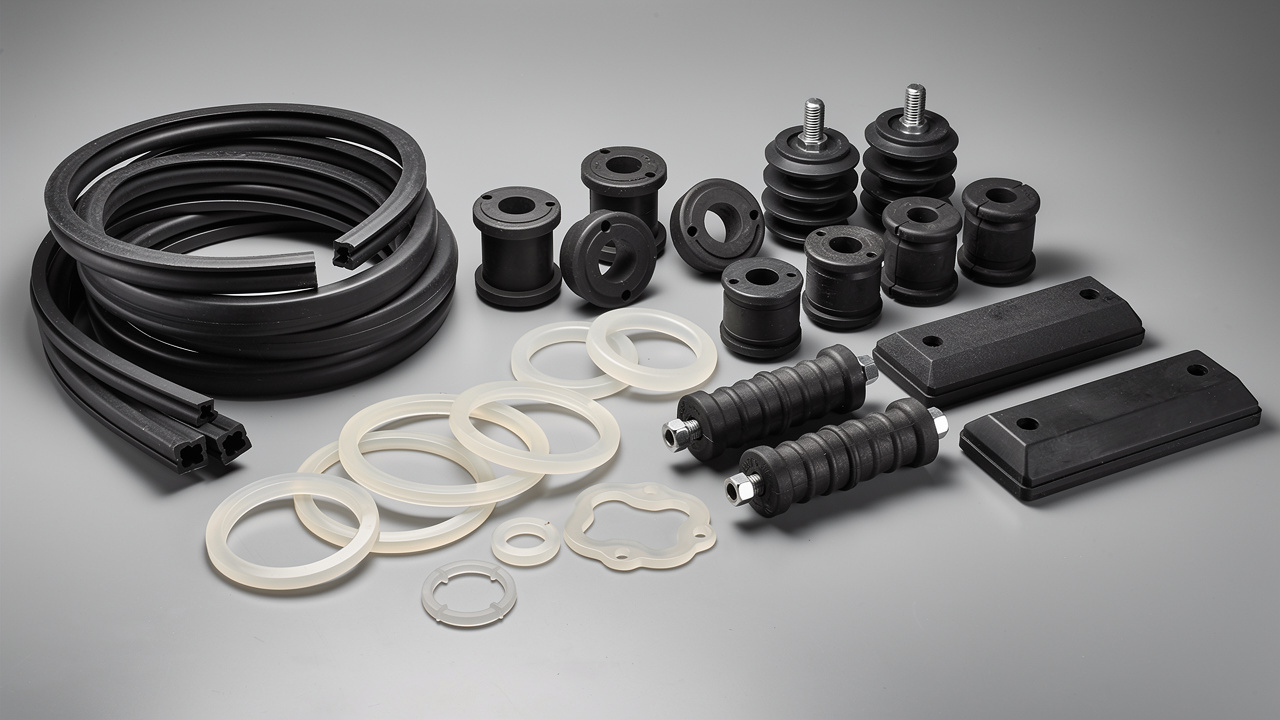
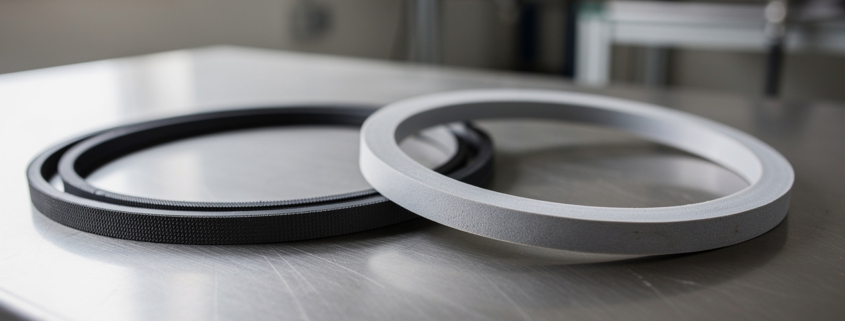
Diverse range of industrial rubber seals, gaskets and components

As a trusted rubber manufacturer, we do not think of our products as simple parts on a list. We design them as working answers to sealing, safety, and performance issues that plant managers and engineers face every day. Across all categories, we provide customization so each part fits the job, not the other way around. This is what helps us act as a true trusted rubber supplier instead of a generic source.

We provide sealing parts that protect against leaks, contamination, and pressure loss. Key products include:

  • Silicone rubber gaskets that handle temperatures up to 250°C while resisting fluids, ozone, oil, and fire, making them a strong choice for power plants, food processing, and chemical facilities
  • Rubber profiles in sponge, solid, hybrid, and co-extruded designs for windows, doors, and openings in buildings, vehicles, and machines
  • Rubber strips made from natural, synthetic, and neoprene compounds for simple yet effective sealing in panels, covers, and enclosures

Our door and gate seals use EPDM, Natural Rubber, SBR, and other blends to keep water, dust, and noise under control across industrial plants, commercial buildings, and residential projects. We also design rubber piston rings that limit gas leakage and wear inside engines and cylinders, which helps extend equipment life and maintain performance over longer operating hours. As a trusted rubber manufacturer in the Philippines, we build each of these sealing parts with long-term performance in mind, not just first-day fit.

Shock and vibration control is another key part of our work. We produce rubber bushings for automotive suspension, construction machines, industrial equipment, and marine hardware to stabilize movement and absorb impact. Our shock absorbers, rubber cushion, rectangular bumpers, rubber pads, and rubber footings help protect floors, frames, and people from repeated shocks and loud vibration. These products support safer workplaces, higher worker comfort, and longer life for motors, bearings, and structures.

We also cover specialized rubber components needed in more focused applications, such as:

  • Rubber tubing using EPDM, Neoprene, Silicone, Viton, Nitrile, and blended compounds for medical, food, and industrial lines where flexibility and chemical resistance are vital
  • Custom rubber balls, linings, and shaped parts for equipment makers that require specific sizes and performance properties
  • Rubber water stoppers for dams, tunnels, and buildings that bend with structural movement and resist corrosion, giving better long-term performance than metal stoppers

Across all these groups, we keep customization open so every client can get parts that match their exact drawings and requirements.

How We Address Critical Industrial Challenges

Rubber bushings and dampeners protecting industrial machinery components

Every plant, project site, or assembly line has its own pain points, and a trusted rubber manufacturer must help remove them, not add new ones. When we talk with plant managers, project engineers, and buyers, we focus first on what keeps them up at night. Only then do we decide which rubber parts, compounds, or designs will give the best answer.

The most common challenges we see include:

  • High temperatures and harsh chemicals
  • Persistent leaks and contamination
  • Excessive vibration, movement, and noise
  • Parts that fail early because materials are mismatched to the application

Many facilities work with extreme temperatures and aggressive chemicals. For these cases, our silicone rubber gaskets handle heat up to 250°C and resist oils, steam, and strong cleaning agents, which suits power generation, petrochemical, and food-grade systems. We also help prevent sealing failures by using well-designed rubber profiles, strips, and piston rings that keep leakage low, reduce unplanned shutdowns, and cut the need for constant maintenance work. This is where a trusted rubber manufacturer can save far more money than the basic cost of the part.

Movement and safety bring another set of challenges. In construction and water infrastructure, our rubber water stoppers provide the flexibility that metal stoppers cannot match, so joints can move without cracking. To reduce workplace hazards, our cushions and pads cut vibration and noise around heavy equipment, which supports worker safety and comfort. When clients bring in highly specific needs, we adjust sizes, shapes, colors, hardness levels, and material mixes to match those demands. We do this through close discussion, drawings, and testing, which turns us into a trusted rubber supplier and problem-solving partner, not just a catalog.

“The bitterness of poor quality remains long after the sweetness of low price is forgotten.” – Most often attributed to Benjamin Franklin

Why Industrial Leaders Choose RK Rubber Enterprise Co.

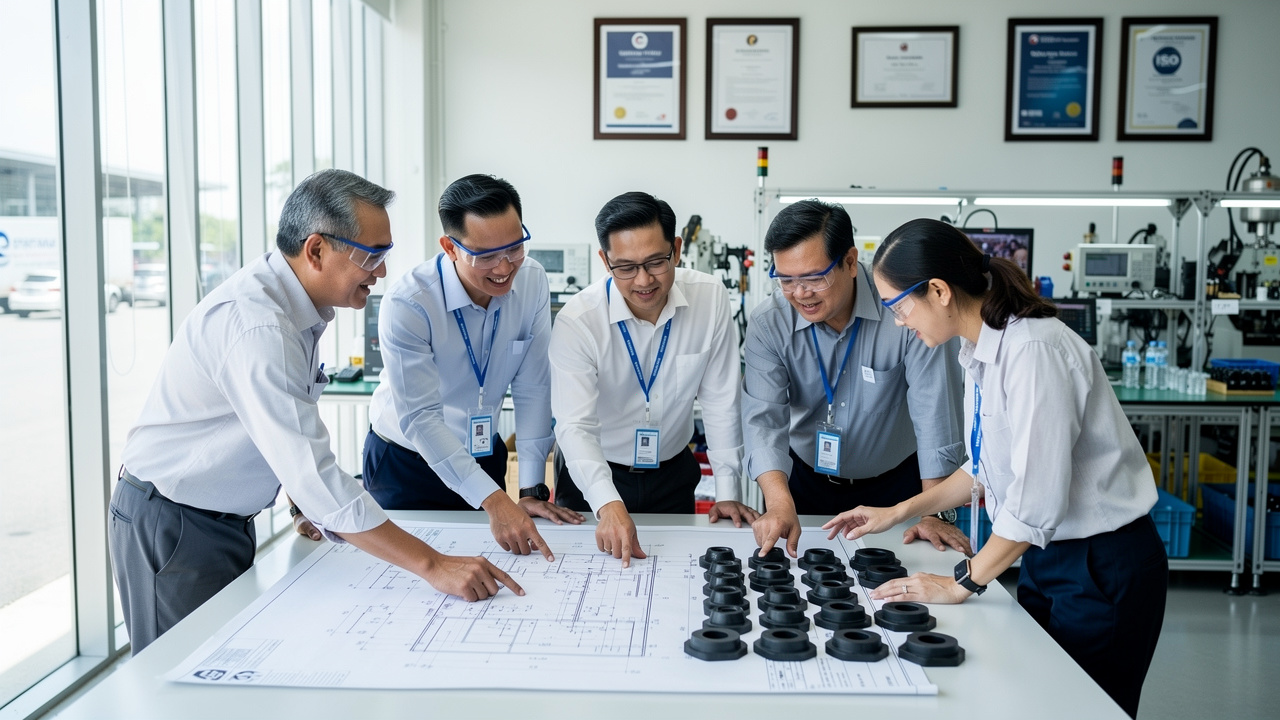
Engineering team collaborating on custom rubber component design

When we speak with industrial leaders, many say they do not want just any rubber vendor. They want a trusted rubber manufacturer that stands with them from design to installation and beyond. We built RK Rubber Enterprise Co. around that kind of relationship, so our role is closer to a technical partner than a simple vendor.

Our quality assurance is something clients can verify, not just hear in a sales pitch. We use dimensional checks, hardness tests, and visual inspections from raw material up to final packing. Our work follows ISO 9001 and aligns with international guidelines like ASTM, DIN, FDA, and RoHS, and we draw from practices used in ISO 14001 and IATF 16949 environments. This focus on system-based quality is a main reason many firms call us their most trusted rubber manufacturer and trusted supplier.

Customization is also a core strength. We adjust sizes, shapes, colors, hardness levels, and rubber compounds so that each part fits exactly what the machine or structure needs. Our team works with EPDM, Neoprene, Silicone, Viton, Nitrile, natural rubber, and blended materials, and we support both simple parts and very detailed custom pieces. By sharing our experience early in the design stage, we help clients avoid errors that can appear later during installation or operation.

At the same time, we know cost and timing matter as much as quality. Our manufacturing facility can handle large runs while still giving careful attention to custom jobs, which keeps lead times realistic and deliveries on schedule. We focus on cost-efficient quality rubber products, so clients do not have to choose between price and performance. We also follow eco-friendly and more sustainable practices in our production, and our mission is clear: satisfy and go beyond expectations through responsive support, clear communication, and lasting partnerships across the Philippines.

Conclusion

Choosing a truly trusted rubber manufacturer is one of the most important decisions an industrial buyer can make. The right partner protects uptime, keeps people safe, and guards every project budget from hidden costs that come from poor quality parts.

At RK Rubber Enterprise Co., we combine strict quality control, wide customization, and a strong customer-focused approach to act as a trusted rubber manufacturer and trusted rubber supplier for many Philippine companies. We already support automotive, construction, marine, power, water, residential, and commercial projects across NCR, Visayas, and Mindanao, and we keep pushing Philippine rubber manufacturing toward global standards.

If you want a partner that will listen, share expertise, and respond fast when requirements change, we are ready to help. Reach out to us for a technical consultation, a custom quote, or to discuss any rubber requirement for your plant or project. Let us show you how the RK Rubber difference can support your success for the long run.

FAQs

What Industries Does RK Rubber Enterprise Co. Serve In The Philippines?

We serve a wide range of industrial rubber products across the country. Our clients include mechanical engineering firms, automotive manufacturers and OEM suppliers, marine and shipbuilding companies, and operators of industrial machinery. We also support construction, power generation, and water management projects, along with aerospace, agriculture, residential, and commercial developments. From NCR to Visayas and Mindanao, we work with both large industrial plants and highly specialized applications.

How Does RK Rubber Ensure Product Quality And Consistency?

We apply strict quality control at every stage of production. Our team performs dimensional checks, hardness tests, and visual inspections from incoming raw materials to finished products. We follow international standards such as ISO 9001 along with ASTM, DIN, FDA, and RoHS guidelines. We apply a zero-defect mindset and always look for ways to improve our processes. Our manufacturing facility supports this approach and helps us deliver reliable, long-lasting parts.

Can RK Rubber Create Custom Rubber Products To My Exact Specifications?

Yes, customization is one of our strongest points as a trusted rubber manufacturer. We can adjust sizes, shapes, colors, hardness levels, and material mixes across almost all product types. Our team works closely with you to understand the application, refine the drawings, and choose the right rubber compounds such as EPDM, Neoprene, Silicone, Viton, Nitrile, natural, synthetic, or blended options. We handle both simple shapes and very complex designs. You can contact us anytime to discuss your specific requirements.

What Makes RK Rubber Different From Other Rubber Suppliers In The Philippines?

Three things stand out for our clients:

  • A strong quality commitment with strict controls and alignment with ISO 9001, ASTM, DIN, FDA, and RoHS standards
  • True customization, acting as a trusted rubber supplier that designs parts around real-world needs rather than forcing standard items into critical applications
  • Products that offer strong performance, from temperature resistance up to 250°C to durability and chemical resistance, all at competitive prices

We also follow eco-friendly production practices and work toward our vision of helping the Philippines grow as a major global exporter of rubber products. Our goal is to exceed expectations and build long-term, trust-based partnerships with every client we serve.

YEDr5uKYjOeOSC35jgRLT 1

Bonding Rubber to Concrete: Adhesives and Prep Guide

When we talk about bonding rubber to concrete, most project teams first think about the rubber’s thickness, hardness, and color. The thin layer of adhesive underneath often feels like an afterthought, until a floor tile lifts, a water stopper leaks, or a machine pad starts to creep across the slab. That is when the real cost of a poor bond shows up in downtime, callbacks, and safety risks.

Across plants, building sites, and infrastructure works, a lot rides on how well bonding rubber to concrete is planned and executed. Expansion joints, water stoppers, anti‑vibration pads, rubber flooring, protective linings, and sealing systems only deliver their design performance when the adhesive matches both the rubber compound and the concrete condition. The wrong adhesive choice, or a rushed application, can turn a high‑quality rubber component into a weak link.

At RK Rubber Enterprise Co., we see this every week. Our EPDM door seals, preformed expansion joint fillers, water stoppers, linings, and anti‑vibration pads are engineered for weather resistance, chemical resistance, and long service life. Their full value appears only when bonding rubber to concrete is done with the right adhesive and correct surface preparation. In this article we walk through the main adhesive types, the surface preparation steps we insist on, and the best practices we recommend so that every rubber component bonded to concrete works as intended for many years.

As one maintenance supervisor told us, “We almost never lose the rubber part; we lose the bond line.”

Key Takeaways

  • Three adhesive families cover most needs for bonding rubber to concrete: synthetic rubber adhesives, contact cements, and two‑component epoxies. Each has clear strengths and limits. Matching these to project conditions prevents early failures and repeated rework.
  • Good surface preparation makes or breaks a rubber‑to‑concrete bond. Cleaning, drying, and mechanical abrasion on both concrete and rubber give the adhesive a sound surface. This preparation should be treated as part of design, not a quick step before installation.
  • Contact cements give instant grip for bonding rubber to concrete on large areas. They also allow almost no repositioning once surfaces touch, so layout and alignment planning become very important. Epoxies give higher strength but need longer curing and tighter control of mixing.
  • Temperature range must match the real environment where bonding rubber to concrete is done. Adhesives have specific working and service temperature limits, and ignoring them can lead to hardening, softening, or peeling. Checking this data early prevents surprises on site.
  • At RK Rubber Enterprise Co., we support projects beyond supplying rubber parts. We share surface preparation checks, adhesive selection pointers, and step‑by‑step guidance so bonding rubber to concrete with our products is consistent, safe, and long lasting.

Understanding Adhesive Types For Rubber-To-Concrete Bonding

Different adhesive types for bonding rubber to concrete

Bonding rubber to concrete is not as simple as “glue it and forget it.” Rubber is flexible and often non‑porous, while concrete is rigid and porous. They move differently with load and temperature, so any adhesive between them has to cope with both stretching and gripping a rough mineral surface.

General construction adhesives are often not designed for this job. Water‑based VAE resin emulsions, for example, bond new concrete to old concrete very well but usually list rubber as an excluded material. To support reliable bonding rubber to concrete, we focus on three adhesive groups that handle this combination effectively when used correctly.

Synthetic Rubber Adhesives

Synthetic rubber adhesives use a blend of synthetic rubber and synthetic resin dissolved in a solvent. This mix gives a flexible bond line that moves with the rubber while still gripping the concrete surface firmly. That flexibility helps the adhesive survive vibration, impact, and temperature swings without cracking.

Key advantages include:

  • Wide material compatibility – A single product can bond natural rubber, synthetic rubber, concrete, metal, plastics, and wood, which is very helpful on mixed‑material projects.
  • Broad temperature resistance – Often covering roughly −40 °C up to about 80 °C, suitable for many conditions in the Philippines and similar climates.
  • Good fatigue behavior – The flexible bond line holds up under repeated movement, which is common in machinery mounts and expansion assemblies.

These adhesives work especially well for:

  • Industrial rubber flooring
  • Protective linings inside concrete tanks
  • Vibration‑control pads on machinery bases
  • Architectural rubber details fixed to slabs or walls

Commercial products in this category are widely available. At RK Rubber Enterprise Co., our role is to help clients pair these adhesives with the right rubber components and proper surface preparation, so the complete system performs as intended.

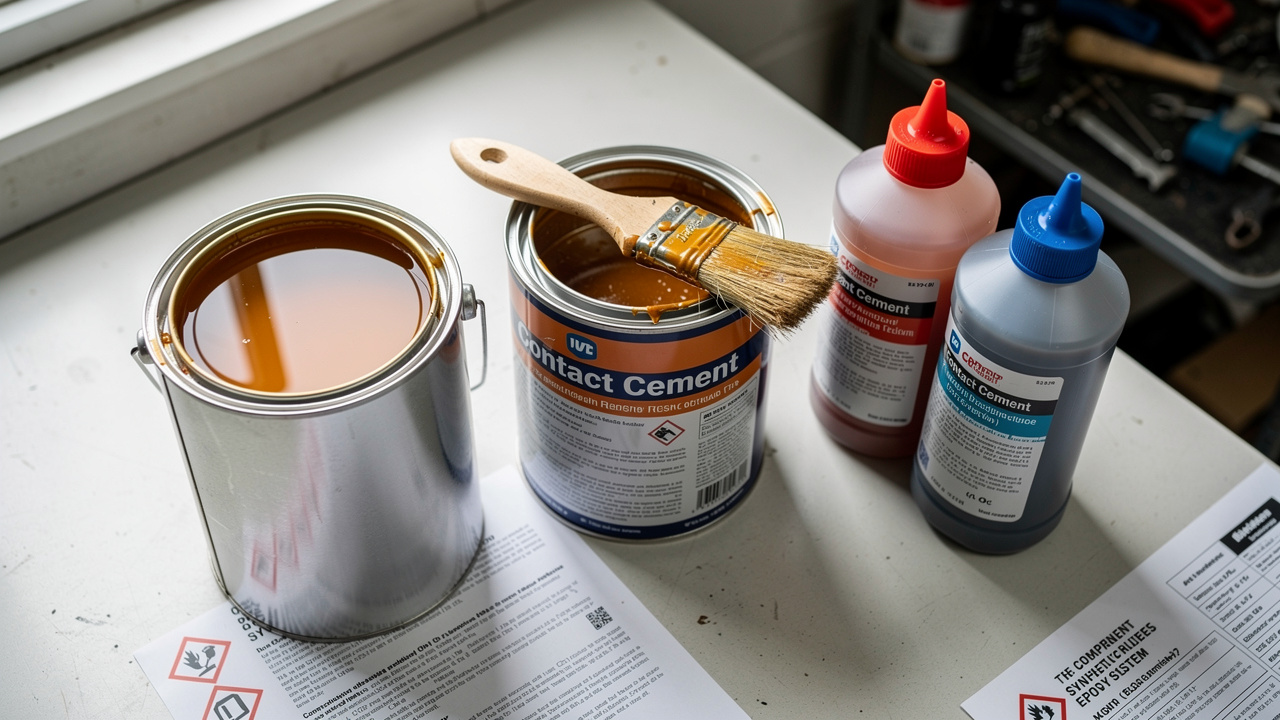
Contact Cement

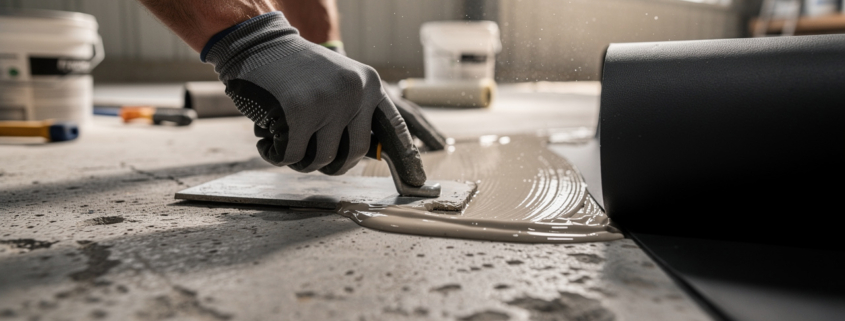
Contact cement is a neoprene‑based adhesive that creates a very fast bond when the two coated surfaces touch. For bonding rubber to concrete over large areas, such as sheets of flooring of flooring or wall linings, this instant grab can save a lot of clamping time and temporary fixtures.

The application process is different from many glues:

  • A thin, even layer is applied to both the prepared concrete and the back of the rubber.
  • The installer waits until the solvent has flashed off and the film feels dry yet tacky.
  • When the two sides meet under firm pressure, the bond forms almost at once.

Because of this, careful alignment planning is essential. There is almost no chance to reposition after contact, so installers often:

  • Use slip sheets and pull them out gradually.
  • Work from one edge and roll across the surface to avoid trapped air.
  • Mark reference lines on the slab before adhesive work starts.

Contact cements give off strong vapors with volatile organic compounds, so good ventilation and proper protective equipment are non‑negotiable during use.

Two-Component Epoxies

Two‑component epoxies consist of a resin and a hardener that are mixed just before use. Once combined, they react chemically and cure into a very strong, rigid material. For bonding rubber to concrete in heavy‑duty settings with high loads or chemical exposure, this class often gives the highest margin of safety.

Typical benefits include:

  • Very high bond strength, often greater than the tensile strength of the concrete itself.
  • Strong resistance to water, fuels, oils, and many industrial chemicals.
  • Useful gap‑filling ability, helpful when the concrete is slightly uneven or pitted.
  • Specialized grades that can cure in damp or wet conditions, valuable in water treatment plants or marine projects.

The trade‑off is that epoxies demand more discipline:

  • There is a limited pot life after mixing.
  • Full cure can take one to three days before design strength is reached.
  • Surface preparation has to be very thorough.
  • Project teams must protect the fresh bond from movement and heavy loading while it cures.

Adhesives specialists often remind installers: “Epoxy is only as strong as the surface you stick it to.”

A simple way to think about selection is:

Adhesive Type Best For Less Suitable When
Synthetic Rubber Adhesive General‑purpose bonding rubber to concrete and metals Very high chemical or temperature exposure
Contact Cement Large sheet goods, flooring, and wall linings Situations needing repositioning after placement
Two‑Component Epoxy Heavy loads, wet areas, and chemical exposure Applications needing a flexible bond line

Critical Surface Preparation For Maximum Bond Strength

Concrete surface preparation before rubber bonding

From our experience, about eighty percent of success in bonding rubber to concrete comes from what happens before the adhesive can even be opened. Adhesives only stick to what they can actually touch, so any dust, oil, moisture, or weak concrete layer becomes a future failure plane.

For this reason, we build surface preparation into our recommendations for products like preformed expansion joint fillers and water stoppers. When our high‑grade rubber meets a well‑prepared slab, the combination can work for many years under traffic, movement, and weather. When preparation is skipped, even the best adhesive and rubber struggle to perform.

A common saying among flooring installers is, “Adhesives rarely fail—dirty substrates do.”

Preparing Concrete Surfaces

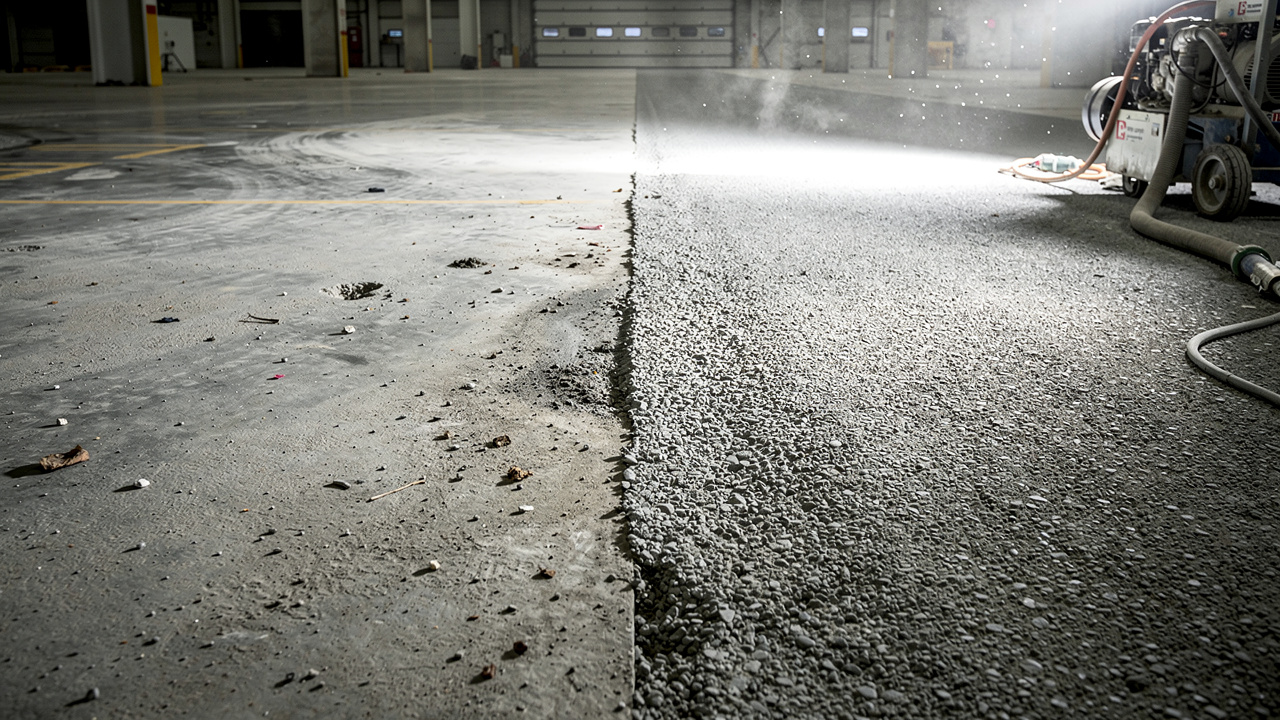
Concrete may look solid, but its surface often carries dust, laitance, oil stains, curing compounds, or old coatings. Effective preparation usually follows this sequence:

  1. Initial cleaning
    • Sweep or vacuum to remove loose particles.
    • Use degreasers where oil or grease is visible.
    • Pressure wash if compatible with the project, then allow the slab to dry.
  2. Check moisture levels
    • Many adhesives require a dry slab, not just a dry surface.
    • Simple field checks, such as taping clear plastic over the slab and looking for condensation, can reveal ongoing moisture emission.
    • New concrete usually needs at least twenty‑eight days before adhesive work starts, depending on mix and curing conditions.
  3. Create a surface profile
    • Methods such as shot blasting, diamond grinding, or scarifying remove the weak top layer and create a roughened texture that gives the adhesive a mechanical key.
    • The goal is a clean, sound, and evenly textured surface without glossy patches.
  4. Repair defects and remove dust
    • Repair cracks, spalls, and holes with suitable mortars or epoxy fillers.
    • Re‑grind repaired zones if necessary to bring them flush.
    • Finish with an industrial vacuum or oil‑free compressed air to clear remaining dust so the adhesive can wet the concrete fully.

A slab prepared this way gives any rubber‑to‑concrete bond a far better chance of long service life.

Preparing Rubber Surfaces

Rubber parts arrive with their own set of surface issues. Mold release agents, talc, and light oxidation all reduce adhesion if left untouched.

A typical preparation sequence is:

  • Solvent cleaning – Wipe the bonding face with an appropriate solvent such as acetone, MEK, or isopropyl alcohol, often using a two‑rag method so that dissolved contaminants are lifted away rather than smeared.
  • Light mechanical abrasion – For most rubber compounds used when bonding rubber to concrete, light sanding with medium‑grit paper removes the glossy skin and exposes a fresh, slightly rough surface. The aim is a uniform, dull appearance without deep scratches that could act as stress raisers.
  • Final wipe – After sanding, another careful solvent wipe removes all dust and loose particles.

Certain rubbers, such as EPDM or silicone, benefit from a primer approved by the adhesive manufacturer. This thin coating changes the surface energy of the rubber and builds a better chemical bridge to the adhesive.

At RK Rubber Enterprise Co., many of our door seals, water stoppers, anti‑vibration pads, and expansion materials use advanced compounds like EPDM, natural rubber, SBR, and neoprene. When we advise on bonding these to concrete, we always stress that good surface preparation protects their built‑in weather and chemical resistance by avoiding early debonding.

Application Best Practices And Safety Protocols

Worker following safety protocols during adhesive application

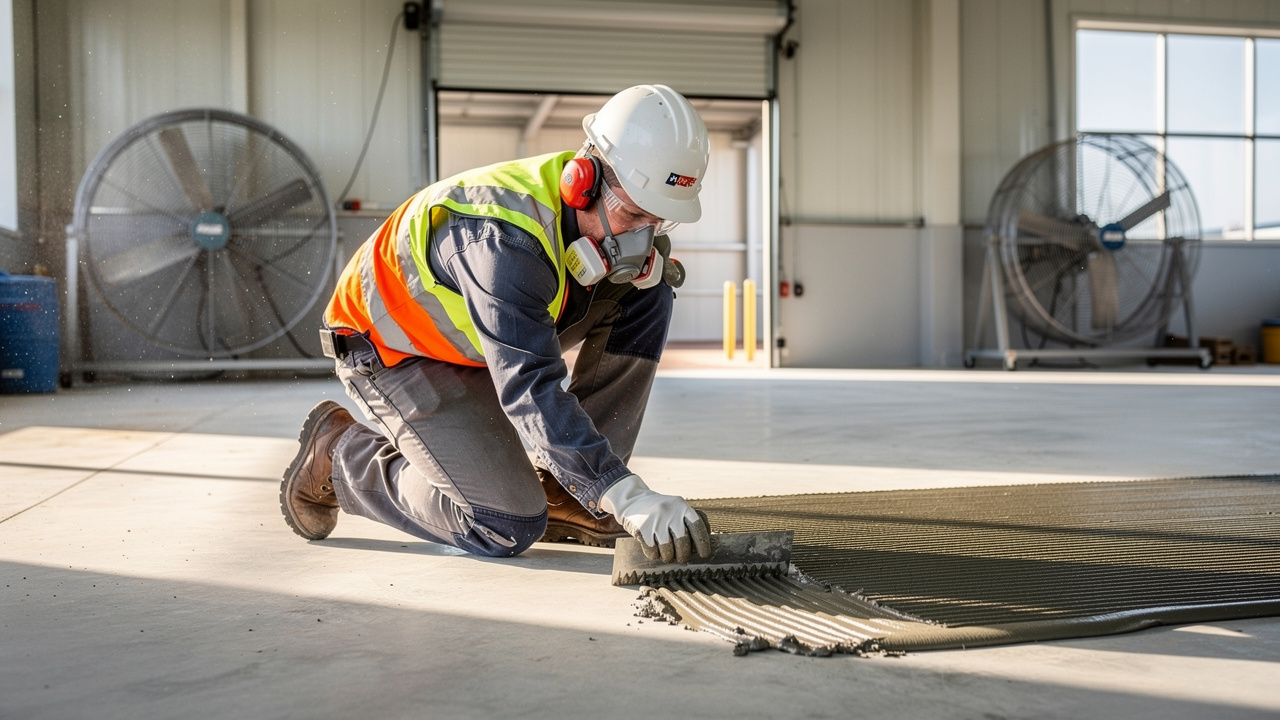
Once both surfaces are prepared, technique takes center stage. The same adhesive can perform very differently depending on how it is mixed, applied, pressed, and cured. Our team often supports engineers and contractors with simple checklists so bonding rubber to concrete becomes a controlled process rather than a guess.

At the same time, many of these adhesives involve solvents, reactive resins, and strong fumes. Safety for installers and nearby staff is a basic requirement. We always pair technical advice with clear reminders on ventilation, protective gear, and fire prevention.

Safety Requirements

  • Ventilation
    • Work areas for bonding rubber to concrete need strong airflow.
    • Open doors and windows where possible and use fans or extraction systems in enclosed spaces.
    • Good airflow helps keep vapors below harmful levels and improves drying of solvent‑based products.
  • Personal protective equipment
    • Every installer should wear chemical‑resistant gloves, safety goggles or a face shield, and suitable work clothing.
    • When fumes are present, a respirator with organic vapor cartridges protects the lungs.
    • Brief workers on correct use of PPE before work starts.
  • Fire safety
    • Solvent‑based adhesives can be highly flammable.
    • Keep open flames, welding sparks, smoking, and unprotected electrical tools away from the area.
    • Place appropriate fire extinguishers for flammable liquids nearby, and close containers as soon as each batch is applied.
  • Storage and disposal
    • Store adhesives in cool, dry locations within the temperature limits on the label and never under direct sun.
    • Keep lids tightly closed when not in use to avoid skinning and vapor build‑up.
    • Handle unused or expired material, solvent waste, and contaminated rags under local regulations, and never pour them into drains or mix with regular trash.

Step-By-Step Application Process

When installing RK Rubber products on concrete, a clear, repeatable process helps keep results consistent:

  • Using contact cement
    • Apply a thin, even coat on both the prepared concrete and the rubber. Rollers or notched trowels help control thickness over larger areas, while brushes can handle small or detailed zones.
    • Wait until the film is dry to the touch yet still tacky before bringing the two sides together with careful alignment.
    • Start pressing from one edge and work across the area to avoid trapping air. A heavy floor roller works well on flat flooring, while a hand roller or padded block helps with vertical or shaped surfaces.
    • Once contact is made, there is almost no chance for correction, so plan dry layouts and trial positioning in advance.
  • Using synthetic rubber adhesives or epoxies
    • Most synthetic rubber adhesives and epoxies are applied to the concrete only, although some systems call for priming the rubber.
    • Two‑part epoxies must be mixed in the exact ratio and within their pot life, using slow, thorough mixing that scrapes container sides and base.
    • Spread the adhesive with a notched trowel to the recommended thickness.
    • Place the rubber within the open time, with gentle sliding or pressing to achieve full contact. Use weights, clamps, or temporary fasteners if specified.
  • Curing and clean‑up
    • Curing is the quiet stage that often gets rushed in bonding rubber to concrete. Follow the manufacturer’s timing for initial set and full cure, and keep temperature within the recommended band, usually near normal room conditions.
    • Keep heavy traffic, machinery loads, or chemical wash‑downs away until full cure so the bond can reach its designed strength without early stress.
    • Wipe away excess adhesive while still soft using the recommended solvent. Cured squeeze‑out can be carefully trimmed once the bond has fully hardened.

How RK Rubber Products Excel In Concrete-Bonded Applications

EPDM rubber water stopper bonded to concrete joint

At RK Rubber Enterprise Co., our main business is manufacturing rubber components, not producing adhesives. Use of waste rubber in construction applications has grown significantly, and we design every profile, pad, and seal with a clear view of how it will behave once bonded to concrete, steel, or other substrates on site. Even so, we design every profile, pad, and seal with a clear view of how it will behave once bonded to concrete, steel, or other substrates on site. That means paying close attention to flexibility, compression set, chemical resistance, and long‑term aging.

Many of our products are intended for bonding rubber to concrete in demanding roles:

  • Preformed expansion joint fillers are supplied with clear notes on primer and adhesive use so that joints can move without losing support.
  • Rubber water stoppers in EPDM or neoprene rely on a stable bond to concrete to keep joints watertight while accommodating movement.
  • Anti‑vibration pads and customized rubber footings need firm anchoring to slabs so they can isolate machinery effectively and reduce noise.
  • EPDM door seals depend on consistent adhesion along thresholds and frames to keep out water, dust, and drafts.

We choose and compound materials for strong resistance to resistance to weather, UV, oils, and many industrial chemicals. Our ability to customize shapes and hardness helps reduce stress concentrations at edges, which also supports adhesive performance. With manufacturing under international standards such as ISO 9001 and relevant ASTM or DIN references, we aim to give project teams confidence that once bonding rubber to concrete is handled correctly, the rubber side of the system will perform reliably for many years.

Conclusion

Strong, reliable bonding rubber to concrete rests on three linked pillars. First, the adhesive type must suit the task, whether that means flexible synthetic rubber adhesive, fast‑grip contact cement, or high‑strength epoxy for heavy‑duty conditions. Second, both concrete and rubber need careful preparation so the adhesive meets clean, sound, and profiled surfaces. Third, application and curing must follow clear steps for mixing, spreading, pressing, and waiting before full loading.

When these points come together, the long‑term performance and life‑cycle cost of floors, joints, linings, and machine bases improve sharply. At RK Rubber Enterprise Co., we supply rubber components with built‑in strength, weather resistance, and chemical resistance, and we also share the practical guidance that helps installations succeed. For projects in industrial plants, buildings, infrastructure, or residential developments that involve bonding rubber to concrete, our team is ready to discuss product options, review site conditions, and support detailed installation planning.

FAQs

Question 1: What Is The Most Important Factor In Achieving A Strong Rubber-To-Concrete Bond?

From our field experience, surface preparation is the single most important factor. Both concrete and rubber must be clean, dry, and mechanically abraded so the adhesive touches solid material. Even premium products for bonding rubber to concrete fail early when applied over dust, oil, moisture, or glossy factory skins.

Question 2: Can I Use Standard Construction Adhesives For Bonding Rubber To Concrete?

General construction adhesives are often not designed for elastomeric materials. Water‑based VAE emulsions, for example, are good for bonding concrete to concrete but usually exclude rubber on their data sheets. We recommend choosing synthetic rubber adhesives, contact cements, or two‑component epoxies that are clearly formulated for bonding rubber to concrete so the bond does not peel or soften under load.

Question 3: How Long Should I Wait Before Subjecting The Bonded Rubber To Heavy Loads Or Traffic?

Handling strength from contact cement often appears as soon as the rubber is pressed into place, but full cure still benefits from about twenty‑four hours. Epoxies can need from one to three days to reach full mechanical properties, depending on the brand and temperature. Applying heavy traffic or high loads too early on bonding rubber to concrete can cause micro‑movement, which may lead to long‑term debonding.

Question 4: What Should I Do If My Concrete Surface Is Uneven Or Has Cracks?

We always advise repairing defects before bonding rubber to concrete:

  • Hairline cracks may accept flexible fillers.
  • Wider or structural cracks often need epoxy injection or engineering review.
  • Spalls and holes should be cut back to sound concrete and patched with suitable repair mortar.

After repairs, re‑profile the surface if needed, then consider a two‑component epoxy adhesive to help bridge minor remaining unevenness during the bonding step.

Question 5: Does RK Rubber Enterprise Co. Provide Adhesive Recommendations For Your Rubber Products?

We focus on manufacturing high‑quality rubber components and do not produce adhesive brands ourselves. However, our installation guides—especially for items like preformed expansion joint fillers and water stoppers—describe surface preparation, priming steps, and general adhesive types that suit bonding rubber to concrete. Our technical and sales teams work with project engineers to match professional‑grade adhesives to our rubber compounds so that the complete system performs as intended.

lTW7yu1SS0wxJaE6os2A1 1

Waste Water Treatment Seals for Corrosive Tanks

A tiny drip under a corrosive tank can look harmless at first. In wastewater plants, that drip often means the waste water treatment seals hiding inside have started to give up. By the time the leak reaches the floor, pumps, motors, tank walls, and even nearby soil or waterways may already be at risk.

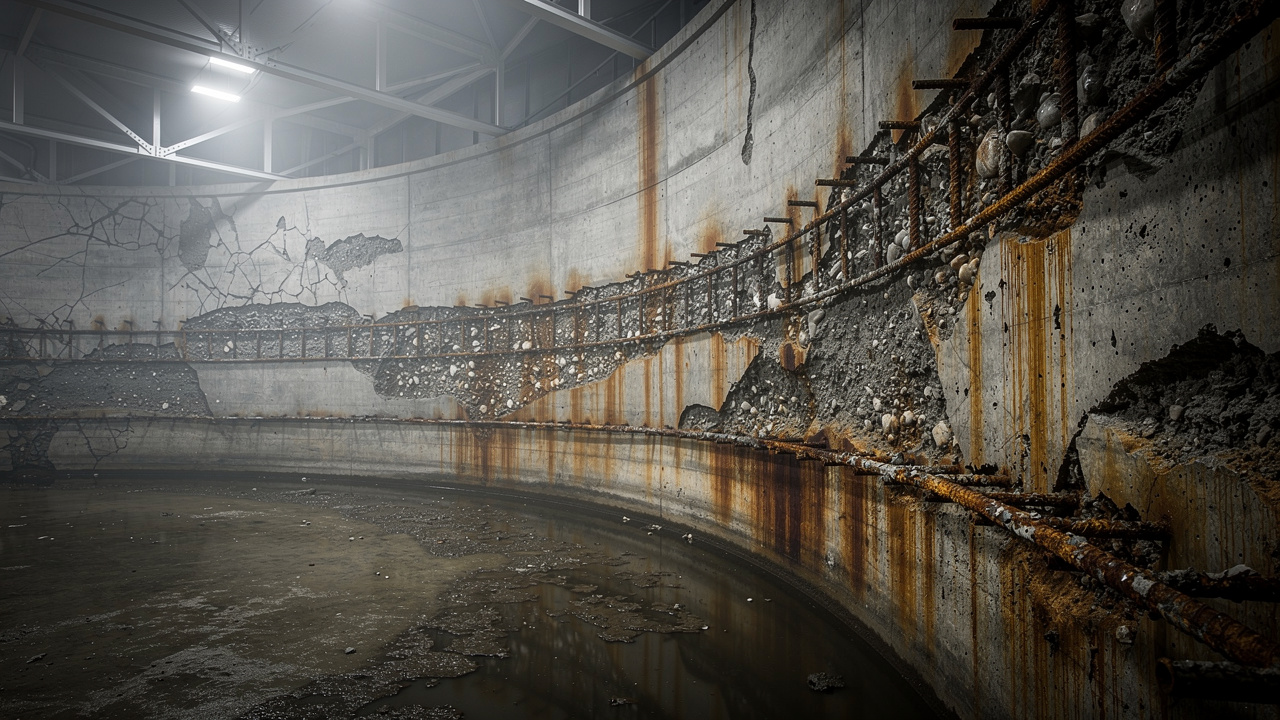
We see this often in treatment facilities that handle strong chemicals, sand and grit, and heavy biological loads. The environment around those seals is harsh every single day. Caustic soda, sodium hypochlorite, coagulants, sediment, and microbes all attack the weakest point in the system. Add tank settlement, thermal movement, and vibration from pumps, and even a well-designed plant in the Philippines can struggle to keep everything tight.

When seals fail, the effects spread fast. Progress on Wastewater Treatment globally shows that infrastructure reliability depends heavily on proper sealing and maintenance practices. Motors burn out on submersible pumps. Corrosive water eats into steel tank walls. Operators face spills, odor complaints, and possible fines for non-compliance. Emergency shutdowns and rush repairs then drive up costs far beyond the price of a set of quality waste water treatment seals.

This is why more facilities are moving from rigid metal parts to rubber-based sealing products. Properly engineered rubber seals, water stoppers, and linings give better chemical resistance, absorb movement, and protect tanks from the inside out. At RK Rubber Enterprise Co., we focus on the engineering behind those parts, not just on the material itself.

In this article, we share how waste water treatment seals work, what really destroys them in corrosive tanks, and how specialized rubber compounds handle those threats better than traditional options. We also explain how our Philippine-based team supports projects from selection to installation, so readers finish with a clear plan to improve reliability and control long-term costs.

“If you can see the leak, you are already late,” is a common reminder among experienced maintenance crews in wastewater plants.

Key Takeaways

A short summary helps put the role of waste water treatment seals into focus before going into details.

  • Waste water treatment seals face constant attack from chemicals, abrasion, and biological activity. Good design and the right rubber compound prevent leaks and protect pumps, tanks, and concrete. This protection supports safe, reliable plant operation over many years.
  • Material choice decides how long a seal will last in a corrosive tank. The same design in the wrong compound can fail in months, while a better match can last many years. Looking closely at pH, chemicals, and temperature makes that match possible.
  • Modern rubber compounds usually perform better than metal parts in wastewater tanks. Rubber does not rust, it flexes with movement, and it handles repeated loading without cracking. This combination gives fewer failures and more stable maintenance planning.
  • Investing in higher-grade seals and linings lowers total cost across the plant. There are fewer unplanned shutdowns, less emergency repair work, and longer intervals between replacements. Working with a partner that understands sealing in Philippine conditions helps turn these gains into real savings.

What Are Waste Water Treatment Seals And Why Do They Matter?

When we talk about waste water treatment seals, we mean every rubber or elastomer component that keeps liquid where it belongs inside a plant. These parts sit in pumps, tanks, and pipe joints, and they stop wastewater from leaking along shafts, through wall penetrations, and across construction joints. In corrosive tanks, they also protect steel and concrete from direct contact with aggressive liquid.

At pump level, waste water treatment seals include mechanical seal elements that sit around the rotating shaft. In submersible, dry-pit, and self-priming pumps, these components create a barrier between the process fluid and sensitive parts like bearings and motors. If this barrier opens even slightly, liquid follows the shaft, reaches the motor, and can cause fast and expensive damage.

In concrete tanks, we see another group of waste water treatment seals:

  • Rubber water stoppers are cast into joints and expansion gaps to hold back liquids even when concrete sections move.
  • Rubber linings form a continuous inner skin that protects the tank shell.
  • For special industrial connections, W-Type rubber seals compress into grooves and flanges to stop both liquid and gas leaks.

When these seals fail, the impact is rarely limited to a small drip. Motors in submersible pumps may short out. Corrosive wastewater can attack reinforcement steel in tanks and slabs. Staff face slip risks, exposure to chemicals, and difficult clean-up work. In the Philippines, where high humidity, changing wastewater chemistry, and import lead times make equipment replacement costly, keeping waste water treatment seals in good condition is a key part of plant reliability planning.

Key Challenges Of Corrosive Wastewater Environments

Corrosive damage on wastewater treatment tank walls

Wastewater treatment is one of the toughest settings for any sealing product. Every waste water treatment seal must deal with chemical attack, physical wear, microbial activity, and movement in the structure around it. Ignoring any of these factors often leads to leaks far sooner than expected.

The main stresses on seals in corrosive tanks include:

  • Chemical Corrosion
    Typical treatment chemicals such as caustic soda, sodium hypochlorite, poly aluminum chloride, and aluminum sulfate all react with certain rubbers and metals. Some elastomers swell and turn soft, others harden and crack, and metal parts can pit or rust. Because pH can swing from acidic to highly alkaline at different stages of the process, a seal may face several harsh conditions in one duty cycle. Research on the Influence of wastewater treatment processes on seal performance confirms that chemical variability is one of the primary causes of premature seal failure.
  • Abrasive Solids
    Sand, grit, and fine mineral particles are common in Philippine wastewater streams, especially where stormwater and household discharges mix. As these solids pass the seal faces in pumps or move along linings, they act like grinding paste. Over time they cut grooves into sealing surfaces and create tiny paths for liquid to escape.
  • Fibrous Material And Ragging
    Items such as so-called flushable wipes, rags, and hair tangle around pump shafts near the seal area. This build-up, often called ragging, can pull at flexible seal parts, open up seal faces, and interfere with the cooling and lubrication film between them. Once that film breaks, friction and heat rise quickly and the waste water treatment seal can fail without much warning.
  • Biological Degradation
    Modern plants use active microbes to break down organic matter. Some rubber compounds and bonding agents are sensitive to attack from these organisms. Over time they can lose strength, become brittle, or show surface cracking, especially in warm tanks common in tropical climates.
  • Structural Movement
    Dynamic conditions in the structure also put stress on static seals. Tanks settle on their foundations. Concrete expands in the afternoon heat and contracts at night. In a seismic country, small ground movements are also part of the picture. Seals at joints and penetrations must flex with this movement while still pressing firmly against concrete or steel. Without that flexibility, even a tiny shift can open a leak path along a wall or base joint.

As one senior plant engineer puts it, “We can design for chemistry, but if we ignore movement and abrasion, seals will still fail faster than the budget can cope.”

How We Address These Challenges: RK Rubber’s Specialized Sealing Products

When we design and manufacture products for corrosive tanks, we start from the real conditions our clients face, not from a generic catalog. We look at chemical lists, pH ranges, solid loads, and movement in the structure, then match each need with the right waste water treatment seals and compounds. Our goal is simple: keep the plant tight while cutting unplanned downtime.

W-Type Rubber Seals

W-type rubber seals with specialized cross-section design

Our W-Type rubber seals use a shaped cross-section that compresses evenly and holds contact pressure over long periods. This form gives several sealing lips within a single part, which helps keep both liquid and gas from passing through critical joints. We use these in industrial wastewater lines, manholes, and special connections where plant operators need high leak resistance under chemical exposure and moderate movement.

Rubber Water Stoppers

For concrete tanks and channels, we produce rubber water stoppers that sit directly inside construction and expansion joints. Unlike rigid metal strips, these flexible parts move with the concrete while still pressing against it. We commonly use EPDM or neoprene for these devices because they resist corrosion and stay flexible in wet conditions. In practice, this reduces joint cracking and minimizes leaks at wall-base and wall-wall interfaces.

Rubber Linings For Corrosive Tank Protection

Professional installation of protective rubber tank lining

Inside corrosive tanks, rubber linings act as a strong inner skin. Our EPDM linings work well where ozone, sunlight, and caustic chemicals such as sodium hydroxide are present, making them suitable for outdoor caustic tanks. Nitrile linings handle high solid loads and many oils, so they fit well in sludge handling areas and industrial waste tanks. Neoprene linings give a balanced response to heat, oil, and many common chemicals, which suits mixed-duty tanks that see changing contents. By shielding steel or concrete from direct contact, these linings slow down corrosion and extend tank service life.

Customized Rubber Products

Every plant is a bit different, so we often design custom waste water treatment seals for special flanges, manways, or equipment brands. We adjust size, shape, and compound so the part fits properly and carries the right compression when installed. Our engineering team reviews drawings and operating data, then proposes designs that match the real stresses in the field.

Advanced Rubber Compounds

Behind all these items is our material expertise. We work with EPDM for chemical and UV resistance, nitrile for abrasion and many hydrocarbons, silicone for very high or low temperatures, neoprene for balanced performance, and FKM for extreme heat and aggressive chemicals. By matching compounds to each tank’s actual chemical mix and temperature profile, we produce waste water treatment seals that stay stable longer and give plant managers more predictable maintenance windows.

To make selection easier, the table below summarizes where each compound commonly fits in wastewater plants:

Rubber Compound Best For Typical Uses In Wastewater Plants
EPDM Strong alkalis, ozone, weathering, hot water Caustic tanks, aeration tanks, outdoor channels, water stoppers
Nitrile Oils, fuels, greases, abrasion Sludge lines, industrial wastewater, oily sumps
Neoprene Moderate oils, weathering, general-purpose sealing Mixed chemical tanks, pipe gaskets, manhole seals
Silicone Very high or low temperatures, thermal cycling Hot condensate lines, special process areas
FKM Aggressive chemicals, solvents, high temperature Chemical dosing lines, high-temperature industrial waste

Choosing the right compound for each duty point is one of the fastest ways to improve seal life without changing the rest of the equipment.

The RK Rubber Advantage: Why Partner With Us

Quality inspection of custom-engineered rubber sealing products

When we work with plant managers, engineers, and contractors, we do not just supply rubber parts. We treat every project as a technical task where the right waste water treatment seals can protect both assets and budgets. That approach sets us apart from basic trading houses that only resell standard items.

We start with the specific conditions at each site, understanding Why Mechanical Seals Are vital for reliable pump operation in water and wastewater applications. Our team studies the wastewater chemistry, operating temperatures, solids content, and expected movement in tanks or structures. Then we recommend seal designs and compounds that match those conditions, instead of forcing a one-size-fits-all product into place. This focus on application details pays off in longer service life and fewer surprises.

Our background in rubber compounding gives us a strong base for those choices. We understand how EPDM, nitrile, silicone, neoprene, and FKM behave under caustic, acidic, or oily conditions, as well as under tropical heat and UV exposure in the Philippines. That knowledge helps us choose materials that hold their properties over time instead of breaking down early.

Because our products are flexible, corrosion-resistant, and able to follow structural movement, they reduce the stress on joints, penetrations, and tank walls. Many clients see lower maintenance hours, fewer emergency shutdowns, and reduced replacement orders once they switch to well-matched waste water treatment seals and linings from us.

“Seals are a small share of our capex, but they cause a big share of our downtime when they fail,” notes one operations manager from a Philippine industrial plant. “Switching to the right rubber parts turned sealing from a constant problem into something we rarely think about.”

We also support projects across their full life cycle. That means helping with material selection, advising on installation practices, and sharing maintenance tips based on field experience. Our manufacturing follows ISO 9001 quality management, and we use tested raw materials from trusted suppliers. As a Philippine-based producer, we can react quickly to design changes, urgent needs, and on-site findings without long international lead times.

Conclusion

Sealing may look like a small part of a wastewater plant, but it carries heavy responsibility. Inside corrosive tanks and pump rooms, waste water treatment seals sit between aggressive liquids and the equipment, structures, and people that must stay safe. Cutting corners at this point often leads to leaks, damaged assets, and long nights dealing with unplanned shutdowns.

Spending more attention and budget on high-grade rubber seals, water stoppers, and linings is a smart long-term choice. Flexible, chemically resistant parts handle movement, abrasion, and chemical swings far better than rigid, corrosion-prone metal items. Over time, that means fewer failures, less emergency work, and more predictable operating costs.

At RK Rubber Enterprise Co., we bring together W-Type rubber seals, engineered water stoppers, specialized linings, and custom-made products to handle the specific stresses of corrosive wastewater tanks. We combine local manufacturing in the Philippines with technical support, so our clients get parts that fit their equipment and their conditions.

If leaks, frequent seal changes, or early tank corrosion are starting to show up in your plant, this is a good time to review your sealing setup. We invite you to reach out to our team to discuss your current waste water treatment seals, share your operating data, and explore better options for long-term reliability and cost control.

FAQs

Question 1: What Makes Rubber Seals Better Than Metal Alternatives For Wastewater Tanks?

Rubber seals handle movement much better than metal parts, because they compress and flex without cracking. They also resist rust, so they do not suffer the oxidation that often shortens metal seal life. Installation is usually simpler, with fewer special tools and less surface preparation. In corrosive wastewater, a well-chosen rubber compound keeps its sealing force longer, which cuts maintenance needs and replacement frequency.

Question 2: How Do I Know Which Rubber Compound Is Right For My Specific Wastewater Application?

Choosing the right compound starts with understanding the liquid inside your tank or line. We look at pH ranges, the exact chemicals used in dosing, and the typical operating temperature, as well as UV and ozone exposure for outdoor tanks. We also consider oils, solvents, abrasion levels, and expected structural movement. At RK Rubber Enterprise Co., our technical team reviews this data and then recommends the most suitable compound, such as EPDM, nitrile, neoprene, silicone, or FKM. We are happy to provide a consultation to walk through this selection with you.

Question 3: What Is The Typical Lifespan Of Rubber Seals In Corrosive Wastewater Environments?

Service life varies with chemistry, temperature, solids content, and how the seal was installed and maintained. With a well-matched compound and good installation practice, many waste water treatment seals can run five to ten years or more. When materials are poorly matched to the chemicals, they may fail within a year or even a few months. Our engineered compounds and custom designs are intended to extend life well beyond what generic parts usually deliver.

Question 4: Can Existing Metal Seals And Joints Be Retrofitted With Rubber Products?

In many cases, yes, existing metal seals and rigid joints can be upgraded using rubber-based products. We frequently design custom rubber seals, water stoppers, and linings that fit into current flanges, joints, or tank shells without full replacement. Typical retrofit work includes sealing leaking construction joints, upgrading old metal expansion joints, and lining corroded tanks from the inside. Our engineering group can study your drawings or site conditions and advise on what kind of retrofit is practical.

Question 5: How Does RK Rubber Enterprise Co. Ensure Quality And Consistency In Your Sealing Products?

We operate under ISO 9001 quality management, which guides our processes from raw material checks to final inspection. Every batch of compound and every finished product goes through tests for chemical resistance, tensile strength, hardness, and flexibility. We work only with trusted suppliers of rubber ingredients and reinforcing materials. Field feedback from industrial clients also feeds into our design and process updates, and we stand behind our products with technical support throughout their service life.

YNmjSsk5ZJohWvQtsQI42 1

Rubber Speed Bumps vs Asphalt: A Safer, Smarter Choice

The sound of a car or forklift slamming into a hard speed bump never feels good. There is that sharp jolt, a small panic about hidden damage, and a quiet worry about what else could go wrong on site. In busy plants, warehouses, and car parks, those bumps are not just small annoyances; they are part of the safety system that guards both people and equipment.

For a long time, asphalt speed bumps were the default inside industrial yards and commercial properties. They are poured with the road, they feel solid, and at first they seem fine. Over time, the limits start to show. Asphalt is rigid and unforgiving, it cracks under heavy loads, lets water in, fades under the sun, and needs fresh paint just to stay visible. That mix leads to more vehicle wear, more tripping hazards, and more maintenance work than many teams expect.

Modern rubber speed bumps take a different path. Vulcanized rubber flexes slightly under load, spreads out the impact, and then returns to its shape instead of breaking apart. That same material science is behind the rectangular rubber bumpers, wheel guards, and donut-type bumpers we make at RK Rubber Enterprise Co. across the Philippines. In this article, we walk through why rubber outperforms asphalt for speed bumps in impact protection, durability, maintenance cost, installation, and safety, so you can decide what fits your facility best.

Key Takeaways

Here is a quick view of what sets rubber speed bumps ahead of asphalt in real sites:

  • Impact absorption: Rubber speed bumps absorb energy instead of pushing it into vehicles. That protects suspensions and tires and lowers repair risk.
  • Weather resistance: Rubber keeps its shape in heat, rain, and standing water. Asphalt can crack or soften. Rubber speed bumps stay safe and predictable longer.
  • Lasting visibility: Molded yellow stripes and glass reflectors stay bright for years. No regular repainting is needed, so visibility remains high day and night.
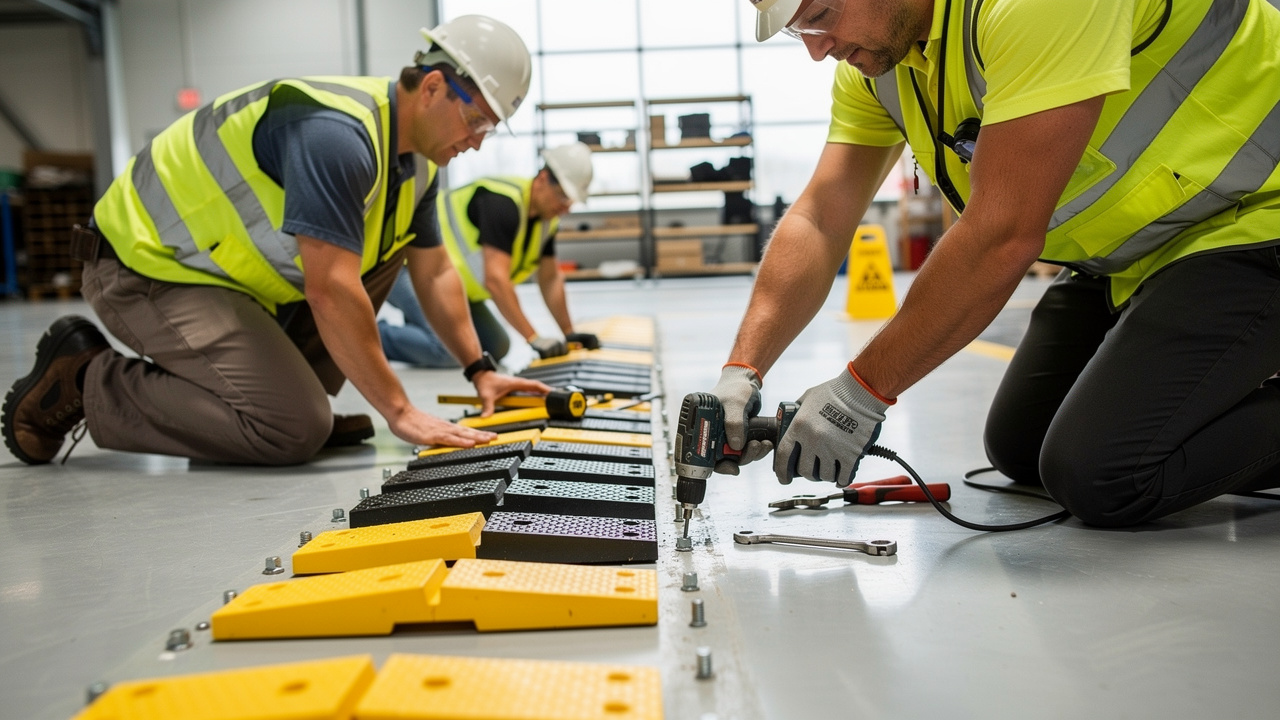
  • Simple, flexible installation: Modular rubber speed bumps install with basic bolts. In-house teams can handle the work, and layouts can change when traffic patterns change.

Superior Impact Resistance And Vehicle Protection

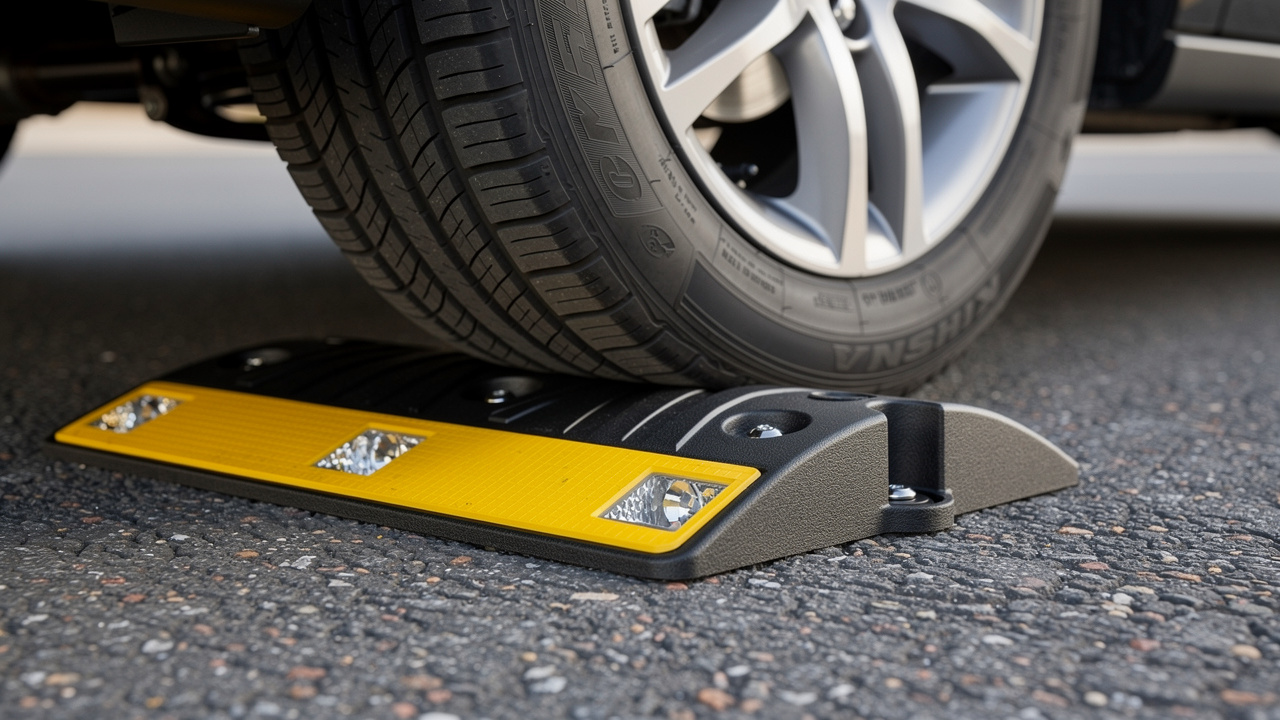
Vehicle tire contacting flexible rubber speed bump

When a vehicle rolls over an asphalt speed bump, the hard surface gives almost no movement, and research such as A Matched Case–Control Study has documented the impact forces transmitted to vehicles and their occupants. The full force of the bump travels straight into the suspension, tires, and even the load inside the vehicle. At low speeds this is already harsh, and when a driver misjudges speed, the jolt can be severe. Over months and years, that repeated shock adds up in worn parts, loose fittings, and damaged cargo.

Rubber speed bumps behave differently because of the elastic nature of vulcanized rubber. During vulcanization, the rubber compound gets cross-linked under heat and pressure, which lets it flex and then return to its original form without cracking. When a wheel hits a rubber speed bump, part of the energy is absorbed and spread across the body of the bump. The contact is still firm enough to slow drivers, but the edge is softer, so the impact on the vehicle is lower.

We see the same effect every day in our other impact protection products at RK Rubber Enterprise Co. Our rectangular rubber bumpers shield loading dock walls and truck bodies during docking. Our rubber wheel guards stop cars from hitting walls or columns and help prevent tire blowouts at the edge of parking slots. Donut-type rubber bumpers work as strong impact absorbers and even vibration dampers. The same thinking goes into rubber speed bumps, which are built to prevent massive damage and costly collisions instead of adding to them.

There is also protection for the bump itself, and federal research on Effects of Traffic Calming measures confirms that properly designed traffic calming devices reduce both vehicle damage and maintenance requirements. Asphalt corners chip away as trucks and forklifts hit them off-center, and pieces can break loose and create debris on the road. Vulcanized rubber bends slightly then recovers, so the speed bump keeps its shape even after thousands of passes each day.

To sum up the protection benefits of rubber speed bumps:

  • Less shock to suspensions, tires, and cargo
  • Fewer loose parts and repairs over time
  • Reduced debris from broken bump edges
  • More consistent impact resistance across the product’s life

Exceptional Durability And Weather Resistance

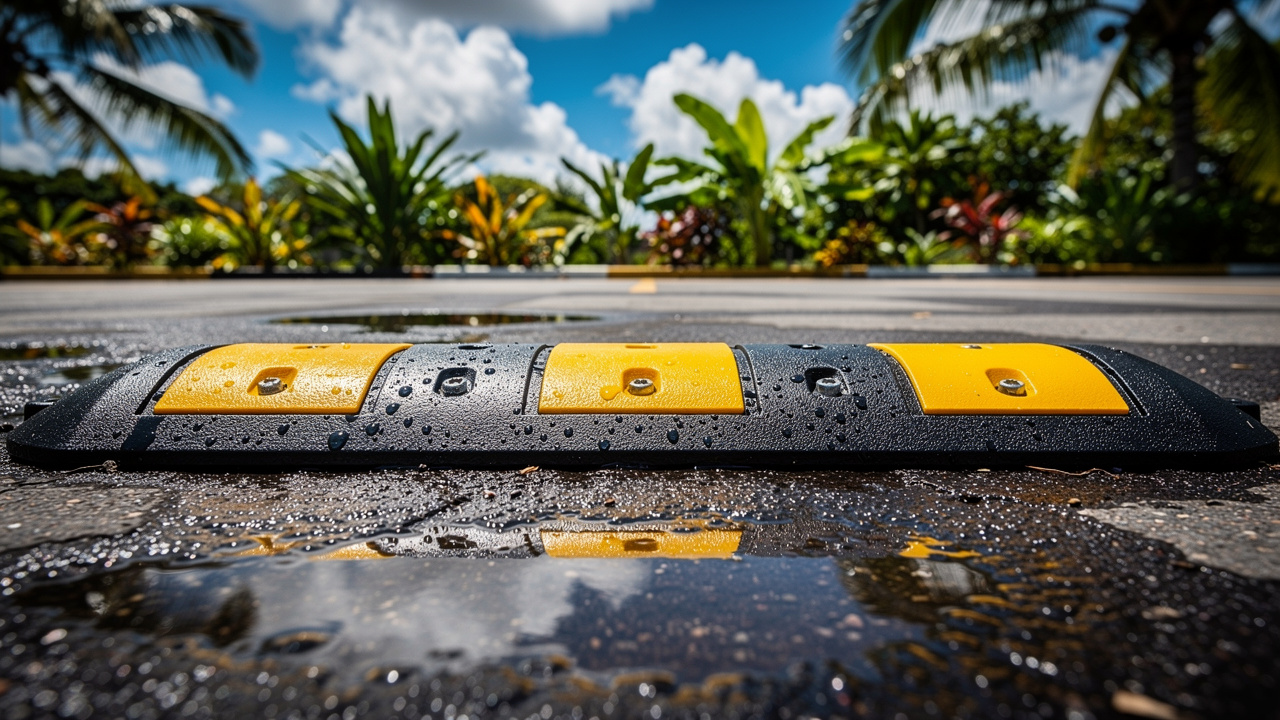
Durable rubber speed bump withstanding tropical weather

Durability starts with the material structure. Vulcanized rubber has cross-linked polymer chains that give it high tensile strength and strong elasticity at the same time. It can stretch slightly under load and then return to its shape without permanent damage. Asphalt does not have this property. Once it cracks, the damage keeps spreading as water and dirt enter the gap.

For sites in the Philippines, weather is a serious test. Common stress factors include:

  • High UV exposure that dries out standard materials
  • Very hot afternoons that soften asphalt layers
  • Sudden heavy rain and standing water in low spots
  • Oil, fuel, and chemical spills from vehicles that attack the surface

Asphalt can dry out and become brittle on the surface while the lower layer softens in heat. Rainwater seeps in, and over time the bump crumbles or sinks. Oil and chemicals speed up wear even further.

Rubber speed bumps from RK Rubber Enterprise Co. use high-grade compounds such as EPDM, natural rubber, and synthetic blends that resist these stress factors. EPDM, for example, is known for good resistance against tear and wear, and it stays stable under sun, ozone, and moisture. The result is a traffic calming product that does not crack under temperature swings, does not absorb water, and does not react badly to the usual oils and chemicals around industrial yards.

Unlike metal parts, rubber speed bumps do not rust, and unlike concrete or asphalt, they do not break apart into sharp pieces. Shape, height, and profile stay consistent for many years, which means the slowing effect stays consistent as well. For plant managers planning long term, this steady performance makes rubber speed bumps a practical base for site traffic control.

Reduced Maintenance Costs And Long-Term Value

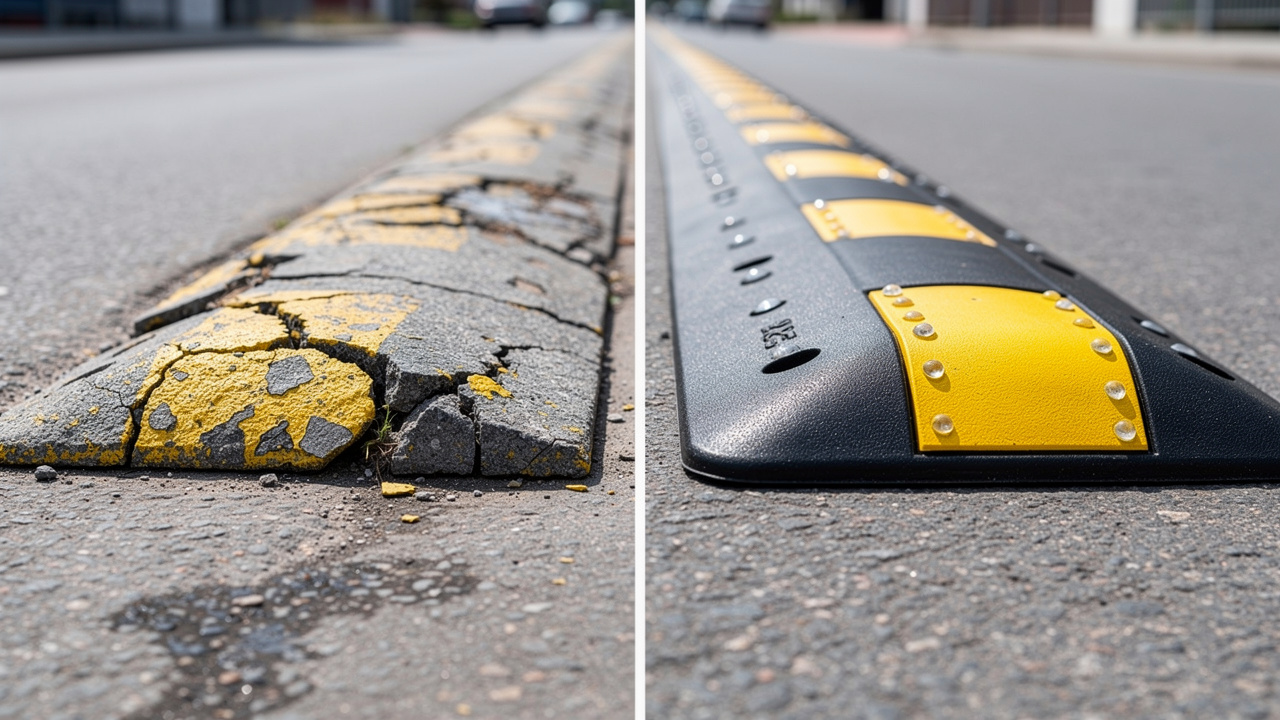
Rubber and asphalt speed bump maintenance comparison

Every asphalt speed bump comes with a hidden service plan. It needs:

  • Regular checks for cracks along the edges and surface
  • Early patching before pieces break off and create hazards
  • Frequent repainting of the yellow or white stripes that drivers rely on
  • Possible grinding and full replacement when the bump deforms or sinks

These tasks take time from the maintenance team, interrupt traffic, and pull budget away from other needs.

Rubber speed bumps have a much lighter upkeep profile. At RK Rubber Enterprise Co., we mold high-visibility yellow EPDM stripes directly into the black rubber body. They are not just painted on the surface, so they do not peel or fade quickly. Many models also include embedded glass reflectors, which pick up headlights and signal the bump clearly at night without extra lights or extra paint. Cleaning is usually as simple as normal sweeping or washing of the lane.

When we compare the full life cycle, a rubber speed bump may cost more than an asphalt bump on day one, but the numbers change fast over the years. There is no repainting every few months, no crack sealing, and far fewer emergency repairs when a piece breaks loose. The bump keeps doing its job, and budgets become easier to plan because there are fewer surprise fixes. For many facilities, that long-lasting performance and extended life span turn rubber into the lower-cost choice over the full period of use.

A simple comparison looks like this:

Aspect Rubber Speed Bumps Asphalt Speed Bumps
Initial Installation Cost Moderate Often lower
Paint And Markings Molded stripes, rarely need attention Regular repainting required
Structural Repairs Rare, usually limited to hardware checks Patching, crack sealing, or full replacement
Typical Service Disruption Short, for bolt checks or cleaning Longer closures for repair and curing
Total Cost Over Years Tends to be lower due to reduced maintenance work Tends to be higher because of repeated repairs and paint

Easier Installation And Operational Flexibility

Workers installing modular rubber speed bump sections

Installing asphalt speed bumps is a project by itself. It calls for cutting or shaping the road surface, bringing in hot mix, using heavy compaction tools, and then waiting for proper curing time. During this work, lanes often need to be closed, and once the asphalt is in place, the location is more or less fixed. If traffic patterns change, removing or shifting an asphalt bump can be expensive.

Rubber speed bumps follow a much simpler method. They come in modular sections with middle parts and end caps, so the length can match different lane widths and site layouts. Our products at RK Rubber Enterprise Co. are fixed to existing concrete or asphalt with anchor bolts and basic hand tools. In many cases, an in-house maintenance team can complete the work in a short window without bringing in outside road contractors.

A typical installation on an existing surface involves:

  1. Marking the location and checking clearances.
  2. Laying out the rubber speed bump sections and end caps.
  3. Drilling holes into the road surface through the pre-formed holes.
  4. Installing expansion anchors or mechanical bolts.
  5. Tightening hardware and checking alignment before reopening the lane.

That modular design also gives sites more freedom over time. If a new gate opens, if truck routes change, or if a construction phase needs temporary clear space, rubber speed bumps can be removed, reconfigured, or relocated. With our customization options and quick turnaround times, we can match dimensions, profiles, and layouts to the needs of your plant or property without long delays.

Improved Safety Features For Comprehensive Protection

Reflective rubber speed bump visible at night

Good speed bumps must slow vehicles and still keep drivers and pedestrians safe around them, and studies like the Temporary Speed Hump Impact evaluation have measured how different speed control devices affect vehicle behavior and safety outcomes. Rubber speed bumps are built with this in mind from top to bottom. The black base with molded yellow stripes gives strong contrast in daylight, while glass reflectors return headlight beams at night so drivers can see the bump early and reduce speed in time.

The surface of quality rubber speed bumps also offers better grip compared to smooth asphalt or painted concrete. This non-slip texture helps tires maintain contact, which is important when roads are wet and when forklifts carry tall or fragile loads. Tapered end caps give a smoother ramp on and off the bump, which makes life safer for cyclists, motorcyclists, and pedestrians stepping nearby. At RK Rubber Enterprise Co., we design our traffic calming products to support company safety programs, reduce tripping risks, and lower the chance of sudden, harsh impacts that lead to incidents.

As a common safety saying puts it, “Safety doesn’t happen by accident.”
Well-placed rubber speed bumps are one of those quiet controls that prevent incidents before they start.

By combining high visibility, reliable grip, and predictable slowing, rubber speed bumps help drivers form safer habits in busy internal roads, loading areas, and car parks.

Conclusion

Rubber speed bumps give plants, warehouses, and commercial sites a clear edge over old-style asphalt bumps. They absorb impact instead of sending it straight into vehicles, stand up better to heat and heavy rain, need far less maintenance, and can be installed or moved with much less disruption. Added features such as molded stripes, reflectors, and tapered ends support safer driving and walking around busy areas.

Asphalt has played its part, but material technology has moved on. With the right rubber speed bumps in place, traffic calming becomes a solid safety investment and a smart financial choice. At RK Rubber Enterprise Co., we combine quality rubber products with practical technical support, so teams avoid common mistakes and pick the right design for each site. If you are planning to upgrade speed control in your plant, car park, or project, we are ready to discuss options, share our experience, and help you choose a setup that protects people, vehicles, and your budget for years.

FAQs

Question 1: Are Rubber Speed Bumps Strong Enough For Heavy Industrial Vehicle Traffic?

Yes, high-quality rubber speed bumps handle heavy trucks, trailers, and forklifts. Vulcanized rubber spreads the load and avoids brittle cracking seen in asphalt bumps. Our products already serve busy industrial yards across the Philippines with steady day-to-day use.

Question 2: How Long Do Rubber Speed Bumps Typically Last Compared To Asphalt?

With normal use, well-made rubber speed bumps can serve seven to ten years or more with very little work. Asphalt bumps often need major repair or full replacement within three to five years. Our weather-resistant and corrosion-resistant compounds help rubber keep both form and function over that longer period.

Question 3: Can Rubber Speed Bumps Be Installed On Existing Asphalt Or Concrete Surfaces?

Yes, rubber speed bumps work very well on both asphalt and concrete roads. Installation usually uses expansion anchors drilled into the existing surface. Surface preparation is simple compared to forming new asphalt bumps, and our team can guide your staff through each step.

Question 4: Do Rubber Speed Bumps Work Effectively In The Hot, Humid Philippine Climate?

They are very well suited to local conditions. Rubber compounds used by RK Rubber Enterprise Co., including EPDM and selected synthetic blends, resist UV rays, heat, and moisture. Unlike asphalt that can soften in high heat and break down in humidity, our rubber speed bumps keep their shape and slowing power through sun, rain, and standing water.

Question 5: What Makes RK Rubber Enterprise Co.’s Speed Bump Options Different From Standard Choices?

We focus on strong materials, practical designs, and real support instead of one-size-fits-all products. Our range covers rubber speed bumps, wheel guards, and rectangular bumpers, so sites can protect lanes, walls, and loading areas as a complete system. With customization, fast lead times, and local technical help, we act as a long-term partner for plant safety rather than just a supplier.

Y6AYezS9vgqL4CKEtCRak 1

Industrial Flood Seals for Reliable Warehouse Protection

Introduction

The first time we watched a warehouse floor vanish under brown floodwater, what shocked us was not the depth but the speed. In minutes, pallets, cartons, and machinery went from safe to scrap. Since then, we have treated industrial flood seals as seriously as any forklift or conveyor on site.

Across the Philippines, stronger typhoons, monsoon rains, and poor drainage keep putting warehouses at risk, with flood damage and infrastructure vulnerability becoming increasingly documented concerns. Once water reaches a loading dock or roll-up door, losses escalate fast: damaged inventory and racking, corroded equipment, long shutdowns, and safety issues for staff. Insurance may pay for part of the damage, but it does not repay lost production days or shaken client trust.

Heavy-duty rubber seals sit at the heart of any practical flood barrier. Steel and concrete carry the load, yet it is the rubber that closes the last few millimeters where water loves to sneak through. For each project we focus on door seals, water stoppers, and gate seals that can handle high water pressure, building movement, and harsh Philippine weather.

At RK Rubber Enterprise Co., we do more than manufacture rubber parts. We help clients avoid design mistakes that only show up during the first real storm. This guide explains how industrial flood seals work, which rubber compounds to choose, where to use them in warehouses, and how to deal with leaks and material failure so you go into the next rainy season with far more confidence.

Key Takeaways

Before we dive into the details, here is the big picture of how industrial flood seals support warehouse protection.

  • Heavy-duty rubber door seals, water stoppers, and gate seals form the active edge of a barrier at doors, ramps, and gates. They close small gaps that rigid materials cannot, so floodwater cannot creep through weak points.
  • Material choice directly affects performance and service life in the Philippines. EPDM resists sun, rain, and ozone, neoprene handles oil and fuel, while natural rubber offers high elasticity in protected zones. A poor material match shortens seal life and raises maintenance costs.
  • Custom sealing profiles usually work better than generic strips when floors are uneven, spans are wide, or joints are complex. Shaping the seal to the exact gap and frame improves installation and long-term reliability, especially in older buildings and retrofits.
  • Industrial flood seals perform best as part of a complete flood plan with barriers, drainage, and regular maintenance. When seals are inspected, cleaned, and replaced on schedule, they stay soft and responsive, which reduces the chance of failure during a strong storm.

Understanding Industrial Flood Seals For Warehouse Protection

When we talk about industrial flood seals, we mean the rubber components that sit between a flood barrier and the structure. They run along the bottom and sides of door frames, gates, and concrete joints, and they compress tightly when a barrier closes so water cannot pass through the contact surface.

There is a clear difference between static and dynamic sealing. Static seals sit on gaps that barely move, such as cast-in joints between concrete slabs. Dynamic seals work on parts that move every day, like swinging gates, sliding doors, and demountable panels. Flood seals in warehouses often have to cope with both, while still working as the building settles over time.

Rubber outperforms metal and many plastics in this role because it compresses, rebounds, and resists corrosion. Under hydrostatic pressure, water pushes against every millimeter of a barrier. A good rubber profile turns that pressure into a tighter seal by spreading contact across a wider area. At RK Rubber Enterprise Co., we group our products for these tasks into three main types: rubber door seals, rubber water stoppers, and rubber gate seals, which work together to keep warehouses dry.

Types Of Heavy-Duty Rubber Seals For Flood Barriers

For warehouse flood mitigation, we rely on several kinds of heavy-duty rubber seals matched to specific parts of the building. One profile may be ideal for a personnel door, while another suits a wide gate or buried joint. Pairing the right seal with the right barrier means the system performs under real flood conditions, not only on paper.

Rubber Door Seals

Heavy-duty rubber door seal compression detail

Rubber door seals protect the many smaller openings that often become early leakage paths. We design these as compression profiles along the door perimeter and threshold, so they press firmly when the door closes and create a continuous contact line on all sides.

Beyond blocking water under moderate to high levels, these seals also soften door impact and cut noise in busy warehouses. For the Philippine climate, we use compounds that resist sun, heat, and humidity so they do not crack or harden. Typical applications include personnel doors, dock access doors, and emergency exits, often combined with demountable panels that staff install when a flood warning is issued.

Rubber Water Stoppers

Rubber water stopper in concrete expansion joint

Rubber water stoppers protect hidden joints inside concrete and structural work. Buildings move a little over time because of settlement, temperature change, and even small earthquakes, and rigid fillers dislike that movement. Flexible water stoppers bridge these joints and keep a tight seal even when concrete on each side shifts.

For this role we often use EPDM or neoprene, which combine flexibility with strong resistance to chemicals and corrosion. Water stoppers can be embedded in fresh concrete during construction or installed as surface-mounted rubber strips during upgrades. They are especially important at expansion joints, cold joints between pours, and the base of ground-level barriers, where repeated movement can cause rigid materials to crack.

Rubber Gate Seals

Industrial gate with rubber seal for flood protection

Rubber gate seals handle wide openings where both water pressure and span are high: large driveways, perimeter flood gates, and tall demountable systems. These seals have extended contact surfaces that spread compression over a broad area, which helps them resist strong hydrostatic pressure without tearing or rolling out of place.

We manufacture gate seals in EPDM, natural rubber, or neoprene, based on expected water height and chemical exposure from trucks, fuel, or industrial liquids. In warehouses and plants, they are integrated with swing-gate barriers and demountable panels across loading yards. Because they can also contain liquids inside an area, they support both flood protection and chemical spill control.

“The seal profile is only a few centimeters wide, but it decides whether a barrier holds or leaks,” as one of our senior project engineers likes to remind clients.

Material Selection: Choosing The Right Rubber Compound

Different rubber compounds for flood seal applications

Choosing the right rubber compound is one of the most important steps when planning industrial flood seals for a warehouse. The wrong material may look fine at first but can harden, crack, or swell long before the barrier reaches its expected service life.

We commonly work with EPDM, natural rubber, SBR, and neoprene:

  • EPDM suits outdoor door and gate seals because it resists strong sunlight, ozone, and rain.
  • Natural rubber offers excellent elasticity and grip for sheltered areas with high mechanical wear.
  • SBR works well where abrasion is high but exposure to oils is low.
  • Neoprene is preferred near fuel, lubricants, or harsh cleaners because it resists many oils and chemicals better than EPDM.

Key properties we check include tensile strength, tear and abrasion resistance, compression set (how well the rubber springs back after long compression), and chemical resistance. Compatibility with concrete, steel, aluminum, coatings, and adhesives also matters, since a reaction with nearby materials can shorten seal life.

At RK Rubber Enterprise Co., we use high‑grade compounds and guide clients through these choices, balancing up-front cost with long service life and fewer replacements.

Strategic Applications And Customization For Warehouse Facilities

No two warehouses in the Philippines are exactly the same, so industrial flood seals must match real site conditions, not just drawings. We usually start with a site assessment, looking at floor levels, nearby waterways, past flood lines, and weak entry points. From there we define target water height, opening spans, and how daily operations move through each area.

Loading docks and cargo bays get special attention because they see the most traffic. A common setup is demountable barrier panels across the dock opening, with heavy-duty rubber door or gate seals along edges and floors. Seals must compress enough to stop water yet still allow quick installation and removal so trucks can keep moving outside flood alerts.

Basement entries and underground storage may use automatic flip-up barriers with molded seals that sit flush in the floor and frame, staying out of the way until water arrives. Low-lying or coastal sites also need perimeter protection at vehicle and pedestrian gates, where wide gate seals and water stoppers follow driveway slopes and tie into concrete walls.

Thanks to broad customization capacity at RK Rubber Enterprise Co., we can adjust profile dimensions, compounds, and mounting methods for both new projects and retrofits so flood protection supports, rather than disrupts, daily operations.

Addressing Common Challenges In Warehouse Flood Protection

After many projects, we keep seeing the same warehouse flood issues. Well-designed industrial flood seals can solve much of this, as long as they reflect real conditions on site.

One concern is leakage under high pressure. To keep this under control, we design seal profiles that build higher contact pressure as water pushes harder on the barrier. Careful control of material hardness and profile shape helps the seal compress enough without cutting or folding, so leakage stays low and predictable.

Another problem is material degradation from heat, sun, salt air, and chemicals. We counter this by using EPDM and neoprene compounds with strong weather and chemical resistance, rather than low‑grade materials that crack or swell after a few seasons.

Building movement is a third issue. Concrete slabs and steel frames shift with settlement and temperature, which can break rigid seals. Our rubber water stoppers and flexible profiles stretch and compress with that movement while still blocking water.

As one warehouse manager told us after a major storm, “The barrier looked solid, but the rubber made it work. Without the seals, the water would have walked straight in.”

Clear installation instructions and, when needed, custom profiles also help contractors fit seals correctly the first time, avoiding gaps and material clashes that shorten service life.

Conclusion

Floods in the Philippines do not wait for project schedules, but careful planning can keep a warehouse ready when water rises. Heavy-duty rubber seals at doors, gates, and joints turn rigid barriers into tight, reliable industrial flood seals that protect stock, machinery, and electrical rooms and help reduce downtime during strong weather.

Custom, high‑grade rubber sealing systems usually perform far better than generic strips or trial‑and‑error fixes. By matching compounds, rubber profiles, and mounting details to each opening, you can cut leakage, extend service life, and lower the real cost per year of protection.

At RK Rubber Enterprise Co., we combine ISO 9001‑based quality control with local knowledge of Philippine sites and weather. If you manage a warehouse, plant, or commercial facility, our team is ready to review your site and recommend practical industrial flood seals so you can face the next rainy season with confidence.

FAQs

Before closing, we want to answer some of the questions we hear most often about industrial flood seals for warehouses and similar facilities.

Question 1: What Is The Difference Between EPDM And Neoprene Rubber Seals For Flood Barriers?

EPDM rubber offers excellent resistance to sunlight, ozone, and rain, so it is usually the first choice for outdoor door and gate seals. Neoprene handles contact with oils, fuel, and many chemicals better, while still giving reasonable weather resistance. For most external industrial flood seals we suggest EPDM; near fuels, oils, or chemical handling we often move to neoprene.

Question 2: How Long Do Heavy-Duty Rubber Flood Seals Typically Last?

Service life depends on material quality, exposure, and maintenance, but well-specified industrial flood seals can last many years. Strong sunlight, frequent chemical contact, and heavy mechanical wear shorten that life, while protection from these factors extends it. We always recommend regular inspection so seals can be replaced before their performance drops during a flood event.

Question 3: Can Rubber Seals Be Customized For Existing Warehouse Flood Barrier Systems?

Yes. We regularly design custom rubber profiles to fit existing gates and barrier frames. We begin with measurements, drawings, or site photos to study current gaps and fixing methods, then adjust profile shape and compound so the new industrial flood seals fit the old hardware while giving better sealing performance.

Question 4: How Do Rubber Seals Accommodate Building Movement Without Losing Effectiveness?

Rubber has natural elasticity, so it stretches and compresses with small shifts in the structure and then returns to its original shape. Our water stoppers and flexible profiles are shaped to allow controlled compression and expansion across joints and interfaces. Rigid materials tend to crack or pull away when a slab moves; a well‑designed rubber seal continues to block water and greatly reduces the chance of joint failure during a flood.

DgHuy1bvWH8lgEqKSke3C 1

Vibration Isolators for HVAC Systems in the Philippines

Picture a new commercial tower in Metro Manila where everything looks perfect on opening day. After a few months, complaints start to pile up about humming ceilings, rattling windows, and an odd buzzing in corner offices. The HVAC equipment on the roof runs within its rated capacity, but without proper vibration isolators, every start and stop sends tiny shocks through the structure.

Those small vibrations do more than annoy tenants. They stress motors and bearings, loosen connections, crack concrete over time, and even drag down energy efficiency. Instead of running smoothly, chillers and air handling units fight against misalignment and extra friction. Maintenance teams chase leaks and noisy fans, and the equipment wears out years ahead of schedule.

We see this pattern again and again when vibration control is treated as an optional add‑on instead of part of the HVAC design. With the right vibration isolators under each unit, movement stays where it should be – inside the machine – instead of spreading into beams, floors, and walls. That means longer service life, fewer breakdowns, and lower power bills. It also supports compliance with the Philippine Electrical Code (PEC) and NFPA 110, which already recognize how serious vibration can be, especially for emergency power systems.

In this article, we walk through what vibration isolators are, why HVAC systems depend on them, how to choose the right type, and how proper isolation improves efficiency and lifespan. We also share how we at RK Rubber Enterprise Co. support projects across the Philippines with anti‑vibration pads, mounts, and spring isolators built for local conditions.

Key Takeaways

Before we go deeper, it helps to see the main points in one place. These highlights show why vibration control should stand beside capacity and efficiency in every HVAC design and upgrade plan.

  • Proper vibration isolation can extend HVAC equipment life by one‑third or more, often around thirty to fifty percent. That longer life means fewer replacements, less scrap, and more predictable capital planning over many years.
  • The Philippine Electrical Code and NFPA 110 call for vibration isolators on emergency power systems. When mechanical rooms combine generators and HVAC equipment, this guidance reinforces the need for proper isolation across the whole setup.
  • Elastomeric and spring vibration isolators work best in different ranges of speed and weight. Matching type and rating to actual equipment data is the key to quiet, stable, and efficient operation.
  • RK Rubber Enterprise Co. provides a wide range of products, from anti‑vibration rubber pads to engineered metal‑bonded mounts and spring units. This mix allows us to match the isolator design to each chiller, fan, or cooling tower instead of using a one‑size‑fits‑all part.
  • Placing vibration isolators between the HVAC equipment and the foundation blocks vibration paths into the structure. This setup cuts noise, protects the building frame, and helps nearby sensitive equipment run correctly.

What Are Vibration Isolators And Why Do HVAC Systems Need Them?

Vibration isolators are engineered parts that sit between a vibrating machine and the structure that supports it. In simple terms, they act like a rubber pads, so the equipment can move slightly without sending that motion straight into beams, slabs, or steel frames. For HVAC systems, these parts are usually rubber‑based mounts, pads, or steel springs designed to work at specific loads and frequencies.

Chillers, air handling units, compressors, and cooling towers all create vibration as motors turn and fans spin. That movement tries to travel from the equipment base through anchor bolts into floors, walls, and columns. Once inside the structure, it spreads out, often showing up as noise or a faint shake far from the machine room.

HVAC equipment needs isolation for three main reasons:

  1. We protect the equipment itself. Vibration isolators lower the stress on motors, bearings, and compressor assemblies, which reduces misalignment, premature wear, and sudden failures—a principle supported by research on mitigation of structural vibrations in mechanical systems. With less mechanical shock, components keep their factory clearances longer, so the units stay closer to original performance.
  2. We protect the structural frame. Repeated vibration loads create tiny cycles of stress in concrete and steel. Over time, this can grow from hairline cracks into visible damage around bases and supports. Proper isolation keeps these pulses away from the structure, which helps maintain long‑term strength.
  3. We protect comfort and quiet inside occupied spaces. Without isolation, structure‑borne vibration turns into noise that travels through slabs and walls. Offices, hotel rooms, and hospital wards can all hear or feel the equipment even several floors away.

“Vibration is one of the most common causes of premature failure in rotating machinery.” — Common teaching in mechanical and rotating equipment design

Industry bodies such as EGSA and NEIS warn against bolting heavy HVAC units directly to floors or pedestals. We follow the same principle and treat vibration isolators as a standard design item, not an afterthought.

The Hidden Costs Of Poor Vibration Control In HVAC Systems

Poor vibration control rarely fails on day one. Instead, it chips away at performance, comfort, and budgets month after month. When vibration isolators are missing, undersized, or badly installed, the extra movement shows up in four costly ways.

  1. Premature failure and heavy maintenance.
    Constant vibration punishes compressor bearings, motor mounts, and refrigerant lines. Bearings can seize, fan shafts drift out of alignment, and copper lines crack, leading to leaks. Each incident brings unplanned shutdowns, rush parts orders, and overtime labor that far exceed the cost of proper isolation.
  2. Lower energy efficiency.
    As components wear and drift out of alignment, motors need more power to do the same work. Fans may rub or run on poor bearings, and compressors pull extra current. Systems without good isolation often run ten to twenty percent below their rated efficiency, which, at Philippine commercial power rates, adds a serious long‑term burden on operating budgets.
  3. Gradual structural damage.
    Small vibrations create repeated stress cycles in pedestals, beams, and slabs. Micro‑cracks form around anchor points, then widen into visible damage that calls for injection, patching, or even partial rebuilding. These repair projects disrupt operations and cost much more than installing correct vibration isolators during the original works.
  4. Noise complaints and comfort issues.
    Structure‑borne vibration can turn quiet hotel rooms into low‑hum zones and disturb patients in hospitals or residents in condominiums. Tenants may demand rent adjustments or simply move out, which affects property value. On top of that, missed code expectations under PEC Chapter 7 and NFPA 110 can create compliance questions and possible liability if damage or failure occurs.

“If you ignore vibration at commissioning, you pay for it for the rest of the building’s life.” — Saying often heard among maintenance and plant engineers

Types Of Vibration Isolators For HVAC Applications

Choosing the right type of vibration isolator starts with understanding how the HVAC unit behaves. Operating speed, weight, mounting layout, and location all guide the choice. In many building projects, we combine different isolator types so that each piece of equipment gets support that fits its actual job instead of a generic pad.

Elastomeric (Rubber) Isolators
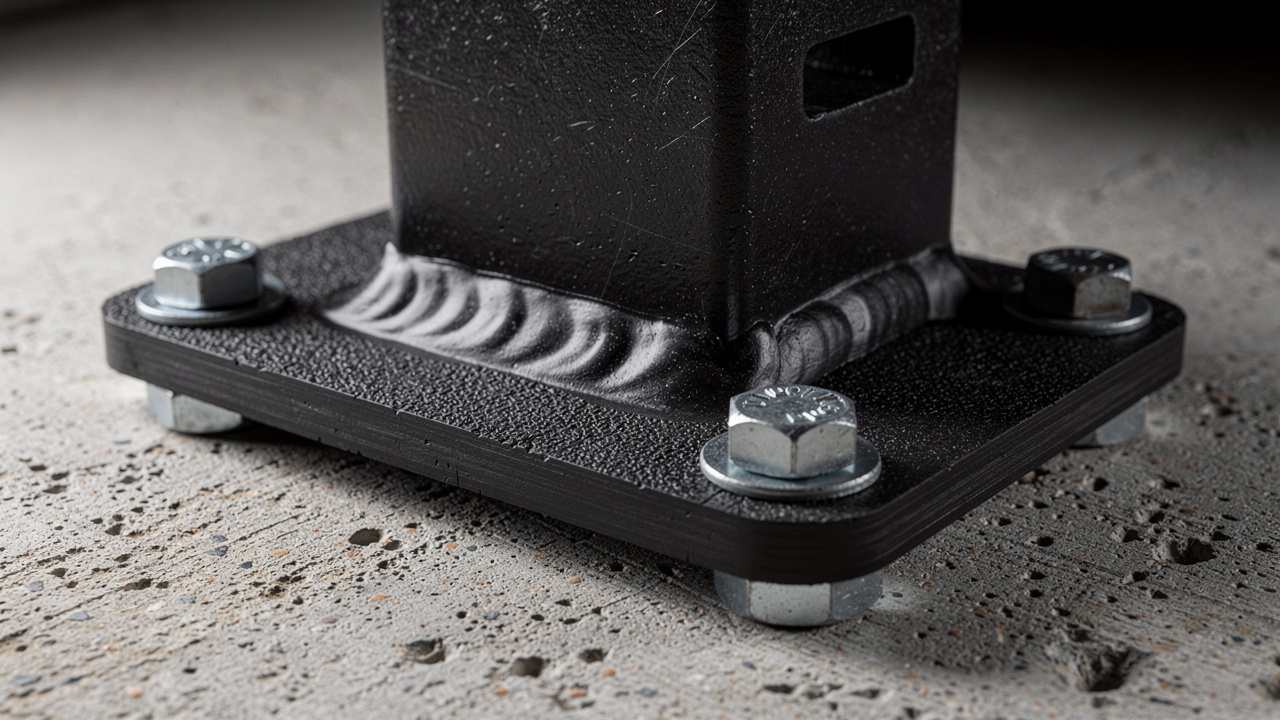
Elastomeric rubber vibration isolator pad detail

Elastomeric vibration isolators use rubber compounds such as natural rubber, neoprene, or specially mixed blends bonded to steel plates or housings. The rubber works as a flexible layer that compresses and rebounds as the machine moves, with performance characteristics documented in numerical and experimental study of elastomeric behavior under dynamic loads. During this motion, it turns part of the vibrational energy into low‑grade heat, which reduces what reaches the structure.

These isolators work very well for higher operating speeds, where vibration frequencies usually sit above fifteen to twenty hertz. Typical HVAC uses include:

  • Air handling units
  • Small and medium chillers
  • Fan coil units
  • Packaged rooftop units
  • Many compressor skids

Their compact form makes them a good match for tight mechanical rooms and roof frames with limited height.

Elastomeric mounts are budget‑friendly for moderate loads, easy to install, and effective on high‑frequency vibration from fast‑turning motors and fans. When we build anti‑vibration rubber pads at RK Rubber Enterprise Co., we use advanced compounds designed for long life, high shock absorption, and strong resistance to oils, cleaning chemicals, and weather. That mix fits well with outdoor rooftop equipment that faces Philippine sun, heat, and heavy rain.

Spring Isolators
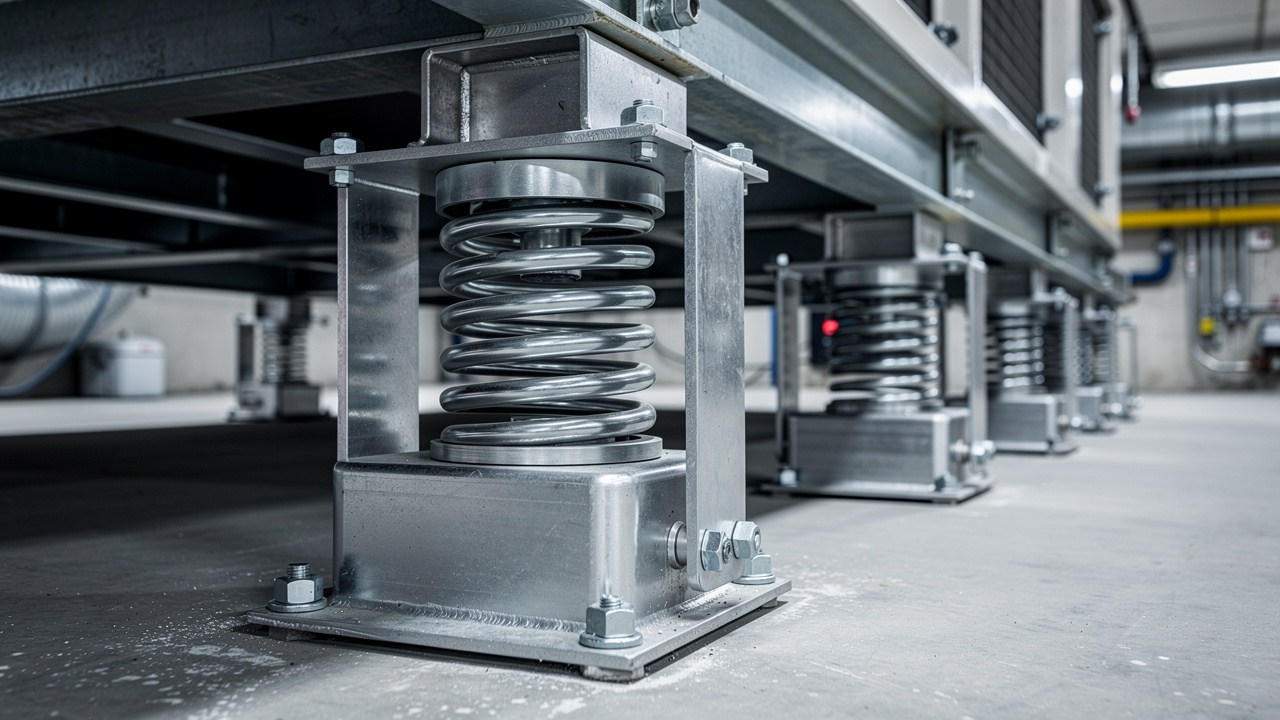
Spring vibration isolators under chiller unit

Spring vibration isolators use one or more steel coil springs inside a frame or housing. The equipment weight compresses the spring to a set deflection, which gives the system a low natural frequency. This design is especially good at cutting low‑frequency vibration from large, slow‑speed equipment where rubber alone would not give enough movement.

For HVAC work, spring isolators are common on:

  • Heavy chillers
  • Cooling towers
  • Large air handling systems
  • Big rooftop units

These machines often run at lower speeds and higher loads, so their vibration can travel deep into the structure if not handled correctly. Spring units allow greater movement while still keeping the equipment stable and level.

Key advantages include:

  • Very good performance at low frequencies
  • Strong load capacity for multi‑ton equipment
  • Consistent behavior over a long service life

Many designs include adjustment hardware so we can fine‑tune preload and leveling after installation. At RK Rubber Enterprise Co., our spring isolators are built with low natural frequency targets and adjustable settings, which help us match each set to the actual weight and support points of the mechanical rubber products.

Specialized And Hybrid Options

Some HVAC setups need more than a single type of vibration isolator:

  • Neoprene pads and strips work well where we need low‑profile support and where oil and chemical resistance matter, such as under smaller pumps or auxiliary equipment.
  • Metal‑bonded elastomer mounts provide precise deflection control for equipment that must hold a strict alignment.
  • Hybrid systems combine springs with elastomer layers to handle a wide spread of frequencies while still damping noise.

With RK Rubber’s customization capability, we size these parts based on real load points and contact areas rather than guesswork.

Compliance With Philippine Standards: PEC And NFPA 110 Requirements

Code compliance is not just about electrical safety. It also includes how mechanical equipment is supported and isolated. In the Philippines, the Philippine Electrical Code (PEC) places clear attention on emergency and standby power systems, which often share space and foundations with large HVAC equipment.

Chapter 7 of the PEC covers installation, testing, and maintenance for emergency systems and points directly to NFPA 110 as the main reference. This makes NFPA 110 more than a guideline; it becomes the standard that inspectors expect to see followed in hospitals, commercial buildings, and industrial plants with emergency power. Where generator sets and major HVAC equipment sit on common structures, this standard pushes the whole design toward better vibration management.

NFPA 110 Rule 7.5 states that:

“Vibration isolators, as recommended by the manufacturer of the EPS, shall be installed either between the rotating equipment and its skid base or between the skid base and the foundation or inertia base.”

In practice, that means two code‑compliant paths:

  • Use isolators between the engine or alternator and the skid, often installed at the factory.
  • Place isolators between the skid and the concrete base on site.

Direct bolting of generator sets or similar heavy rotating machines to the foundation fails this expectation and can lead to inspection issues. Non‑compliance may also affect equipment warranties and raise questions if structural damage or failure occurs later.

We always suggest going beyond the bare minimum by following manufacturer isolation guidance for all major HVAC units, not just emergency equipment. Our team at RK Rubber Enterprise Co. supports this process with product selection help, drawings, and data that make it easier to document compliance.

How To Select The Right Vibration Isolators For Your HVAC System

Good results start with the right data. Picking vibration isolators based only on rough weight guesses or catalog pictures often leads to underperformance. We follow a simple framework that any facility manager or engineer can use as a checklist.

Step 1 – Determine Equipment Operating Frequency
Look at fan and motor speed in revolutions per minute and convert that to hertz by dividing by sixty. Higher frequencies often point to elastomeric isolators, especially above about fifteen hertz. Lower speeds, especially on big chillers and towers, usually call for spring isolators with enough deflection to sit well below the disturbing frequency.

Step 2 – Calculate Total Load And How It Is Shared
Include the full operating weight of the HVAC unit, not just the dry weight on the nameplate. That means adding refrigerant, oil, and any accessories. Then check the base frame and mounting bolt layout to understand how this weight spreads across each isolator. Undersized mounts can bottom out, while oversized ones may not deflect enough to work properly.

Step 3 – Define The Isolation Level You Need
General comfort cooling for offices may work well with about eighty‑five to ninety percent isolation, following established vibration isolation use guidelines for commercial applications. Hospitals, data centers, and research facilities may need ninety‑five percent or more. Higher targets push designs toward spring isolators and more deflection, especially at low frequencies.

Step 4 – Consider The Environment
Philippine heat, humidity, UV exposure, and occasional flooding all affect material choice. Check for outdoor or rooftop placement, exposure to oils or chemicals, and temperature swings in mechanical rooms. Rubber compounds must stand up to these conditions without hardening or creeping.

Step 5 – Review Space And Support Limits
Available height, base footprint, and foundation capacity shape the final choice. Some spring isolation systems need more clearance, while low‑profile neoprene pads work in tight spaces. Also plan access so maintenance teams can inspect or change isolators without major disassembly.

Step 6 – Match Hardness And Dynamic Stiffness
For elastomeric mounts, Shore hardness affects how much they deflect under load and where the natural frequency sits. Dynamic stiffness tells us how the mount behaves under actual vibration, not just static weight. At RK Rubber Enterprise Co., we use this data to select or customize rubber cushion so the system avoids resonance and meets target isolation.

When customers share accurate load and layout data, we can provide clear recommendations and test information that support both performance and compliance documentation.

Measurable Benefits: How Proper Vibration Isolation Improves HVAC Performance
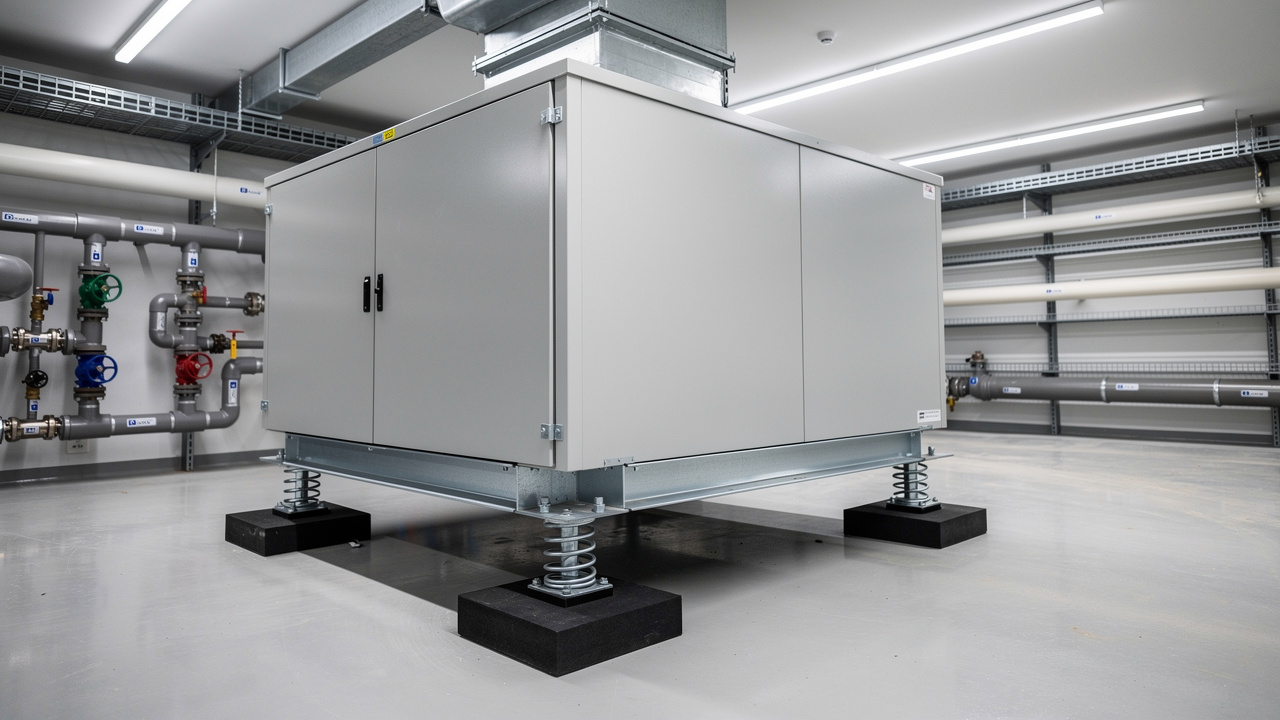
Properly isolated HVAC unit in mechanical room

When vibration isolators are selected and installed correctly, the gains show up in both technical reports and financial statements. Many plants and buildings move from constant repairs to stable, predictable HVAC operation once proper isolation is in place.

Key measurable benefits include:

  • Longer equipment lifespan.
    With lower mechanical stress on bearings, shafts, and compressor internals, HVAC units can run thirty to fifty percent longer before major overhaul or replacement. Over a ten‑ to fifteen‑year planning window, this can keep expensive chillers and large fans in service well past the point where poorly isolated units would already be replaced.
  • Lower maintenance costs.
    Better isolation means fewer bearing changes, fewer refrigerant leaks due to cracked lines, and less time spent on repeated alignment work. Many facilities report maintenance savings in the range of twenty to forty percent for well‑isolated systems, along with fewer emergency callouts and less unplanned downtime during peak cooling months.
  • Improved energy performance.
    Machines that stay in alignment and operate on healthy bearings use less power. With proper vibration control, it is common to see five to fifteen percent better energy use compared with similar equipment installed on hard mounts. With local electricity costs, even the lower end of that range gives a strong payback.

On top of this, stable isolation supports:

  • More consistent temperatures and humidity
  • Fewer nuisance trips and control issues
  • Quieter spaces and better comfort for occupants
  • Less risk of damage to foundations and nearby sensitive equipment

RK Rubber Enterprise Co. supports these gains with high‑quality rubber compounds and tested spring designs that hold their properties over many years in Philippine conditions.

Conclusion

Good HVAC design is about more than picking the right capacity and controls. Without proper vibration isolation, even the best chiller or air handling unit can become a source of wasted energy, early failure, and ongoing complaints. Well‑chosen vibration isolators keep movement inside the machine, protect the building, and help systems run closer to their rated performance for a longer time.

By investing in quality isolation, we protect both the equipment and the structure that supports it. That means fewer major repairs, less noise in offices or hotel rooms, and a longer interval before expensive replacements appear in the budget. When we factor in lower energy use and reduced maintenance, the initial cost of good isolators often pays back many times over the life of the HVAC plant.

For facilities in the Philippines, the PEC and NFPA 110 already recognize how important proper vibration control is, especially around emergency power systems. Bringing the same care to all major HVAC equipment keeps projects safer, quieter, and easier to justify during audits and inspections. Facility managers, engineers, and contractors should review existing installations, check for proper vibration control, and specify isolation from the start on new projects.

At RK Rubber Enterprise Co., we support this work with a wide product range, from anti‑vibration rubber pads and neoprene strips to engineered metal‑bonded mounts and spring isolators. Our team helps match each product to real loads and conditions, giving customers both reliable performance and peace of mind.

FAQs

Question 1: What Is The Difference Between Elastomeric And Spring Vibration Isolators For HVAC Systems?

Elastomeric vibration isolators use rubber compounds to absorb higher‑frequency vibration, usually above fifteen to twenty hertz. They suit smaller and medium HVAC units, such as compressors, fan coil units, and packaged rooftop systems, where loads and deflections stay moderate. Spring isolators use steel coils to handle lower‑frequency vibration and heavier equipment, such as chillers and cooling towers. They provide greater deflection and better isolation for slow‑speed machines. The choice depends on operating speed, weight, and how much isolation the project needs, and RK Rubber Enterprise Co. offers both types with options for customization.

Question 2: Are Vibration Isolators Required By Law In The Philippines For HVAC Installations?

For emergency power supply systems, yes. PEC Chapter 7 points to NFPA 110, whose Rule 7.5 calls for vibration isolators between the rotating equipment and skid, or between the skid and the foundation. General HVAC equipment outside emergency systems may not always be named directly in the same way. However, manufacturers and industry groups such as EGSA and NEIS strongly discourage direct bolting without isolation. Following their guidance protects structural and equipment warranties and reduces the risk of damage or liability.

Question 3: How Do I Know What Size And Type Of Vibration Isolator I Need For My HVAC Equipment?

Sizing starts with accurate equipment data. You need the full operating weight including refrigerant, oil, and accessories; the rotating speed of fans or compressors; and the mounting layout. From there, check how weight is shared across the support points and what isolation level is needed for the space below or around the unit. Undersized isolators will compress too much and lose their function, while oversized units may not deflect enough and can cause instability. The best path is to consult manufacturer data and then work with a partner like RK Rubber Enterprise Co., where our technical team uses real load point measurements and site conditions to recommend the correct type and rating.

Question 4: Can Vibration Isolators Really Extend HVAC Equipment Lifespan And Reduce Energy Costs?

Yes, and the gains are measurable. By cutting vibration levels, you reduce wear on bearings, motors, and compressor parts, which can extend service life by thirty to fifty percent compared with rigid mounting. That same reduction in friction and misalignment often improves energy performance by about five to fifteen percent, because motors do not fight extra resistance. Maintenance needs usually drop by twenty to forty percent as leaks, bearing failures, and misalignment problems become less common. In many projects, the cost of proper vibration isolators pays back within two to three years through combined savings, especially when using RK Rubber’s durable compounds and tested designs.

Question 5: How Often Should Vibration Isolators Be Inspected Or Replaced?
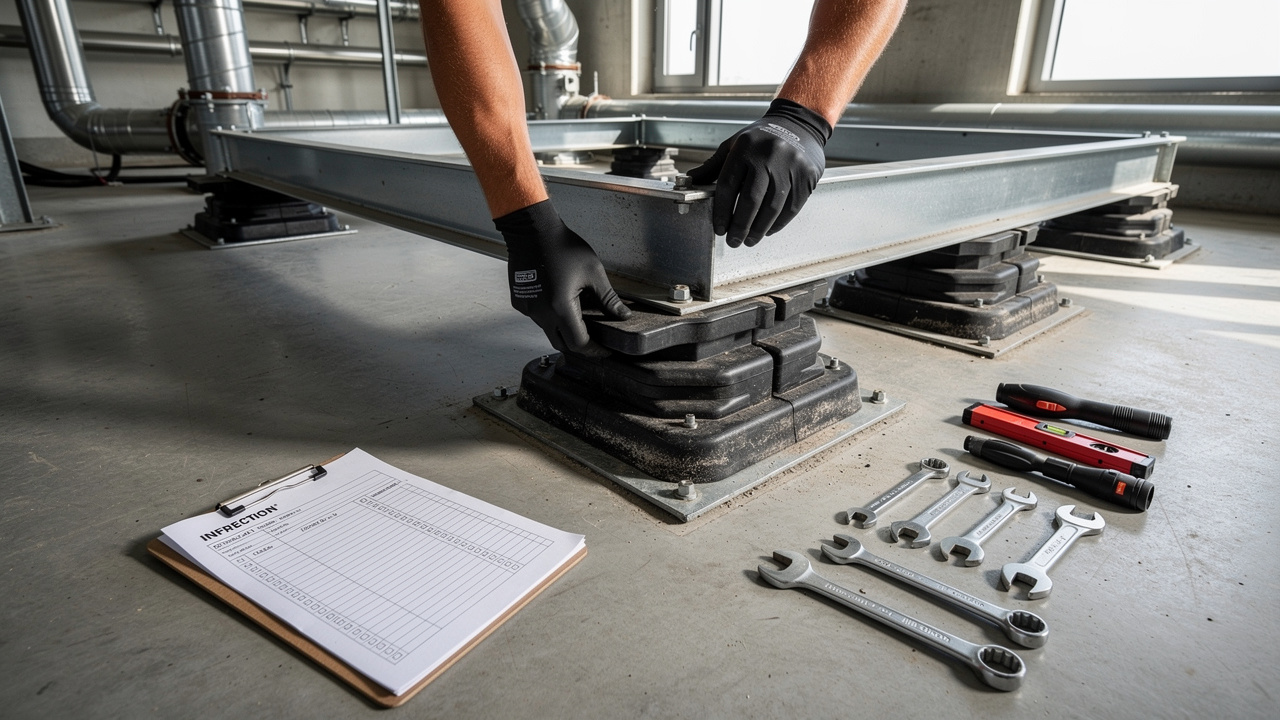
Technician inspecting vibration isolators during maintenance

We suggest at least one visual inspection each year. During this check, look for cracks, hardening, or excessive compression in rubber parts and make sure the equipment remains level on its supports. Quality elastomeric mounts often last ten to fifteen years, while well‑protected spring isolators can serve for fifteen to twenty years or more. Signs that replacement is needed include visible cracking, permanent flattening beyond design limits, and noticeable increases in transmitted vibration or noise. RK Rubber Enterprise Co. designs its products with strong resistance to weather, corrosion, and mechanical shock, which supports long service life under Philippine conditions.
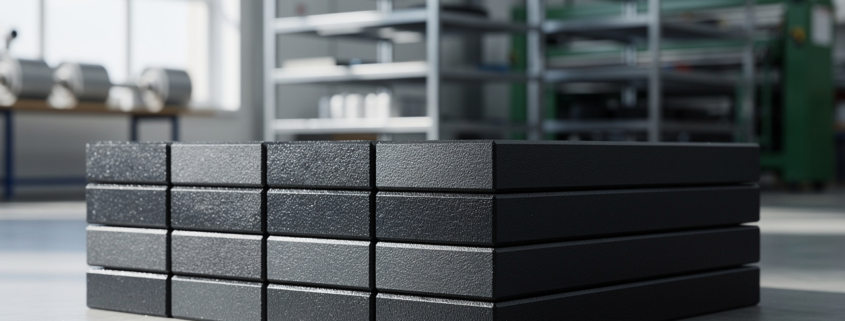
Introduction

Picture a new commercial tower in Metro Manila where everything looks perfect on opening day. After a few months, complaints start to pile up about humming ceilings, rattling windows, and an odd buzzing in corner offices. The HVAC equipment on the roof runs within its rated capacity, but without proper vibration isolators, every start and stop sends tiny shocks through the structure.

Those small vibrations do more than annoy tenants. They stress motors and bearings, loosen connections, crack concrete over time, and even drag down energy efficiency. Instead of running smoothly, chillers and air handling units fight against misalignment and extra friction. Maintenance teams chase leaks and noisy fans, and the equipment wears out years ahead of schedule.

We see this pattern again and again when vibration control is treated as an optional add‑on instead of part of the HVAC design. With the right vibration isolators under each unit, movement stays where it should be – inside the machine – instead of spreading into beams, floors, and walls. That means longer service life, fewer breakdowns, and lower power bills. It also supports compliance with the Philippine Electrical Code (PEC) and NFPA 110, which already recognize how serious vibration can be, especially for emergency power systems.

In this article, we walk through what vibration isolators are, why HVAC systems depend on them, how to choose the right type, and how proper isolation improves efficiency and lifespan. We also share how we at RK Rubber Enterprise Co. support projects across the Philippines with anti‑vibration pads, mounts, and spring isolators built for local conditions.

Key Takeaways

Before we go deeper, it helps to see the main points in one place. These highlights show why vibration control should stand beside capacity and efficiency in every HVAC design and upgrade plan.

  • Proper vibration isolation can extend HVAC equipment life by one‑third or more, often around thirty to fifty percent. That longer life means fewer replacements, less scrap, and more predictable capital planning over many years.
  • The Philippine Electrical Code and NFPA 110 call for vibration isolators on emergency power systems. When mechanical rooms combine generators and HVAC equipment, this guidance reinforces the need for proper isolation across the whole setup.
  • Elastomeric and spring vibration isolators work best in different ranges of speed and weight. Matching type and rating to actual equipment data is the key to quiet, stable, and efficient operation.
  • RK Rubber Enterprise Co. provides a wide range of products, from anti‑vibration rubber pads to engineered metal‑bonded mounts and spring units. This mix allows us to match the isolator design to each chiller, fan, or cooling tower instead of using a one‑size‑fits‑all part.
  • Placing vibration isolators between the HVAC equipment and the foundation blocks vibration paths into the structure. This setup cuts noise, protects the building frame, and helps nearby sensitive equipment run correctly.

What Are Vibration Isolators And Why Do HVAC Systems Need Them?

Vibration isolators are engineered parts that sit between a vibrating machine and the structure that supports it. In simple terms, they act like a rubber pads, so the equipment can move slightly without sending that motion straight into beams, slabs, or steel frames. For HVAC systems, these parts are usually rubber‑based mounts, pads, or steel springs designed to work at specific loads and frequencies.

Chillers, air handling units, compressors, and cooling towers all create vibration as motors turn and fans spin. That movement tries to travel from the equipment base through anchor bolts into floors, walls, and columns. Once inside the structure, it spreads out, often showing up as noise or a faint shake far from the machine room.

HVAC equipment needs isolation for three main reasons:

  1. We protect the equipment itself. Vibration isolators lower the stress on motors, bearings, and compressor assemblies, which reduces misalignment, premature wear, and sudden failures—a principle supported by research on mitigation of structural vibrations in mechanical systems. With less mechanical shock, components keep their factory clearances longer, so the units stay closer to original performance.
  2. We protect the structural frame. Repeated vibration loads create tiny cycles of stress in concrete and steel. Over time, this can grow from hairline cracks into visible damage around bases and supports. Proper isolation keeps these pulses away from the structure, which helps maintain long‑term strength.
  3. We protect comfort and quiet inside occupied spaces. Without isolation, structure‑borne vibration turns into noise that travels through slabs and walls. Offices, hotel rooms, and hospital wards can all hear or feel the equipment even several floors away.

“Vibration is one of the most common causes of premature failure in rotating machinery.” — Common teaching in mechanical and rotating equipment design

Industry bodies such as EGSA and NEIS warn against bolting heavy HVAC units directly to floors or pedestals. We follow the same principle and treat vibration isolators as a standard design item, not an afterthought.

The Hidden Costs Of Poor Vibration Control In HVAC Systems

Poor vibration control rarely fails on day one. Instead, it chips away at performance, comfort, and budgets month after month. When vibration isolators are missing, undersized, or badly installed, the extra movement shows up in four costly ways.

  1. Premature failure and heavy maintenance.
    Constant vibration punishes compressor bearings, motor mounts, and refrigerant lines. Bearings can seize, fan shafts drift out of alignment, and copper lines crack, leading to leaks. Each incident brings unplanned shutdowns, rush parts orders, and overtime labor that far exceed the cost of proper isolation.
  2. Lower energy efficiency.
    As components wear and drift out of alignment, motors need more power to do the same work. Fans may rub or run on poor bearings, and compressors pull extra current. Systems without good isolation often run ten to twenty percent below their rated efficiency, which, at Philippine commercial power rates, adds a serious long‑term burden on operating budgets.
  3. Gradual structural damage.
    Small vibrations create repeated stress cycles in pedestals, beams, and slabs. Micro‑cracks form around anchor points, then widen into visible damage that calls for injection, patching, or even partial rebuilding. These repair projects disrupt operations and cost much more than installing correct vibration isolators during the original works.
  4. Noise complaints and comfort issues.
    Structure‑borne vibration can turn quiet hotel rooms into low‑hum zones and disturb patients in hospitals or residents in condominiums. Tenants may demand rent adjustments or simply move out, which affects property value. On top of that, missed code expectations under PEC Chapter 7 and NFPA 110 can create compliance questions and possible liability if damage or failure occurs.

“If you ignore vibration at commissioning, you pay for it for the rest of the building’s life.” — Saying often heard among maintenance and plant engineers

Types Of Vibration Isolators For HVAC Applications

Choosing the right type of vibration isolator starts with understanding how the HVAC unit behaves. Operating speed, weight, mounting layout, and location all guide the choice. In many building projects, we combine different isolator types so that each piece of equipment gets support that fits its actual job instead of a generic pad.

Elastomeric (Rubber) Isolators

Elastomeric rubber vibration isolator pad detail

Elastomeric vibration isolators use rubber compounds such as natural rubber, neoprene, or specially mixed blends bonded to steel plates or housings. The rubber works as a flexible layer that compresses and rebounds as the machine moves, with performance characteristics documented in numerical and experimental study of elastomeric behavior under dynamic loads. During this motion, it turns part of the vibrational energy into low‑grade heat, which reduces what reaches the structure.

These isolators work very well for higher operating speeds, where vibration frequencies usually sit above fifteen to twenty hertz. Typical HVAC uses include:

  • Air handling units
  • Small and medium chillers
  • Fan coil units
  • Packaged rooftop units
  • Many compressor skids

Their compact form makes them a good match for tight mechanical rooms and roof frames with limited height.

Elastomeric mounts are budget‑friendly for moderate loads, easy to install, and effective on high‑frequency vibration from fast‑turning motors and fans. When we build anti‑vibration rubber pads at RK Rubber Enterprise Co., we use advanced compounds designed for long life, high shock absorption, and strong resistance to oils, cleaning chemicals, and weather. That mix fits well with outdoor rooftop equipment that faces Philippine sun, heat, and heavy rain.

Spring Isolators

Spring vibration isolators under chiller unit

Spring vibration isolators use one or more steel coil springs inside a frame or housing. The equipment weight compresses the spring to a set deflection, which gives the system a low natural frequency. This design is especially good at cutting low‑frequency vibration from large, slow‑speed equipment where rubber alone would not give enough movement.

For HVAC work, spring isolators are common on:

  • Heavy chillers
  • Cooling towers
  • Large air handling systems
  • Big rooftop units

These machines often run at lower speeds and higher loads, so their vibration can travel deep into the structure if not handled correctly. Spring units allow greater movement while still keeping the equipment stable and level.

Key advantages include:

  • Very good performance at low frequencies
  • Strong load capacity for multi‑ton equipment
  • Consistent behavior over a long service life

Many designs include adjustment hardware so we can fine‑tune preload and leveling after installation. At RK Rubber Enterprise Co., our spring isolators are built with low natural frequency targets and adjustable settings, which help us match each set to the actual weight and support points of the mechanical rubber products.

Specialized And Hybrid Options

Some HVAC setups need more than a single type of vibration isolator:

  • Neoprene pads and strips work well where we need low‑profile support and where oil and chemical resistance matter, such as under smaller pumps or auxiliary equipment.
  • Metal‑bonded elastomer mounts provide precise deflection control for equipment that must hold a strict alignment.
  • Hybrid systems combine springs with elastomer layers to handle a wide spread of frequencies while still damping noise.

With RK Rubber’s customization capability, we size these parts based on real load points and contact areas rather than guesswork.

Compliance With Philippine Standards: PEC And NFPA 110 Requirements

Code compliance is not just about electrical safety. It also includes how mechanical equipment is supported and isolated. In the Philippines, the Philippine Electrical Code (PEC) places clear attention on emergency and standby power systems, which often share space and foundations with large HVAC equipment.

Chapter 7 of the PEC covers installation, testing, and maintenance for emergency systems and points directly to NFPA 110 as the main reference. This makes NFPA 110 more than a guideline; it becomes the standard that inspectors expect to see followed in hospitals, commercial buildings, and industrial plants with emergency power. Where generator sets and major HVAC equipment sit on common structures, this standard pushes the whole design toward better vibration management.

NFPA 110 Rule 7.5 states that:

“Vibration isolators, as recommended by the manufacturer of the EPS, shall be installed either between the rotating equipment and its skid base or between the skid base and the foundation or inertia base.”

In practice, that means two code‑compliant paths:

  • Use isolators between the engine or alternator and the skid, often installed at the factory.
  • Place isolators between the skid and the concrete base on site.

Direct bolting of generator sets or similar heavy rotating machines to the foundation fails this expectation and can lead to inspection issues. Non‑compliance may also affect equipment warranties and raise questions if structural damage or failure occurs later.

We always suggest going beyond the bare minimum by following manufacturer isolation guidance for all major HVAC units, not just emergency equipment. Our team at RK Rubber Enterprise Co. supports this process with product selection help, drawings, and data that make it easier to document compliance.

How To Select The Right Vibration Isolators For Your HVAC System

Good results start with the right data. Picking vibration isolators based only on rough weight guesses or catalog pictures often leads to underperformance. We follow a simple framework that any facility manager or engineer can use as a checklist.

Step 1 – Determine Equipment Operating Frequency
Look at fan and motor speed in revolutions per minute and convert that to hertz by dividing by sixty. Higher frequencies often point to elastomeric isolators, especially above about fifteen hertz. Lower speeds, especially on big chillers and towers, usually call for spring isolators with enough deflection to sit well below the disturbing frequency.

Step 2 – Calculate Total Load And How It Is Shared
Include the full operating weight of the HVAC unit, not just the dry weight on the nameplate. That means adding refrigerant, oil, and any accessories. Then check the base frame and mounting bolt layout to understand how this weight spreads across each isolator. Undersized mounts can bottom out, while oversized ones may not deflect enough to work properly.

Step 3 – Define The Isolation Level You Need
General comfort cooling for offices may work well with about eighty‑five to ninety percent isolation, following established vibration isolation use guidelines for commercial applications. Hospitals, data centers, and research facilities may need ninety‑five percent or more. Higher targets push designs toward spring isolators and more deflection, especially at low frequencies.

Step 4 – Consider The Environment
Philippine heat, humidity, UV exposure, and occasional flooding all affect material choice. Check for outdoor or rooftop placement, exposure to oils or chemicals, and temperature swings in mechanical rooms. Rubber compounds must stand up to these conditions without hardening or creeping.

Step 5 – Review Space And Support Limits
Available height, base footprint, and foundation capacity shape the final choice. Some spring isolation systems need more clearance, while low‑profile neoprene pads work in tight spaces. Also plan access so maintenance teams can inspect or change isolators without major disassembly.

Step 6 – Match Hardness And Dynamic Stiffness
For elastomeric mounts, Shore hardness affects how much they deflect under load and where the natural frequency sits. Dynamic stiffness tells us how the mount behaves under actual vibration, not just static weight. At RK Rubber Enterprise Co., we use this data to select or customize rubber cushion so the system avoids resonance and meets target isolation.

When customers share accurate load and layout data, we can provide clear recommendations and test information that support both performance and compliance documentation.

Measurable Benefits: How Proper Vibration Isolation Improves HVAC Performance

Properly isolated HVAC unit in mechanical room

When vibration isolators are selected and installed correctly, the gains show up in both technical reports and financial statements. Many plants and buildings move from constant repairs to stable, predictable HVAC operation once proper isolation is in place.

Key measurable benefits include:

  • Longer equipment lifespan.
    With lower mechanical stress on bearings, shafts, and compressor internals, HVAC units can run thirty to fifty percent longer before major overhaul or replacement. Over a ten‑ to fifteen‑year planning window, this can keep expensive chillers and large fans in service well past the point where poorly isolated units would already be replaced.
  • Lower maintenance costs.
    Better isolation means fewer bearing changes, fewer refrigerant leaks due to cracked lines, and less time spent on repeated alignment work. Many facilities report maintenance savings in the range of twenty to forty percent for well‑isolated systems, along with fewer emergency callouts and less unplanned downtime during peak cooling months.
  • Improved energy performance.
    Machines that stay in alignment and operate on healthy bearings use less power. With proper vibration control, it is common to see five to fifteen percent better energy use compared with similar equipment installed on hard mounts. With local electricity costs, even the lower end of that range gives a strong payback.

On top of this, stable isolation supports:

  • More consistent temperatures and humidity
  • Fewer nuisance trips and control issues
  • Quieter spaces and better comfort for occupants
  • Less risk of damage to foundations and nearby sensitive equipment

RK Rubber Enterprise Co. supports these gains with high‑quality rubber compounds and tested spring designs that hold their properties over many years in Philippine conditions.

Conclusion

Good HVAC design is about more than picking the right capacity and controls. Without proper vibration isolation, even the best chiller or air handling unit can become a source of wasted energy, early failure, and ongoing complaints. Well‑chosen vibration isolators keep movement inside the machine, protect the building, and help systems run closer to their rated performance for a longer time.

By investing in quality isolation, we protect both the equipment and the structure that supports it. That means fewer major repairs, less noise in offices or hotel rooms, and a longer interval before expensive replacements appear in the budget. When we factor in lower energy use and reduced maintenance, the initial cost of good isolators often pays back many times over the life of the HVAC plant.

For facilities in the Philippines, the PEC and NFPA 110 already recognize how important proper vibration control is, especially around emergency power systems. Bringing the same care to all major HVAC equipment keeps projects safer, quieter, and easier to justify during audits and inspections. Facility managers, engineers, and contractors should review existing installations, check for proper vibration control, and specify isolation from the start on new projects.

At RK Rubber Enterprise Co., we support this work with a wide product range, from anti‑vibration rubber pads and neoprene strips to engineered metal‑bonded mounts and spring isolators. Our team helps match each product to real loads and conditions, giving customers both reliable performance and peace of mind.

FAQs

Question 1: What Is The Difference Between Elastomeric And Spring Vibration Isolators For HVAC Systems?

Elastomeric vibration isolators use rubber compounds to absorb higher‑frequency vibration, usually above fifteen to twenty hertz. They suit smaller and medium HVAC units, such as compressors, fan coil units, and packaged rooftop systems, where loads and deflections stay moderate. Spring isolators use steel coils to handle lower‑frequency vibration and heavier equipment, such as chillers and cooling towers. They provide greater deflection and better isolation for slow‑speed machines. The choice depends on operating speed, weight, and how much isolation the project needs, and RK Rubber Enterprise Co. offers both types with options for customization.

Question 2: Are Vibration Isolators Required By Law In The Philippines For HVAC Installations?

For emergency power supply systems, yes. PEC Chapter 7 points to NFPA 110, whose Rule 7.5 calls for vibration isolators between the rotating equipment and skid, or between the skid and the foundation. General HVAC equipment outside emergency systems may not always be named directly in the same way. However, manufacturers and industry groups such as EGSA and NEIS strongly discourage direct bolting without isolation. Following their guidance protects structural and equipment warranties and reduces the risk of damage or liability.

Question 3: How Do I Know What Size And Type Of Vibration Isolator I Need For My HVAC Equipment?

Sizing starts with accurate equipment data. You need the full operating weight including refrigerant, oil, and accessories; the rotating speed of fans or compressors; and the mounting layout. From there, check how weight is shared across the support points and what isolation level is needed for the space below or around the unit. Undersized isolators will compress too much and lose their function, while oversized units may not deflect enough and can cause instability. The best path is to consult manufacturer data and then work with a partner like RK Rubber Enterprise Co., where our technical team uses real load point measurements and site conditions to recommend the correct type and rating.

Question 4: Can Vibration Isolators Really Extend HVAC Equipment Lifespan And Reduce Energy Costs?

Yes, and the gains are measurable. By cutting vibration levels, you reduce wear on bearings, motors, and compressor parts, which can extend service life by thirty to fifty percent compared with rigid mounting. That same reduction in friction and misalignment often improves energy performance by about five to fifteen percent, because motors do not fight extra resistance. Maintenance needs usually drop by twenty to forty percent as leaks, bearing failures, and misalignment problems become less common. In many projects, the cost of proper vibration isolators pays back within two to three years through combined savings, especially when using RK Rubber’s durable compounds and tested designs.

Question 5: How Often Should Vibration Isolators Be Inspected Or Replaced?

Technician inspecting vibration isolators during maintenance

We suggest at least one visual inspection each year. During this check, look for cracks, hardening, or excessive compression in rubber parts and make sure the equipment remains level on its supports. Quality elastomeric mounts often last ten to fifteen years, while well‑protected spring isolators can serve for fifteen to twenty years or more. Signs that replacement is needed include visible cracking, permanent flattening beyond design limits, and noticeable increases in transmitted vibration or noise. RK Rubber Enterprise Co. designs its products with strong resistance to weather, corrosion, and mechanical shock, which supports long service life under Philippine conditions.
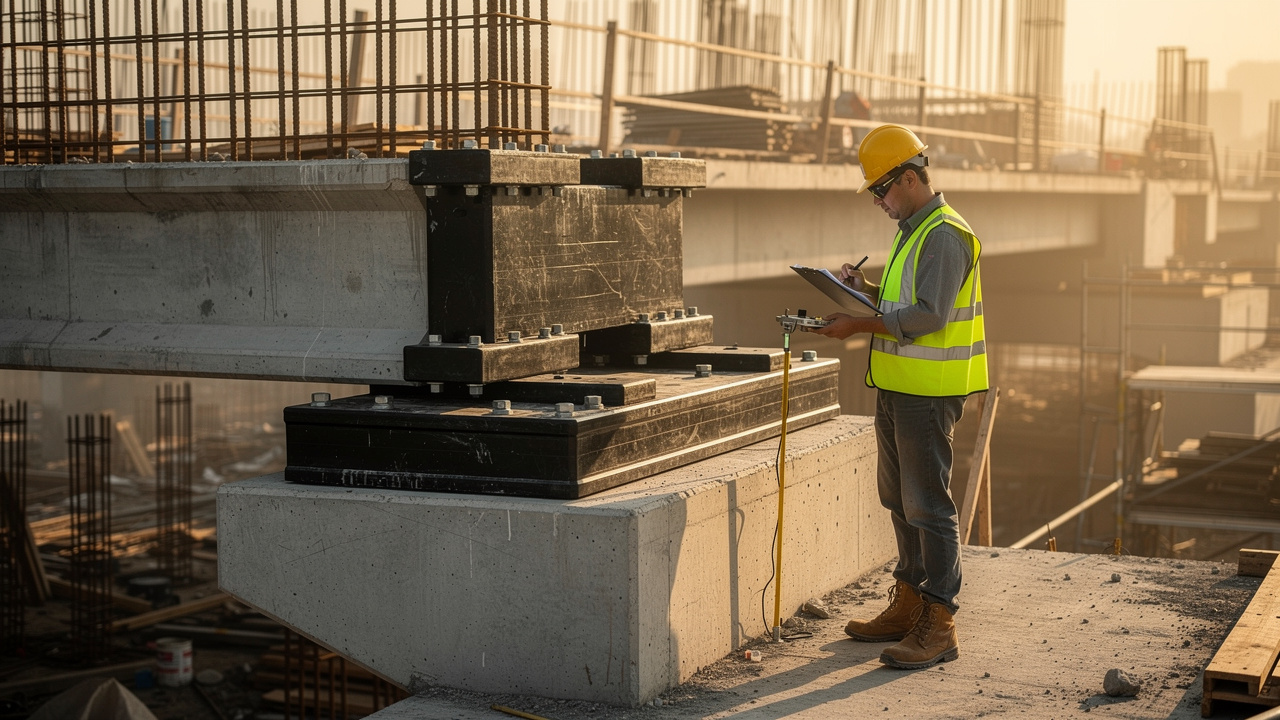
tt0CnFXwKXfBjlp72B VI 1

Viton gaskets vs EPDM: high-performance sealing guide

A single gasket can shut down an entire plant. We have seen it happen in fuel depots, boiler rooms, and chemical lines across the Philippines. One small ring of rubber hardens, swells, or cracks, and the result is leaks, unplanned stoppage, safety risk, and a lot of stress for everyone from maintenance to management.

As one maintenance supervisor told us, “A five‑peso gasket can stop a five‑million‑peso line if you pick the wrong material.”

This is why the choice between EPDM and Viton gaskets matters far more than it seems on paper. Both belong to the same broad family of elastomers, yet they behave very differently once fuels, acids, steam, or high heat enter the picture. EPDM often looks cheaper and “good enough” until it meets petroleum products or higher temperatures and fails sooner than planned.

For many plants, contractors, and OEMs, the key question is simple: When is EPDM fine, and when do conditions justify an upgrade to Viton for high‑performance sealing? In this guide, we compare the two materials where it matters most: chemical resistance, temperature limits, cost over time, and field suitability.

At RK Rubber Enterprise Co., we work with Philippine industrial users every day on this decision. The aim is to match gasket material to real service conditions with confidence, know when Viton is a smart investment, and know when EPDM still delivers strong value.

Key Takeaways

  • Viton gaskets excel where fuel, oil, aggressive solvents, or concentrated chemicals are present, especially near 200°C, making them ideal for oil and gas, chemical processing, mining, and fuel systems.

  • EPDM gaskets are strong performers in water‑based and outdoor applications with weather, ozone, and UV exposure, and typically handle up to about 150°C at a lower cost.

  • Upgrading from EPDM to Viton makes sense when systems handle fuels, petroleum oils, strong acids, harsh solvents, or any mix of those at raised temperature, particularly in safety‑critical or hard‑to‑reach lines.

  • Good material choice balances chemical compatibility, temperature, pressure, plant standards, and long‑term cost. RK Rubber Enterprise Co. helps clients weigh these factors using real operating data, not guesswork.

What Are Viton Gaskets and Why They Matter for High-Performance Sealing

Viton fluoroelastomer gasket in industrial application

When we talk about Viton gaskets, we mean gaskets made from Viton, a fluoroelastomer (FKM) synthetic rubber. Its high fluorine content gives it strong resistance to fuels, oils, and many aggressive chemicals, even at raised temperature.

In practice, Viton provides a tight, long‑lasting seal in places where standard rubber would soften, swell, or crack, with performance verification of elastomer materials confirming its superior stability under stress. Gaskets sit clamped between flanges or covers for years while hot fuels, solvents, or mixed process fluids pass by. Viton resists this combination of thermal and chemical stress much better than general‑purpose elastomers.

Because of this, Viton is treated as a premium material. It appears in:

  • Refineries, depots, and petrochemical plants (valves, pump seals, manways)

  • Automotive and aerospace fuel systems and transmission seals

  • Hydraulic systems with aggressive fluids and higher temperatures

RK Rubber Enterprise Co. supports these needs with Viton O‑rings and Viton gaskets rated for roughly -20°C to about 200°C, plus PTFE‑encapsulated variants for tougher chemical service. What our clients value most is seal integrity over time: Viton resists compression set and maintains elasticity against fuels, acids, bases, hydraulic fluids, and many solvents where EPDM or Nitrile would struggle.

Understanding EPDM Gaskets: The Versatile Workhorse of Industrial Sealing

EPDM rubber gaskets for water and HVAC systems

EPDM, short for Ethylene Propylene Diene Monomer, is one of the most widely used synthetic rubbers in sealing work. EPDM gaskets resist weathering, ozone, and sunlight very well, staying flexible over a broad temperature range and offering a practical, cost‑friendly option for many projects.

Thanks to its saturated backbone, EPDM stays elastic instead of cracking when left outdoors for years. Typical gasket‑grade EPDM handles roughly -50°C up to about 150°C, which covers most water, HVAC, and non‑fuel duties in buildings and plants.

Chemically, EPDM works very well with:

  • Water, hot water, and many steam applications

  • Glycol‑based fluids and many alcohols

  • Mild acids and alkalis

However, it reacts badly with petroleum oils, fuels, and many hydrocarbon solvents, tending to swell and lose sealing force. That is why EPDM should not be used in fuel systems or oil lines.

Common uses include automotive door and window seals, HVAC and water line gaskets, and marine hatch seals. RK Rubber Enterprise Co. supplies EPDM gaskets and rubber tubing to many sectors across the Philippines, often as the best mix of price, durability, and service life where petroleum products are not present.

Critical Performance Differences: Viton Vs. EPDM Chemical Resistance

Chemical resistance comparison between gasket materials

When engineers ask whether they should move from EPDM to Viton gaskets, chemical resistance is usually the first topic. Each material handles certain media well and fails badly with others, so matching the material to the actual fluid list is essential.

Viton offers broad chemical resistance, especially for hydrocarbons and strong process fluids. It handles petrol, diesel, jet fuel, mineral oils, synthetic lubricants, many hydraulic oils, and a wide range of hydrocarbon solvents. It also resists many acids and bases that quickly damage general‑purpose rubbers.

EPDM sits nearly on the other side of the chart. It performs very well with water, hot water, steam, glycols, many alcohols, and dilute acids and alkalis, which explains its popularity in municipal water and many cleaning lines. It fails, however, in true petroleum oils, fuels, and strong hydrocarbon solvents.

Use the table below as a quick guide:

Fluid Family

Viton Gaskets

EPDM Gaskets

Fuels and petroleum oils

Very suitable

Not suitable

Water, hot water, and steam

Suitable

Very suitable

Many acids and bases

Often suitable

Often suitable at low level

Alcohols and many glycols

Often suitable

Very suitable

Many hydrocarbon solvents

Often suitable

Not suitable

There are always exceptions, so we ask for exact product names or safety data sheets, then check compatibility before recommending Viton gaskets or any other material. In general, fuel system gaskets, oil line seals, and many petrochemical joints favor Viton, while hot‑water systems and many HVAC lines are strong candidates for EPDM.

Temperature Performance: When Viton’s Heat Resistance Becomes Essential

Viton gasket heat resistance in refinery application

Temperature is the second major factor in the Viton versus EPDM choice. EPDM gaskets usually work well from about -50°C to roughly 150°C in continuous service. Viton typically covers about -20°C up to around 200°C, with short peaks above that. The extra margin at the high end often decides whether an upgrade is needed.

Heat does more than harden rubber; it also increases compression set—a gasket’s tendency to stay flattened and lose sealing force. Viton maintains a low compression set even near its upper temperature limit, while EPDM loses spring more quickly in that region.

This matters in:

  • Engine bays and fuel systems with hot exhaust parts nearby

  • Chemical plants and refineries with hot acids or solvent streams

  • Sterilization or cleaning systems using high heat and aggressive media

Because higher temperature also accelerates chemical attack, a medium that seems mild at room temperature can become much more damaging at 150–200°C. That is where Viton gaskets provide clear value, extending service life and cutting unplanned gasket changeouts.

Cost Vs. Performance: Making the Business Case for Upgrading to Viton

Viton compounds cost more to produce, so Viton gaskets often run three to five times the unit price of similar EPDM parts. Looking only at the purchase price can make Viton seem hard to justify.

We encourage clients to think in terms of total cost of ownership instead:

  • How long does each gasket last in real service?

  • How difficult is it to access and replace?

  • What is the cost of downtime and lost production?

  • What are the safety or environmental risks if it leaks?

For water lines, HVAC flanges, and outdoor weather seals, EPDM usually offers better value: it is affordable, easy to source, and reliable in moderate conditions.

“The cheapest gasket is rarely the least expensive option once you factor in downtime and labor.” — Senior maintenance planner, process plant client

Consider a line where an EPDM gasket lasts six months before swelling and leaking, but a Viton gasket in the same spot runs three years. Once labor, shutdown, and potential clean‑up are added, the higher‑priced Viton part often works out cheaper over the life of the asset and reduces emergency work.

Application Guide: When to Choose EPDM Vs. When to Upgrade to Viton

Many engineers and buyers want simple rules of thumb. Charts are helpful, but a quick mental checklist is often just as valuable.

Choose EPDM gaskets when:

  • The system is mainly water‑based (municipal water, hot water loops, many steam or HVAC lines).

  • The primary challenges are weather, ozone, and UV (window seals, door gaskets, façade and roof joints, marine hatch seals).

  • Temperatures stay at or below about 150°C and no fuels or oils are present.

Upgrade to Viton gaskets when:

  • The media includes fuels, petroleum oils, or gas streams with aggressive components.

  • Strong acids, harsh solvents, or explosive gases are part of the process.

  • Continuous temperature is above about 150°C, especially with chemicals in the mix.

  • The joint is safety‑critical, hard to reach, or tied to very expensive production equipment.

RK Rubber Enterprise Co. supports these decisions with EPDM and Viton in standard and custom profiles (including W‑type, J‑type, and special shapes), so clients do not have to compromise gasket geometry to gain better material performance.

Material Selection Best Practices: How RK Rubber Enterprise Co. Ensures Optimal Seal Performance

Engineer selecting optimal gasket material for application

For us, choosing between EPDM and Viton gaskets is never just a quick yes or no. Real systems involve multiple fluids, cleaning cycles, pressure changes, movement, and local regulations.

Our process typically includes:

  1. Application assessment
    We clarify operating and peak temperatures, pressure range, joint type (static or moving), and thermal or pressure cycling. We also list every fluid that may contact the gasket, including cleaning agents.

  2. Material matching
    Using compatibility data and field experience, we compare the duty against EPDM, Viton, and other elastomers. For food, beverage, and pharmaceutical work, we also consider hygiene and documentation requirements, along with local availability.

  3. Validation and testing
    For severe applications, we can arrange tests that simulate years of service using heat, pressure, and chemical exposure, and then check hardness change, volume resistivity of Viton and other properties, and compression set.

  4. Installation and maintenance support
    We assist with correct gasket sizing, bolt loading, and compression guidelines, then help define realistic inspection and replacement intervals to avoid surprise leaks.

By following this structured approach, RK Rubber Enterprise Co. offers more than rubber parts. We provide material selection support and practical advice that link design intent with field reality, so seals perform as expected on both technical and business terms.

Conclusion

Gasket material choice has a direct impact on safety, uptime, and long‑term cost. A seal that does not match its environment will swell, crack, or harden early, and the result is leaks, clean‑up work, and lost production.

EPDM remains an excellent choice for many Philippine applications: water‑based systems, outdoor joints exposed to sun and rain, HVAC ducting, chilled‑water loops, and many marine duties. In these roles, EPDM gaskets offer long life at a friendly price.

Once fuels, oils, aggressive chemicals, or sustained high temperature enter the picture, it is time to consider Viton gaskets. Their resistance to hydrocarbon media and many strong chemicals, combined with stable behavior near 200°C, makes them a safer and more predictable option, especially in safety‑critical or hard‑to‑reach locations.

We encourage plant managers, engineers, and contractors to think beyond unit price and look at total cost and risk. RK Rubber Enterprise Co. is ready to help—from material selection and custom design through installation guidance—so that small sealing parts support safe, steady operation for many years.

FAQs

Question 1: What Is the Main Difference Between Viton and EPDM Gaskets?

Viton gaskets are fluoroelastomer parts designed for fuels, oils, many aggressive chemicals, and temperatures up to about 200°C. EPDM gaskets work best with water, steam, many alcohols, and outdoor exposure, usually up to around 150°C, but they are not suitable for petroleum products.

Question 2: Can I Use EPDM Gaskets in Fuel Systems or With Petroleum Products?

No. EPDM swells and loses strength in contact with petrol, diesel, many oils, and strong hydrocarbon solvents, which can lead to leaks and fire risk. For fuel or oil service, we recommend Viton gaskets or other elastomers rated for hydrocarbons, selected with RK Rubber Enterprise Co.’s guidance.

Question 3: How Long Do Viton Gaskets Typically Last Compared to EPDM Gaskets?

Service life depends on temperature, pressure, media, and movement. In suitable duties, Viton gaskets often run for several years thanks to strong resistance to heat and chemicals. EPDM can also last years in water and outdoor roles, but fails quickly if misapplied in oils or fuels.

Question 4: Is Viton Suitable for Food-Grade or Pharmaceutical Applications?

Certain Viton grades can meet food‑contact and pharmaceutical requirements, but not all compounds are suitable. For these sectors, RK Rubber Enterprise Co. matches Viton gaskets or approved EPDM grades to the process fluids, cleaning methods, and relevant standards.

Question 5: How Do I Know If My Application Requires an Upgrade From EPDM to Viton?

Warning signs include: contact with fuels, petroleum oils, strong acids, harsh solvents, or mixed chemical streams; continuous temperature above about 150°C; repeated EPDM failures or swelling; and duties that are safety‑critical or hard to access. In these cases, our engineers can review your data and advise whether Viton gaskets are the better choice.

rYpaNldg 31SBgStdorb 1

Rubber to Metal Bonding for Durable Industrial Mounts

Every quiet CNC machine and every stable chiller on a rooftop is standing on something most people never notice. Between the steel base and the concrete, soft rubber mounts absorb vibration and shock. When those mounts rely on strong rubber to metal bonding, equipment runs smoother, lasts longer, and stays safer for everyone around it.

Getting that bond right is much harder than it looks. The rubber has to cling to the metal while the mount flexes thousands of times, sometimes in high heat, near oil or chemicals, or under heavy impact. One wrong adhesive choice, or a shortcut in surface preparation, can lead to peeling, cracked rubber, or sudden failure that shuts down production.

There is no single best way to join rubber and metal. Different elastomers, such as natural rubber, neoprene, silicone, or butyl, behave differently on steel, aluminum, or cast iron. Load, temperature range, vibration level, and chemicals on site all change how we design the mount and which bonding system we choose.

At RK Rubber Enterprise Co., we focus on metal-bonded elastomer mounts and other vibration control products for Philippine industries, serving sectors within the growing Rubber-To-Metal Bonded Articles Market that spans automotive, industrial machinery, and infrastructure applications. We combine material science, adhesive know-how, and process control to design mounts that keep machinery stable in factories, automotive plants, commercial buildings, and infrastructure projects. Our work follows strict ISO 9001 quality systems and uses test methods based on ASTM and DIN standards, so each mount performs the way it was specified.

In this guide, we share how we think about rubber to metal bonding for custom industrial mounts. We will walk through bonding basics, how we choose the right adhesive, the way surface preparation affects actual performance in the field, and the checks that keep bonds reliable. By the end, it becomes much easier to speak with our engineering team, ask the right questions, and specify mounts that match real operating conditions.

As many maintenance managers like to say, “Vibration mounts rarely fail in the catalog; they fail on the plant floor.”

Key Takeaways

  • Substrate compatibility sits at the base. Rubber and metal must match well. Wrong pairs weaken any bond quickly over time.
  • Neoprene adhesives resist oils and chemicals. They also cope well with wide temperatures. This keeps mounts steady in harsh plants.
  • Surface preparation is never optional. Clean, roughened metal helps the adhesive grip. Good prep often doubles bond life.
  • Custom engineering of rubber and metal matters. We tune hardness, thickness, and geometry. That gives mounts better damping and load sharing.
  • Quality checks protect against hidden issues. We monitor bond-line thickness and surface finish. Consistent inspection supports long service in the field.

Understanding Rubber-To-Metal Bonding Fundamentals

Grit-blasted metal surface for adhesive bonding

Rubber to metal bonding is part chemistry and part surface engineering. On a clean, prepared metal surface, adhesive molecules anchor themselves while the rubber compound cures around them. At the same time, micro-roughness on the metal lets the cured elastomer key into small valleys, so the bond acts like tiny mechanical rubber products hooks plus chemical glue.

When we mold rubber onto metal inserts, we also rely on chemical cross-links that form between the rubber, the primer, and the metal treatment. Heat and pressure in the mold drive these reactions. If temperature, cure time, or primer thickness fall outside their window, the bond looks fine at first but starts to separate under real loading.

Different elastomers behave very differently on various metals, and understanding environmental exposure and accelerated testing of these bonded assemblies helps predict long-term performance:

  • Natural rubber offers excellent elasticity but needs protection from oils and heat.
  • Neoprene works well with steel and cast iron in oily, hot areas.
  • Silicone excels on stainless parts that see extreme temperature swings.
  • Aluminum and some coated steels may need special primers or conversion coatings so the adhesive can wet the surface instead of sitting on a slick film.

For industrial mounts we look beyond simple pull-off strength. We pay attention to:

  • Static load capacity and deflection, which define how much the mount compresses under machine weight.
  • Dynamic stiffness and hysteretic damping, which show how well the mount filters vibration at operating speed.
  • Fatigue and environmental resistance, including temperature, ozone, fuel, coolants, and cleaning chemicals.

One of our senior engineers often says, “If you do not control the bond line, the bond will control you.”

Bond failure usually follows a few patterns:

  • Adhesive failure happens when rubber peels cleanly away from metal.
  • Cohesive failure means the rubber or adhesive tears within its own body, which points to wrong hardness or poor cure.
  • Environmental attack shows up as swelling, cracking, or hardening after fluid or temperature exposure.

To avoid these issues, we at RK Rubber Enterprise Co. match elastomer type, Shore hardness, and dynamic modulus to each job so the rubber to metal bonding shares load correctly instead of being overstressed.

Selecting The Right Adhesive For Your Application

No single adhesive works best for every rubber to metal bonding job. We weigh materials, loads, temperature, fluids, and production speed before we choose a system.

Polychloroprene (Neoprene) Adhesives

Neoprene rubber mounts with bonded steel inserts

Polychloroprene, or neoprene, is our main choice for demanding rubber to metal bonding, following established Rubber-to-Metal Bonding Performance guidelines that document the chemistry’s superior adhesion characteristics. High grade products deliver strong shear and peel strength from about minus thirty four to roughly one hundred forty nine degrees Celsius. That range matches many plant conditions without sudden loss of grip.

Neoprene adhesives stand up well to oil, fuel, cutting fluids, water, and sunlight, so they fit harsh industrial areas. They dry quickly yet offer a bonding window of several minutes, which lets us position inserts without rushing. Medium viscosity makes them easy to apply by brush or spray on most metal surfaces.

In our neoprene mounts for gearboxes, compressors, and CNC machines, this chemistry keeps rubber anchored to metal even under vibration. That way the mount wears in a controlled manner instead of peeling suddenly at the bond line.

Silicone Rubber Adhesives

Silicone rubber adhesives fill a more specialized role. Their main strength is very high temperature resistance while staying flexible, which makes them helpful near ovens, exhaust lines, or hot engine parts. After curing, the bond stays soft, so it can absorb movement from thermal expansion between rubber and metal without cracking. One part and two part systems are available, and formulas can be adjusted for faster cure or higher heat resistance. Shear strength is lower than neoprene, but performance under compression and heat is excellent.

Other Adhesive Options And Their Limitations

Natural rubber based adhesives can bond to metals like iron or steel in light work, and they suit materials such as wood or fabric. Their flexibility is good at room temperature, yet they soften and degrade under heat, oils, solvents, or sunlight, so we avoid them for industrial mounts.

Cyanoacrylate, or super glue, cures in seconds and gives very high initial strength on small, clean rubber and metal parts. The bond line is thin and stiff, so repeated vibration, impact, or large temperature swings can cause cracks and sudden failure.

Butyl rubber rubber adhesives shine in sealing and tire repair because they resist gas and moisture and stay tacky. For structural mounts their focus on sealing instead of carrying loads makes them weaker than neoprene systems.

To summarize common choices:

Adhesive Type Best Use Main Limit
Neoprene General industrial mounts Needs clean, prepared metal
Silicone High heat, thermal cycling Lower shear strength
Cyanoacrylate Small, rigid parts Poor under vibration
Butyl / Natural Rubber Sealing and light work Not for structural loads

Essential Surface Preparation And Bonding Techniques

Technician cleaning metal surface before bonding

When we design strong rubber to metal bonding, we start with surface cleaning. Metal inserts arrive with oil, rust, mill scale, or dust that will block adhesion if left in place. We remove these films by solvent degreasing, abrasion, or a mix of both, then keep the cleaned parts away from bare hands so new grease does not sneak back in.

A slightly rough metal surface gives the adhesive more area to grip. Grit blasting creates controlled roughness and also exposes fresh metal under surface oxides. Depending on the steel or aluminum grade, we may add conversion coatings, phosphate layers, or specialized primers that react chemically with both metal and rubber during molding.

As process engineers like to remind teams, “Clean, dry, and rough is the starting point for any reliable bond.”

Adhesive works best in a thin, even layer rather than a thick puddle. We control viscosity, mixing, and application method so the film wets the entire bonding area without runs or dry spots. Temperature and humidity in the bonding area stay within the adhesive supplier’s recommended window, because cold metal or very humid air can slow cure and trap bubbles.

After we bring the treated metal and uncured rubber together, we hold everything firmly while the adhesive cures. Proper clamping or molding pressure keeps the bond line at the right thickness and stops parts from slipping under their own weight. We also separate initial handling strength from full cure strength, since some joints need several hours before they can take full design load.

Throughout this stage, our quality team checks that bond-line thickness and surface finish stay within limits for each mount design. We inspect for voids, bubbles, and incomplete coverage at the rubber edge, where problems show up first. For hybrid designs that combine bonding and bolts, we verify joint torque so the mechanical fasteners share load correctly. We then run sample parts through temperature and hysteresis tests, following ISO 9001 procedures and ASTM or DIN methods, to confirm that actual performance matches the design model.

Conclusion

Vibration isolation mounts supporting industrial CNC machinery

Strong rubber to metal bonding does not happen by accident. It depends on the right combination of rubber compound, metal preparation, adhesive chemistry, and controlled processing, all matched to the way the mount will actually work in service. When any of those parts is chosen on guesswork, bonds may peel, crack, or age far faster than the equipment around them.

For industrial mounts, polychloroprene neoprene adhesives give a strong mix of strength, temperature range, and resistance to oils and chemicals. Combined with the right elastomer hardness and geometry, they help mounts carry static load, manage vibration, and survive fatigue without sudden failure.

At RK Rubber Enterprise Co., we focus our design and manufacturing on bonded elastomer mounts for Philippine industries. We adjust materials, hardness, and mount shape for specific machines, loads, temperatures, and standards such as ISO 9001, ASTM, and DIN. Our testing on damping, hysteresis, and bond strength aims to extend equipment life and cut unplanned stops. When a project needs new or upgraded industrial mounts, our engineering team can review your requirements and provide recommendations and quotes.

FAQs

Question 1: What Is The Strongest Adhesive For Bonding Rubber To Metal In High-Stress Applications?

For high stress rubber to metal bonding, we normally choose high grade polychloroprene neoprene adhesives. They give high shear and peel strength, with test data reaching hundreds of psi in shear depending on temperature. These systems also handle oils, fuels, coolants, and heat well, so the bond keeps holding even when mounts work near engines or gearboxes.

Question 2: How Does Surface Preparation Affect The Longevity Of Rubber-To-Metal Bonds?

Surface preparation largely decides how long a bond will last. Removing oil, rust, and dust lets adhesive touch real metal instead of a weak film. Controlled roughness from blasting adds mechanical grip, while primers and conversion coatings build chemical bridges. At RK Rubber Enterprise Co. we inspect surfaces and bond lines carefully before and after molding.

Question 3: Can Rubber-To-Metal Mounts Withstand Extreme Temperature Fluctuations?

Yes, when we choose materials correctly, rubber to metal mounts can handle wide temperature swings. Neoprene based bonding systems work from about minus thirty four up to around one hundred forty nine degrees Celsius. We also match elastomer type and thermal expansion with the metal, then test hysteresis across the range to keep preload changes under control.

Question 4: What Makes RK Rubber Enterprise Co.’s Industrial Mounts Different From Standard Products?

Our mounts stand out through custom engineering, careful material choice, and strict quality control. We tune elastomer hardness and dynamic stiffness for each machine and environment, instead of relying on off the shelf parts. Every batch goes through dimensional checks, hardness tests, and visual inspection based on ISO 9001, ASTM, and DIN methods.

9WmWw7a L tkgthEg9Ha6 1

UV Resistant Rubber for Philippine Outdoor Use

Introduction

A cracked rooftop chiller seal or brittle pump gasket might look harmless at first. A few months later, that same defect can turn into a leak, a shutdown, or even a safety issue. Very often, the real cause is ozone cracking and a poor choice of UV resistant rubber for Philippine conditions.
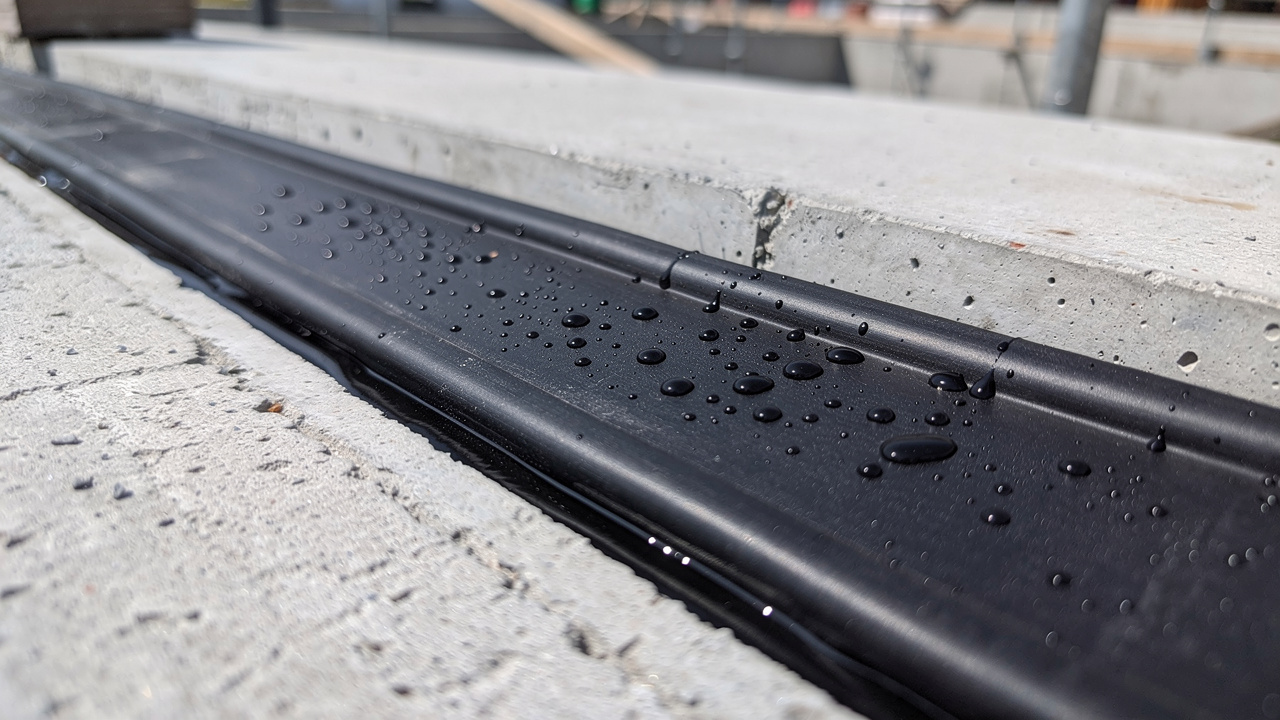
Ozone in the air attacks certain rubber types, starting as fine surface lines and growing into deep, straight fissures along stretched areas. At the same time, strong sunlight triggers UV damage that hardens, chalks, and embrittles rubber that once was flexible and safe.

The Philippine climate speeds this up: intense sun, high UV index, hot surfaces, humidity, and ozone from traffic and industry all act together. For plant managers, contractors, and facility teams, that means more downtime and faster replacement if the wrong material is used.

This guide explains how ozone and UV damage rubber, which materials stand up best in the Philippines, how to choose the right UV resistant rubber, and how RK Rubber Enterprise Co. supports projects with Philippine-optimized compounds and technical guidance.

Key Takeaways

  • EPDM and Silicone are the most reliable choices for UV resistant rubber in outdoor Philippine applications. EPDM covers most general needs; Silicone is better for very high temperatures or critical sealing.
  • Material choice must balance UV and ozone resistance with temperature limits, chemical exposure, mechanical stress, and budget. A rubber that survives sun but fails in contact with oil or chemicals still causes downtime.
  • Philippine weather accelerates aging through strong UV, hot surfaces, humidity, and ozone. Correct UV resistant rubber can extend replacement intervals three to five times compared with unsuitable compounds.
  • Nitrile and Natural Rubber perform well for oil resistance and abrasion under cover, but they crack quickly under sun and ozone. For outdoor use, EPDM, Silicone, Neoprene, Butyl, Viton, PVC, or TPE are usually better fits.
  • Working with an experienced local manufacturer such as RK Rubber Enterprise Co. helps cut risk. Local compounding, practical material selection, and sound storage, installation, and inspection practices all extend service life.

Understanding Ozone Cracking And UV Degradation In Rubber

Comparison of rubber samples at different UV degradation stages

To choose the right UV resistant rubber, it helps to know what actually attacks elastomers outdoors. Two main factors work together: ozone and ultraviolet (UV) light.

Many common rubbers (especially Natural Rubber and Nitrile) have double bonds in their polymer backbone. Ozone targets these bonds, starting microcracks on stressed surfaces. These lines grow deeper and longer until full splits appear — this is ozone cracking.

UV damage follows a different path but has a similar effect. UV light breaks chemical bonds inside the rubber. Stabilizers slow this down, but once enough bonds break, the material loses elasticity, hardens, turns chalky, and begins to crack. Research on the impact of UV rays on high-performance rubber components confirms how prolonged exposure accelerates these degradation processes. Heat and daily expansion–contraction cycles push this damage even faster.

The Philippine Climate Factor A Perfect Storm For Rubber Degradation

What might take years in mild climates can happen in a fraction of the time in the Philippines, as a study on performance and aging under prolonged UV exposure demonstrates:

  • Very high UV index for much of the year, especially on roofs, vehicles, ports, and open plants.
  • Hot surfaces, with dark rubber easily exceeding 60 °C in direct sun, and even higher near metal roofs or hot equipment.
  • Humidity and pollutants, which speed chemical reactions and carry ozone and reactive gases from traffic, generators, and high-voltage gear.
  • Monsoon cycles, with repeated wet/dry and swell/shrink movements that help cracks open wider.

When we specify UV resistant rubber for Philippine projects, we always consider this full package of stresses, not just a single UV test result.

Top UV-Resistant Rubber Materials For Philippine Applications

Selection of EPDM and silicone rubber profiles and gaskets

Not all elastomers behave the same under sun and ozone. Some have saturated backbones or special chemical groups that resist attack. For Philippine outdoor use, four stand out again and again:

  • EPDM (Ethylene Propylene Diene Monomer)
  • Silicone Rubber
  • Viton (FKM)
  • Butyl Rubber (IIR)

Each offers a different blend of temperature range, chemical resistance, mechanical properties, and cost. Often, the best design uses more than one of these in different parts of the same system.

“Environment beats material every time if you pick the wrong compound.”
— common saying among rubber technologists

EPDM Ethylene Propylene Diene Monomer The Versatile Workhorse

EPDM rubber roofing membrane on commercial building under sun

EPDM is our go-to recommendation for general-purpose UV resistant rubber outdoors in the Philippines.

  • Strengths: Outstanding resistance to ozone, UV, rain, and aging thanks to its saturated backbone; good flexibility down to around −40 °C and up to about 120 °C (higher for some grades); very good resistance to water, steam, diluted acids and alkalis, alcohols, and many polar fluids.
  • Limits: Poor resistance to petroleum oils, fuels, and many non-polar solvents.

In practice, EPDM stays springy for years, keeping sealing pressure on windows, doors, roofs, and outdoor machinery. At RK Rubber Enterprise Co., we supply EPDM sheets, extruded profiles, and custom parts formulated specifically for Philippine weather so clients get long outdoor life without Silicone-level pricing.

Silicone Rubber Extreme Temperature Champion

When temperature and weather exposure are both demanding, Silicone is hard to beat.

  • Strengths: Very wide temperature range (roughly −60 °C to about 260 °C, depending on grade), excellent UV and ozone resistance, and good stability under rapid temperature swings.
  • Typical uses: High-temperature gaskets, oven doors, LED fixtures, architectural glazing, equipment near burners or heaters that also face sun and rain.

Silicone does not bond easily with common adhesives, so surface preparation and the right Silicone-based adhesive or primer are important. RK Rubber Enterprise Co. manufactures Silicone gaskets and sheets for high-temperature and outdoor exposure in food processing, industrial ovens, and architectural projects.

Viton FKM The Ultimate Performance Answer

Viton (FKM) is a fluoroelastomer developed for very harsh environments.

  • Strengths: Outstanding resistance to oils, fuels, many solvents, aggressive chemicals, and high temperatures (often up to around 200 °C in continuous service); very good UV and ozone resistance.
  • Typical uses: Chemical plant valves, refinery equipment, fuel system parts, and other high-value assets where both chemicals and strong sunlight are present.

The trade-off is cost: Viton parts are several times more expensive than EPDM. For many outdoor applications, EPDM or Silicone already provide enough performance. We reserve Viton for outdoor areas with both high chemical load and strong sun, where lower-grade rubbers would fail quickly.

Butyl Rubber IIR The Impermeable Barrier

Butyl Rubber (IIR) is special because of its extremely low gas and moisture permeability.

  • Strengths: Excellent resistance to ozone, UV, heat, and aging, plus very low gas permeability. Good resistance to many acids and alkalis.
  • Typical uses: Tank and pond liners, gas covers, stoppers, and seals where gas leakage must remain very low, such as wastewater tank covers exposed to sun and rain.

When gas tightness and vapor control rank higher than everything else, Butyl is often the best choice. When general outdoor weathering and flexibility are the main needs, EPDM usually comes first.

Quick Comparison Of Key Materials

Material UV / Ozone Resistance Typical Temperature Range (°C) Oil / Fuel Resistance Typical Outdoor Uses
EPDM Excellent −40 to 120 (higher for some grades) Poor Roofs, door/window seals, outdoor gaskets, cable covers
Silicone Excellent −60 to 260 (grade-dependent) Moderate High-temp gaskets, ovens, lighting, glazing
Viton (FKM) Very good −20 to 200 (grade-dependent) Excellent Chemical and fuel systems, harsh industrial sites
Butyl (IIR) Excellent −40 to 110 (approx.) Moderate Gas barriers, tank liners, covers

Good Alternative Materials Balancing Multiple Requirements

Real projects often need more than UV and ozone resistance. Oil splash, fuels, processing methods, or visual requirements can shift the choice toward other materials.

Neoprene offers a middle ground between weathering resistance and oil resistance. PVC and TPE give good outdoor life for many light industrial and consumer products at attractive costs, often with wide color choices.

Neoprene CR The Balanced Performer

Neoprene (CR) is a synthetic rubber that balances moderate UV resistance with moderate oil resistance.

  • Works from roughly −40 °C to about 100 °C.
  • Handles outdoor sun for several years, though not as long as EPDM in pure weather exposure.
  • Offers better resistance to oils and greases than EPDM, at a similar price range.

Common uses include gaskets and hoses that see both sunlight and occasional oil contact, such as engine compartment seals, outdoor hoses with oil mist, or protective boots on exposed joints. RK Rubber Enterprise Co. produces Neoprene strips, sheets, and profiles for these mixed exposure cases.

Thermoplastic Alternatives PVC And TPE

Thermoplastics like PVC and TPE process like plastics but behave like softer rubbers.

  • PVC: Can be made from rigid to flexible; with the right stabilizers it offers good weathering resistance and many color options. Used in window frames, siding, cable covers, light-duty tubing, and decorative trim.
  • TPE: Feels more like soft rubber, with many grades showing good ozone and UV resistance. Common in grips, seals, and flexible tubing on outdoor tools and consumer products.

We suggest PVC or TPE when low weight, complex shapes, or bright colors matter, and when temperatures and chemicals stay within moderate ranges.

Materials To Avoid For Outdoor Philippine Applications

Some of the most common rubbers in industry age very quickly outdoors in the Philippines. Nitrile (NBR), Natural Rubber, and SBR have unsaturated backbones that ozone attacks easily, as aging studies of polymer blends have documented. They may work very well indoors or under cover, yet fail fast in open sun.

Knowing where these rubbers belong — and where they do not — is an important part of any UV resistant rubber plan.

Nitrile NBR Oil-Resistant But UV-Vulnerable

Nitrile (NBR) is excellent against oils, fuels, and greases, which is why it is common in engines, hydraulics, and fuel systems.

Outdoors in the Philippines, however, NBR hardens and cracks quickly under sun and ozone, often within months. It remains a strong choice indoors or in shaded housings, but for exposed equipment that also sees oil, we usually move to Neoprene, Viton, or a design that keeps NBR inside a protected housing while EPDM or Silicone handle the outer weather seal.

Natural Rubber And SBR Indoor Performers Only

Natural Rubber and SBR (Styrene Butadiene Rubber) offer high tensile strength and very good abrasion resistance, which is why they are common in tires, conveyor belts, and impact pads.

Under Philippine sun, both lose flexibility, become sticky, then hard and brittle. Cracks deepen and pieces can flake off. They perform well for indoor impact pads, vibration mounts, and conveyor systems, but they are poor choices for exposed roof seals, outdoor joints, or long-term sun exposure unless heavily shielded and expected life is short.

Critical Selection Criteria Beyond UV Resistance

UV and ozone resistance matter, but they are only part of the selection picture. A gasket that handles sunlight but fails from heat, chemicals, or repeated movement still causes trouble.

When we specify UV resistant rubber for Philippine sites, we review temperature range, chemical exposure, mechanical demands, installation method, and expected service life.

Temperature Requirements And Thermal Cycling

Dark rubber in direct sun can be much hotter than the surrounding air, especially near metal roofs, boilers, ovens, or engines. Daily swings between cool nights and hot days cause expansion and contraction, adding fatigue.

  • EPDM covers most outdoor needs up to about 120 °C.
  • Silicone or Viton are safer when continuous temperatures are higher or when rapid temperature swings are common.

Cold performance matters less locally, but it is important for exported equipment or parts stored in chilled warehouses.

Chemical And Fluid Exposure Assessment

Chemicals and fluids can destroy rubber faster than UV. We always ask:

  • Which acids, bases, solvents, oils, fuels, cleaners, or process chemicals are present?
  • Are exposures constant, occasional, or only during cleaning?

Common patterns:

  • UV + oils/fuels: Neoprene or Viton, or shielded Nitrile.
  • UV + water/steam/diluted chemicals: EPDM or Butyl.
  • UV + high temperature + aggressive chemicals: Viton or Silicone.

At RK Rubber Enterprise Co., we map real chemical exposure against material compatibility before any order is finalized.

Mechanical Properties And Physical Demands

Mechanical demands can be as important as weathering:

  • Compression set: Affects long-term sealing force in gaskets. EPDM and Silicone often perform better than cheaper rubbers.
  • Tensile strength and elongation: Matter in expansion joints or flexible couplings.
  • Abrasion and tear resistance: Key in conveyor systems, impact pads, and linings.

We match hardness, thickness, and mechanical properties with environmental resistance so the part survives both physical loads and weather.

RK Rubber Enterprise Co. UV-Resistant Offerings For Philippine Weather

As a Philippine manufacturer, RK Rubber Enterprise Co. sees firsthand how quickly the wrong rubber fails outdoors. Our product lines focus on compounds that stand up to local UV, ozone, heat, and humidity, backed by field feedback and quality control.

We provide EPDM sheets and profiles, Silicone gaskets and sheets, rubber linings, door seals, and custom items for many industries, along with technical support on design and maintenance.

Our EPDM Product Range Engineered For Philippine Outdoor Applications

Our EPDM products include:

  • Sheets from about 1 mm to around 40 mm thickness for roofing membranes, pads, and cut gaskets.
  • Solid and sponge profiles for doors, windows, panels, and equipment enclosures.

These EPDM compounds are formulated with stabilizers suitable for Philippine UV and humidity. They perform well on commercial roofs, vehicle weather stripping, cable covers, and other outdoor seals in contact with water, steam, and many diluted chemicals.

Silicone Rubber Gaskets And Sheets Premium Performance For Extreme Conditions

For high temperature and demanding sealing, we supply Silicone gaskets and sheets that:

  • Handle heat up to around 250 °C (grade-dependent).
  • Resist UV, ozone, and many cleaning cycles.
  • Retain flexibility across a wide temperature range.

Typical applications include baking ovens, dryers, sterilizers, food processing lines, architectural glazing, and lighting fixtures that face both heat and strong sun. We also advise clients on adhesives, primers, and installation practices for Silicone.

Custom Rubber Products And Expert Support

Many Philippine projects need custom profiles, shapes, or linings. RK Rubber Enterprise Co. designs:

  • Rubber linings for tanks, chutes, and pipes that face wear, corrosion, and sometimes sun at exposed edges.
  • Door seals and specialized profiles that keep water, dust, and noise out of buildings and equipment.

We support clients with material selection, seal geometry, bonding methods, and inspection plans. Because production is local, we can respond quickly to design changes and urgent site needs.

Best Practices For Maximizing Service Life

Professional installation of rubber gasket on industrial equipment

Even the best UV resistant rubber lasts longer when stored, installed, and maintained correctly. Poor handling can cut service life in half, no matter how good the compound is.

“Paying a little more attention up front is cheaper than paying for the same repair again and again.”
— common view among maintenance managers

Proper Storage And Handling Before Installation

Good storage slows natural aging:

  • Keep rubber in a cool, dry, dark area (roughly 10–25 °C).
  • Avoid direct sunlight, weather, and strong ozone sources (motors, welders, UV lamps).
  • Store away from open containers of solvents, fuels, or aggressive cleaners.
  • Use first-in, first-out stock rotation, and keep items in original wrapping until use.

During handling, avoid dragging over sharp edges, over-stretching, or contaminating with oils that are not part of the intended service.

Installation Techniques For Optimal Performance

Correct installation prevents early failure:

  • Clean and dry all contact surfaces; remove dust, rust, old adhesive, and oils.
  • Use primers and adhesives compatible with the specific rubber and substrate, especially for EPDM and Silicone.
  • Avoid excessive stretching or compression; both raise stress and encourage cracking or permanent flattening.
  • Round sharp metal edges that touch rubber.

RK Rubber Enterprise Co. often helps clients prepare simple installation guides so crews follow consistent, sound practices.

Inspection And Maintenance Protocols

Regular inspection catches problems early:

  • For critical outdoor seals and linings, inspect visually at least quarterly; less critical parts can be checked annually.
  • Look for chalking, discoloration, surface cracks, hardening, or loss of shape.
  • Press a thumb into the rubber to feel for stiffness or slow rebound.
  • Clean with mild soap and water; avoid petroleum-based cleaners on EPDM.

When repeated inspections show growing cracks or hardening, plan replacement during scheduled shutdowns rather than waiting for a leak or break.

Industry-Specific Applications In The Philippines

Each sector faces its own combination of sun, heat, chemicals, and mechanical stress. The right UV resistant rubber for a vehicle is not always the same as for a roof or a chemical plant.

Automotive Manufacturing And Transportation

In automotive work:

  • EPDM is standard for window, door, trunk, and sunroof seals that must block rain and dust while facing strong sun.
  • Under the hood, Neoprene and other special rubbers handle both heat and contact with oils and fuels.
  • Interior parts also see UV through glass; materials must resist fading and cracking.

RK Rubber Enterprise Co. supplies custom profiles and parts for OEM and aftermarket clients who must meet performance standards under Philippine driving and parking conditions.

Construction And Infrastructure Projects

In buildings and infrastructure:

  • EPDM membranes are widely used for flat roofs and terraces, offering long-term waterproofing and UV resistance.
  • EPDM expansion joint profiles allow movement in buildings and bridges without cracking.
  • Silicone sealants and gaskets are common in glazing and curtain walls, bonding glass to frames and withstanding sun and temperature swings.

We support contractors and designers with EPDM sheets, profiles, and guidance on where EPDM, Silicone, or other elastomers best fit the building envelope.

Industrial And Manufacturing Facilities

Industrial plants often combine chemicals, heat, vibration, and weather:

  • EPDM gaskets and covers protect outdoor housings, pump bases, and control cabinets.
  • Viton or special EPDM grades may be needed where aggressive chemicals are present.
  • Silicone gaskets serve in high-temperature dryers, ovens, or food processing lines with frequent hot cleaning.
  • Rubber linings and vibration mounts must handle wear and weather at the same time.

We work with plant teams to specify linings, high-temperature gaskets, profiles, and covers that cut leaks, protect workers, and reduce unplanned maintenance.

Cost-Benefit Analysis Investing In Quality UV-Resistant Rubber

Focusing only on price per meter or per gasket often hides larger costs that appear later. For outdoor Philippine use, the wrong rubber can trigger repeated replacements, emergency work, and damage to nearby equipment.

A better approach is to look at total cost of ownership: material, labor, downtime, and follow-up repairs.

True Cost Of Material Failure

When an outdoor rubber part fails:

  • You pay for replacement parts, adhesives, and hardware.
  • Labor to remove, clean, and reinstall often costs more than the part itself.
  • Unplanned downtime can disrupt production, delay projects, and require overtime.
  • Secondary damage (water ingress, corrosion, misalignment, safety incidents) can multiply the total cost.

A Nitrile seal that fails every year may look cheap at first, but over five years, repeated material, labor, and downtime often cost far more than a higher-grade EPDM part that lasts the full period.

ROI Of Premium Materials And Expert Partnerships

A simple life-cycle view helps:

Total cost = Initial material + (Replacement cost × Number of replacements) + Downtime + Extra maintenance

When you compare options this way:

  • A more expensive EPDM or Silicone part that lasts five to ten years often costs less over time than a cheaper Natural Rubber or Nitrile part replaced every year.
  • Fewer unexpected failures reduce emergency callouts, overtime, and rushed purchases.
  • Using a technical partner like RK Rubber Enterprise Co. lowers the risk of wrong material choices and early failures.

Clients who shift to higher-grade UV resistant rubber and sound design support often see strong returns through longer service life and fewer shutdowns.

Conclusion

Rubber selection for outdoor Philippine use is a strategic choice that affects safety, uptime, and long-term cost. Strong UV, high temperatures, humidity, and ozone push many standard rubbers beyond their limits.

EPDM and Silicone stand out as the most reliable UV resistant rubber options outdoors, while Viton, Butyl, Neoprene, PVC, and TPE cover specific needs such as harsh chemicals, gas barriers, moderate oil contact, or appearance.

Good design looks at more than UV ratings. It considers temperature, chemicals, mechanical loads, installation, and realistic service life — and it weighs total cost across years, not just purchase price.

RK Rubber Enterprise Co. aims to be a technical partner as well as a supplier, offering EPDM sheets and profiles, Silicone gaskets and sheets, linings, door seals, and custom products tailored to Philippine conditions, along with guidance on installation and maintenance.

If your current seals, gaskets, or linings are cracking, chalking, or needing frequent replacement, it may be time to review your material choices and consider better UV resistant rubber options.

FAQs

Outdoor rubber performance in the Philippines raises many practical questions. Below are some of the ones we hear most often at RK Rubber Enterprise Co.

Question 1 What Is The Most Cost-Effective UV-Resistant Rubber For General Outdoor Use In The Philippines

For most general outdoor applications, EPDM is the best value UV resistant rubber:

  • It handles strong sunlight, ozone, rain, and temperature swings much better than many common elastomers.
  • Its cost is moderate, well below Silicone or Viton.

Neoprene only becomes more attractive when moderate oil resistance is also required. If operating temperatures stay below about 120 °C and there is no direct contact with petroleum oils, EPDM usually gives the best balance of service life and spending. RK Rubber Enterprise Co. keeps a wide EPDM range in stock specifically for Philippine weather.

Question 2 How Long Should UV-Resistant Rubber Last In Philippine Weather Conditions

Actual service life depends on material, design, and exposure, but typical ranges are:

  • EPDM: About 10–20 years on roofs, door seals, and outdoor gaskets when well designed and maintained.
  • Silicone: Often 15–25 years or more under strong sun and high temperature when chemicals are compatible.
  • Neoprene: Around 5–10 years outdoors, depending on sun exposure and oil contact.
  • Nitrile / Natural Rubber outdoors: Often show serious cracking and hardening within 6–18 months, which is why we avoid them for exposed service.

Sun hours, ozone levels, operating temperature, mechanical movement, and storage/installation practices all influence these numbers. We provide realistic life estimates and inspection advice based on specific products and applications.

Question 3 Can I Use Nitrile Rubber Outdoors If I Protect It With A Cover Or Coating

Covers, paints, and coatings can slow UV damage on Nitrile, but they do not change its basic weakness to sun and ozone.

  • If every part of the rubber stays fully covered at all times, aging is slower.
  • In real use, covers shift, coatings crack, or maintenance exposes sections — and those exposed zones start to harden and crack much like unprotected Nitrile.

Short-term outdoor storage with temporary covers is usually fine. For long-term outdoor service, however, we generally recommend:

  • Neoprene for moderate oil and weather exposure.
  • Viton for very harsh chemical and temperature conditions.
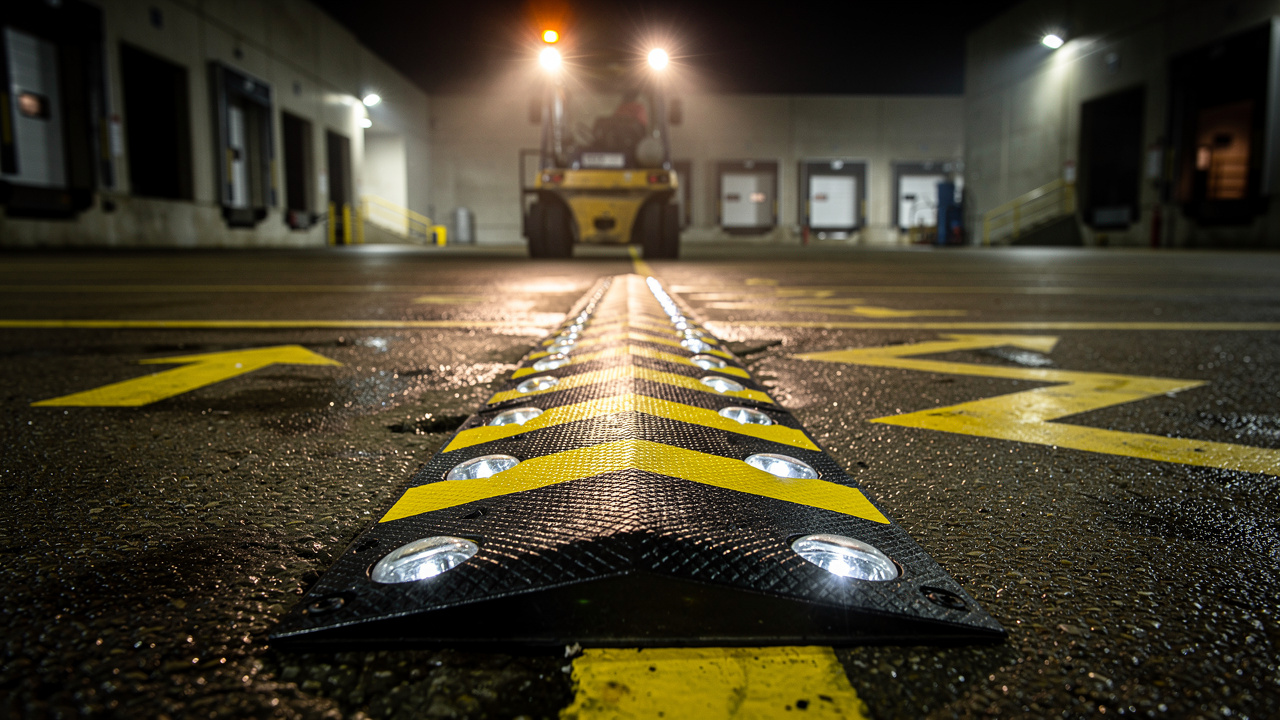
  • Design changes that keep Nitrile inside protected housings while EPDM or Silicone handle the outer weather seal.
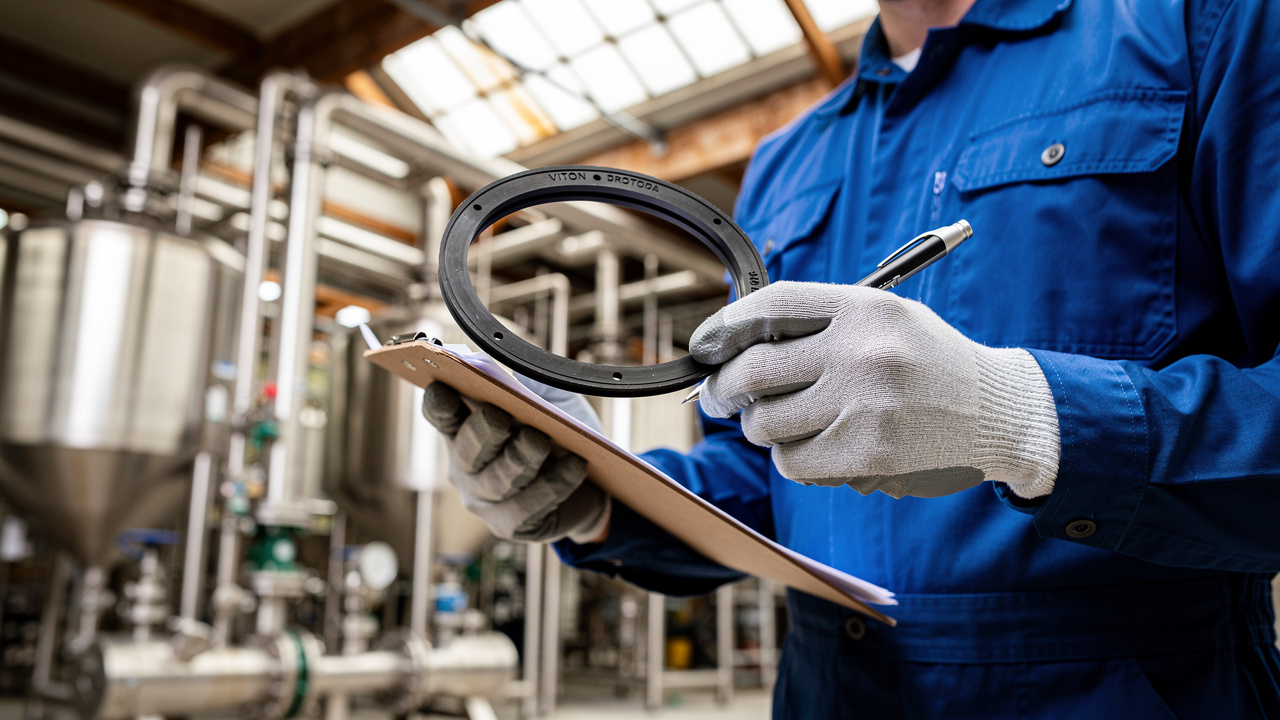
When clients bring this question to RK Rubber Enterprise Co., we review the actual exposure and suggest safer, more stable material combinations rather than relying only on covers or coatings.